Tesla Plans Colossal 124-Stall V4 Supercharger in San Francisco, Reshaping Urban EV Charging
Tesla has filed permits for one of its largest V4 Supercharger stations globally, a 124-stall facility in San Francisco, signaling a major shift to high-density urban EV charging and broader NACS adoption.
✨ This content was summarized and interpreted by AI; it may contain errors — please verify accuracy with the original sources. Learn more
Listen to this story
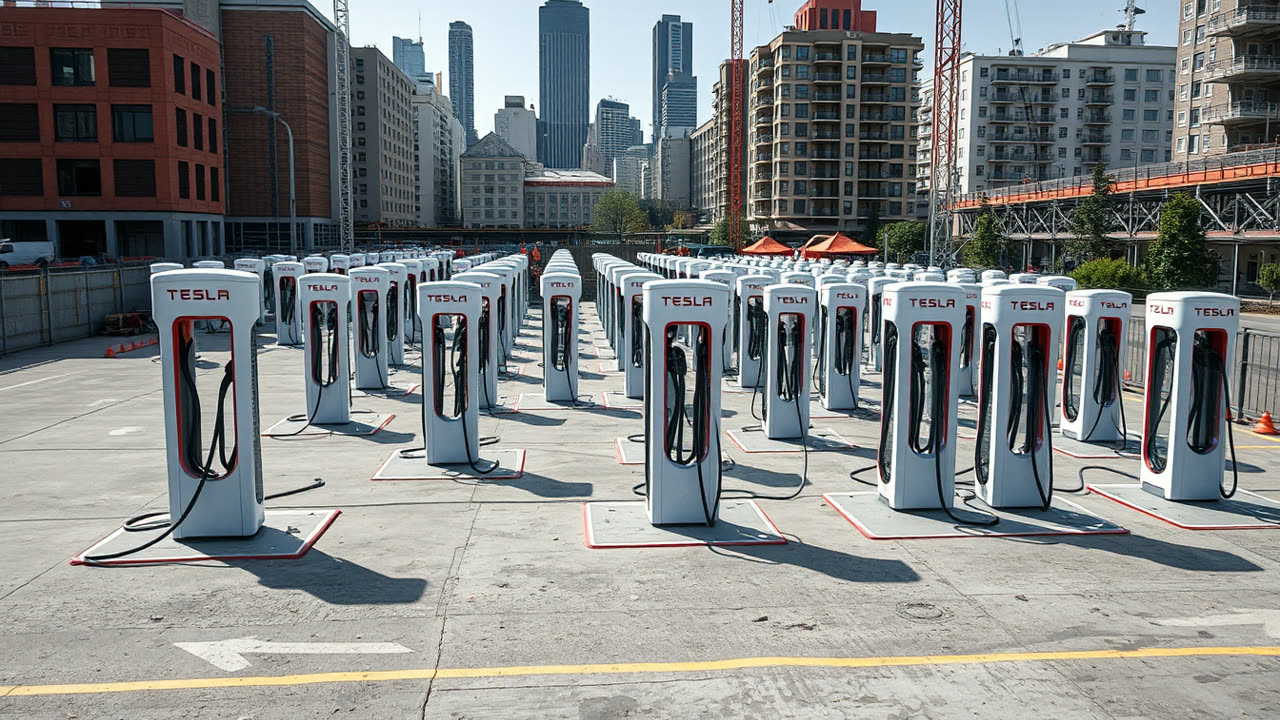
Tesla is poised to dramatically reshape the urban electric vehicle charging landscape with plans for a colossal 124-stall V4 Supercharger station in San Francisco, situated on a former yellow-cab storage lot at the corner of Alem. This proposed facility, for which planning permits have already been filed, represents a significant escalation in Tesla's infrastructure strategy, moving beyond highway corridors to address the acute demand for high-speed, high-density charging within dense metropolitan centers. The sheer scale of this project, potentially one of Tesla's largest worldwide, indicates a proactive approach to mitigating range anxiety and charging bottlenecks in a city with a rapidly growing EV population.
The deployment of a V4 Supercharger of this magnitude signals a pivotal evolution in Tesla's charging technology and philosophy. V4 Superchargers typically boast an increased power output, with some installations reaching up to 350 kW per stall, a substantial upgrade from the V3's peak of 250 kW, enabling even faster charging times for compatible vehicles. Critically, the V4 design incorporates longer cables, enhancing accessibility for a broader range of electric vehicles, including non-Tesla models that utilize the North American Charging Standard (NACS). This architectural shift is crucial as the NACS standard gains widespread adoption across the automotive industry, effectively opening Tesla's superior network to a vast new cohort of EV drivers and positioning Tesla as a foundational infrastructure provider for the entire ecosystem, not just its own vehicles. Furthermore, the inclusion of integrated payment terminals on V4 units streamlines the charging process for all users, moving away from Tesla's app-centric billing and standardizing the experience across brands.
This urban mega-station directly addresses several critical challenges for EV owners and the industry. For users, a 124-stall facility dramatically reduces wait times, a common pain point at smaller, often congested urban charging hubs. In a city like San Francisco, where many residents lack access to home charging, such a large-scale public utility becomes indispensable, transforming the feasibility of EV ownership for apartment dwellers and gig-economy drivers. The strategic placement on the city's south side, likely near major thoroughfares and commercial zones, maximizes convenience and accessibility. From an industry perspective, this move intensifies the competition among charging network providers. While Electrify America, EVgo, and ChargePoint have been expanding, Tesla's network has consistently been lauded for its reliability and user experience. A massive urban V4 deployment further solidifies Tesla's competitive edge, pushing rivals to accelerate their own infrastructure build-outs and improve service quality.
Comparing Tesla's approach to its rivals highlights a key differentiator: vertical integration and a relentless focus on user experience. Unlike many competing networks that rely on third-party hardware or fragmented software solutions, Tesla designs, builds, and operates its Superchargers, ensuring a cohesive and generally seamless experience. While Electrify America has committed billions to expand its network, and companies like ChargePoint offer a wide array of AC and DC chargers, Tesla's advantage has historically been its ubiquity and reliability of high-speed DC fast charging. The V4 rollout, particularly with NACS compatibility and payment terminals, effectively levels the playing field for non-Tesla EVs while maintaining Tesla's operational excellence. The scale of the San Francisco project also sets a new benchmark for urban charging hubs, dwarfing typical installations from other providers, which often feature fewer than 20 stalls.
The implications for urban planning and grid infrastructure are profound. Integrating a 124-stall, high-power charging station into an existing urban grid requires significant foresight and investment in local substation upgrades and power distribution. San Francisco's utility providers will need to ensure sufficient capacity to handle peak demand, which could be substantial if a significant portion of the stalls are in use simultaneously. This project serves as a test case for how cities can adapt their energy infrastructure to support widespread EV adoption, potentially spurring further collaboration between automotive companies, utilities, and municipal governments. The land acquisition for such a large site in a prime urban location also underscores the increasing value of real estate for critical EV infrastructure, a challenge that will only grow as demand for charging points escalates.
Looking ahead, Tesla's San Francisco Supercharger signals a strategic shift towards saturating high-demand urban markets, not just connecting long-distance routes. We can anticipate similar large-scale V4 deployments in other major metropolitan areas globally, particularly those with high EV penetration and limited home charging options. This expansion will likely be accompanied by continued efforts to integrate renewable energy sources, such as solar canopies and battery storage, to mitigate grid strain and enhance sustainability. The widespread adoption of NACS across the industry means that Tesla's Supercharger network is rapidly becoming the de facto public charging backbone in North America, accelerating EV adoption across all brands. Challenges remain, including navigating complex permitting processes, securing suitable urban land, and continuously upgrading grid infrastructure. However, the vision of a future where charging an EV in a dense city is as routine and rapid as refueling a gasoline car is rapidly materializing, with Tesla at the forefront of this transformative urban electrification.