Tesla Roadster 2.0 October 1 Reveal Confirmed, Promising Hypercar Redefinition
Tesla has confirmed the October 1 reveal of its second-generation Roadster, nine years after its prototype debut, signaling a launch set to redefine the electric hypercar segment and challenge performance perceptions.
✨ This content was summarized and interpreted by AI; it may contain errors — please verify accuracy with the original sources. Learn more
Listen to this story
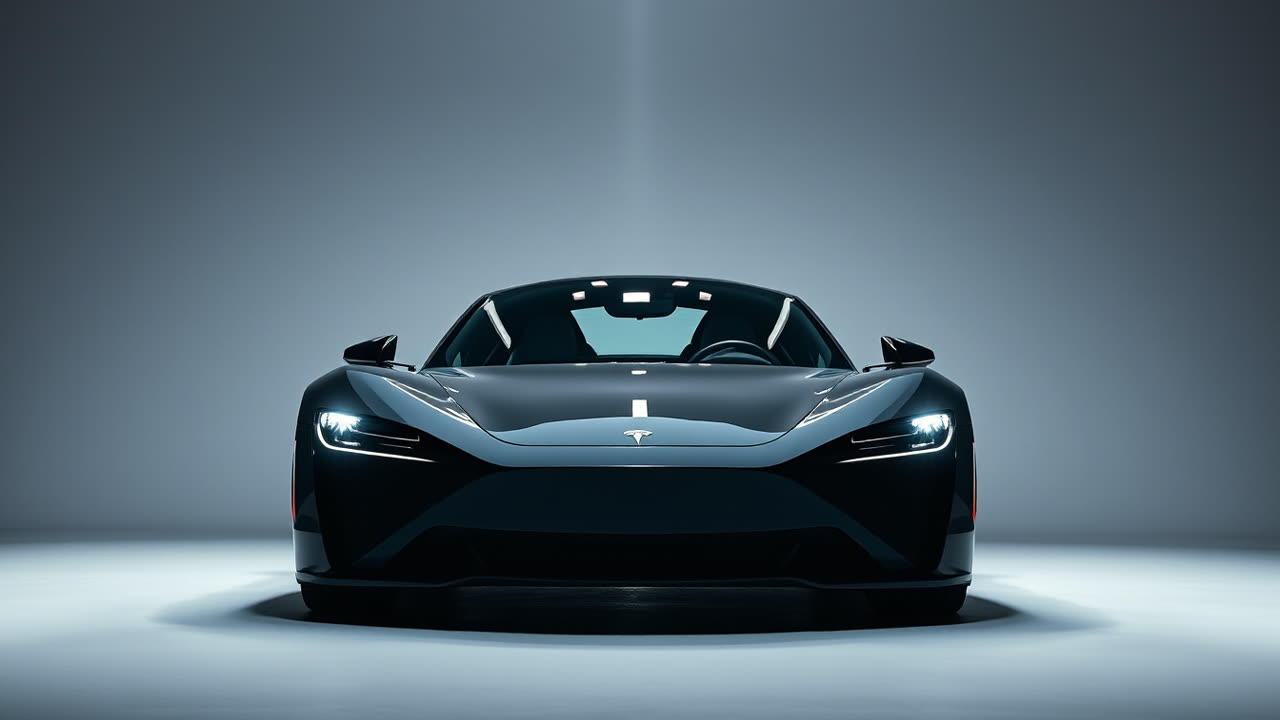
Tesla has confirmed an October 1 reveal for the long-anticipated second-generation Roadster, nine years after its initial prototype debut, signaling a potential launch that could redefine the electric hypercar segment and challenge the broader automotive industry's perceptions of performance. The company’s "Go for launch" teaser image, depicting the sleek electric vehicle bathed in rocket-launch-style lighting, injects a renewed urgency into a project that has often been overshadowed by Tesla’s mass-market ambitions and production challenges. This reveal is not merely about a new vehicle; it represents a critical moment for Tesla to finally deliver on a decade-old promise and demonstrate the pinnacle of its engineering capabilities, potentially influencing future battery and powertrain developments across its more accessible lineup.
The significance of this reveal extends far beyond the niche market of ultra-luxury performance vehicles. When first unveiled as a surprise at the Tesla Semi event in November 2017, the Roadster 2.0 promised staggering, almost unbelievable specifications: 0-60 mph in 1.9 seconds, a quarter-mile in 8.8 seconds, a top speed exceeding 250 mph, and an astounding 620 miles of range. These figures, if achieved, would make it the fastest production car ever, electric or otherwise, at the time of its initial announcement. The core news now is whether Tesla can not only meet these ambitious targets but also exceed them, given the significant advancements in battery technology and electric motor efficiency over the past nine years. The initial reservation price was set at $50,000 for the standard model, with a $250,000 Founders Series. Should these prices hold, the Roadster would represent unprecedented performance for its cost, significantly undercutting rivals.
The impact on users, particularly the early adopters and enthusiasts who placed deposits years ago, will be substantial. For them, the reveal is the culmination of a long wait, promising access to a vehicle that could reshape their understanding of automotive performance and luxury. For the broader automotive industry, the Roadster’s launch could serve as a powerful proof point for electric vehicle (EV) capabilities, potentially accelerating the adoption of high-performance electric powertrains even in traditional internal combustion engine (ICE) strongholds. A successful launch could further legitimize EVs as not just efficient and sustainable, but also as the undisputed leaders in raw speed and acceleration, forcing legacy automakers to redouble their electrification efforts in their performance divisions.
Comparing the new Roadster to its predecessor, the original Tesla Roadster (produced from 2008 to 2012), highlights a monumental leap in technology and ambition. The first Roadster, based on the Lotus Elise chassis, was a pioneering but relatively low-volume sports car with a 0-60 mph time of 3.7 seconds and a range of approximately 244 miles. The new Roadster, by contrast, is an entirely bespoke design, targeting hypercar territory with performance figures that dwarf even today’s most extreme ICE vehicles. Against current electric hypercar rivals like the Rimac Nevera, which boasts a 0-60 mph time of 1.74 seconds and a top speed of 258 mph, the Roadster’s previously stated 1.9-second acceleration would still be competitive, though potentially no longer class-leading in acceleration alone. However, its promised 620-mile range remains an unmatched figure in the hypercar segment, offering a blend of extreme performance and unprecedented usability. The Lotus Evija, with its 2,000 hp and 0-60 mph in under 3 seconds, and the Pininfarina Battista, with 1,900 hp and 0-60 mph in 1.86 seconds, also represent formidable competition, often priced well above the Roadster's initial estimates, typically exceeding $2 million.
The "Go for launch" imagery suggests that Tesla might be hinting at the rumored "SpaceX Package," which Elon Musk previously discussed would incorporate cold air thrusters, potentially allowing for even more extreme acceleration and handling. If this feature is part of the October 1 reveal, it would not only differentiate the Roadster but also push the boundaries of automotive engineering into entirely new, perhaps even aerospace-inspired, territory. This would be a genuine game-changer, moving beyond mere horsepower and torque to fundamentally alter the vehicle's interaction with physics.
Looking ahead, the successful launch and eventual production of the Roadster could solidify Tesla's position not just as a mass-market EV leader but also as a technological vanguard. It would validate the company’s long-term vision of using high-end, halo products to drive innovation that eventually trickles down to more affordable models. The battery technology, motor efficiency, and thermal management systems developed for the Roadster could find their way into future Cybertruck variants, next-generation Model 3s, or even the long-awaited $25,000 Tesla. Furthermore, the Roadster's market entry could prompt other luxury and performance brands to accelerate their own electric hypercar projects, fostering a new era of intense competition and innovation in the upper echelons of the automotive world. The October 1 reveal is more than just a product launch; it's a statement about the future of performance, technology, and Tesla's enduring ambition.