Tesla Roadster's 2026 Reveal Ignites EV Hypercar Race Amidst VW's Efficiency Push and BYD's Global Challenge
The long-anticipated Tesla Roadster is finally set for a production reveal on October 1, 2026, marking an end to nearly nine years of delays and shifting timelines for the electric hypercar.
✨ This content was summarized and interpreted by AI; it may contain errors — please verify accuracy with the original sources. Learn more
Listen to this story
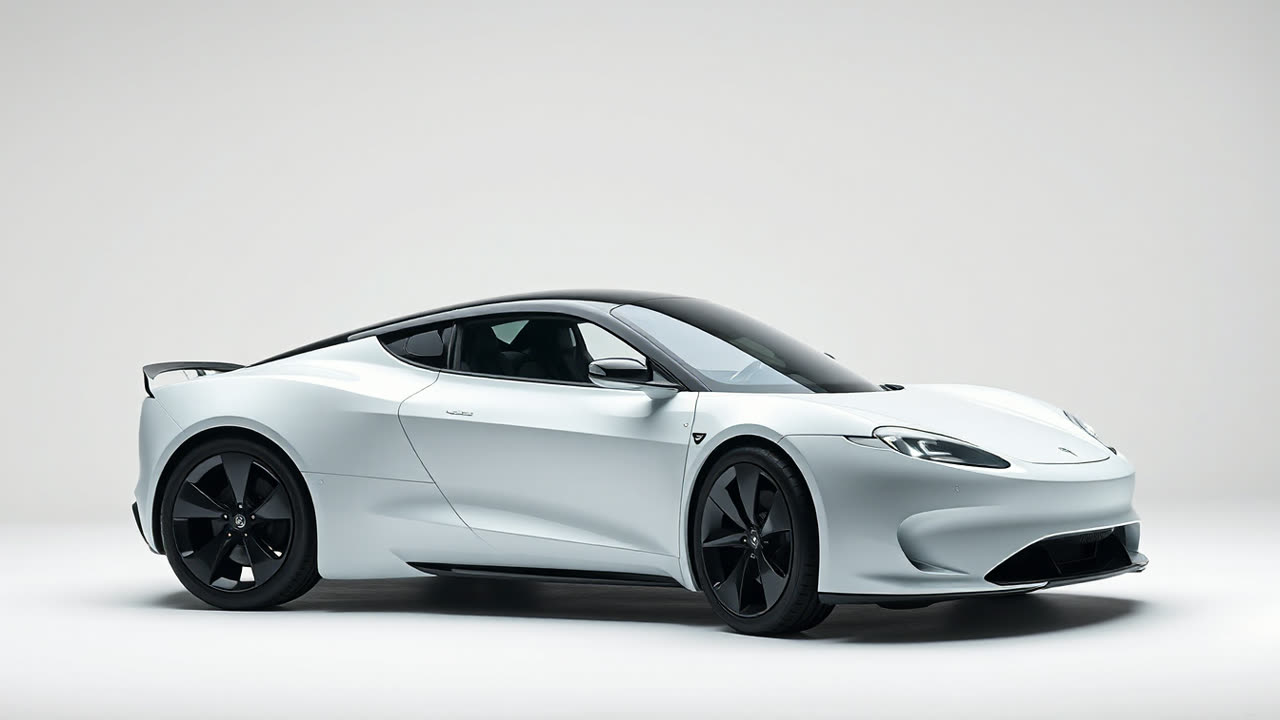
The long-anticipated Tesla Roadster is finally set for a production reveal on October 1, 2026, marking an end to nearly nine years of delays and shifting timelines for the electric hypercar. This event, taking place in Waco, Texas, has been teased by Tesla CEO Elon Musk as "out of this world" and potentially "the most memorable product unveil ever," hinting at extraordinary performance and the long-rumored SpaceX cold-gas thruster package. Originally unveiled in November 2017 with audacious claims of a sub-2-second 0-60 mph time, a 250+ mph top speed, and a 620-mile range, the Roadster's journey has been fraught with postponements, with production initially targeted for 2020. The base model was priced at $200,000, and the Founders Series at $250,000, with substantial deposits required for reservation holders. While the reveal is imminent, actual production is internally targeted for 2027 or 2028 at Gigafactory Texas, meaning deliveries remain some time away.
This reveal, however, signifies more than just a new vehicle launch for Tesla; it's a critical statement on its technological prowess and brand ambition. The Roadster, a low-volume, high-performance sports car, serves as a halo product, showcasing advanced battery efficiency, chassis design, and software integration that could eventually trickle down to more mainstream models. In a market increasingly crowded with capable EVs, the Roadster aims to reassert Tesla's position at the bleeding edge of automotive innovation, particularly in the hypercar segment where it seeks to challenge established players like Ferrari, Lamborghini, and Porsche. The inclusion of a potential "SpaceX package" with cold-gas thrusters, hinted at by the "Go for launch" teaser imagery, suggests Tesla is pushing boundaries beyond conventional automotive engineering, blurring the lines between terrestrial vehicles and aerospace technology. This could redefine what consumers expect from top-tier performance vehicles, though its impact on the broader market might remain niche due to its high price and specialized nature.
Concurrently, Volkswagen has unveiled its "Mission Efficiency" concept, a spiritual successor to the ultra-efficient XL1, now reimagined as a fully electric vehicle. The original XL1, a diesel plug-in hybrid produced in limited numbers between 2013 and 2016, achieved exceptional fuel economy with a drag coefficient of 0.189. The new Mission Efficiency concept pushes these boundaries further, boasting a world-record drag coefficient of just 0.158 for a road-approved car. Built on the MEB+ platform and utilizing components from the new ID. Polo, this 2+2 concept demonstrates incredible efficiency, consuming just 6.89 kWh/100 km (or approximately 9 miles per kWh) and achieving a verified 794-mile (1,278 km) journey from Wolfsburg to Vienna on a single 54.9 kWh battery charge, with 101 miles remaining. Features like clad rear wheels, an enclosed underbody, active cooling flaps, a 370 W solar roof system, and electromechanical rear brakes contribute to this remarkable efficiency. While the Mission Efficiency is not slated for production in its current form, it serves as a critical engineering showcase, with its innovations in aerodynamics, weight reduction, and drivetrain efficiency expected to influence future mass-market ID. series EVs, proving that extended range doesn't necessarily require massive battery packs. This focus on efficiency could dramatically lower the cost and material requirements for future EVs, making sustainable transport more accessible.
Meanwhile, BYD continues its aggressive expansion, introducing new models to challenge Tesla across various segments. The company has already surpassed Tesla in global battery-electric vehicle sales in 2025 and again in Q2 2026, demonstrating its growing dominance, particularly in China and increasingly in overseas markets like the UK and Brazil. BYD's "Tesla fighter" refers to several high-performance offerings, notably the Yangwang U7 and models from its new "FORMULA" series under the Fang Cheng Bao brand. The Yangwang U7, a full-size luxury sedan launched in May 2025, is available in both battery electric (BEV) and plug-in hybrid (PHEV) variants. The EV version boasts a quad-motor, 1,287 hp powertrain, achieving 0-100 km/h in 2.9 seconds, and offers a CLTC range of 720 km from a 135.5 kWh Blade Battery, with a 150 kWh option extending range to 1,006 km. Its advanced e⁴ (YiSiFang) individual wheel drive system provides torque vectoring and four-wheel steering.
Beyond the U7, BYD's new FORMULA series, unveiled at the Beijing Auto Show 2026, includes the Fang Cheng Bao Formula S, a high-performance electric sedan with a starting price around $28,080. The Formula S offers a dual-motor AWD version with 657 hp, a 0-100 km/h time of 3.6 seconds, and a 730 km CLTC range, built on a high-voltage EV architecture with second-generation Blade LFP battery technology and flash-charging capability. These models, particularly the Yangwang U7, directly compete with high-end Tesla offerings like the Model S in terms of performance and luxury. BYD's strategy of vertical integration, controlling the entire production chain from battery cells to vehicle assembly, allows for competitive pricing and rapid innovation, which is evident in its market share gains. The company is also aggressively expanding its manufacturing footprint, with plans for four factories in Europe, including three vehicle assembly plants and one battery factory, aiming to boost overseas sales to between 1.9 million and 2.0 million vehicles in 2026.
The convergence of these developments highlights a dynamic and increasingly diverse sustainable transport landscape. Tesla's Roadster aims to push the performance envelope, serving as a technological beacon, while Volkswagen's Mission Efficiency concept underscores a renewed focus on extreme energy conservation for future mass-market adoption. BYD, on the other hand, is rapidly expanding its portfolio with compelling, high-performance, and value-driven EVs, directly challenging Tesla's market leadership through sheer volume, technological integration, and aggressive global expansion. The industry is moving beyond mere electrification; it's now a multi-faceted race for ultimate performance, unparalleled efficiency, and broad market accessibility, each strategy representing a distinct vision for the future of mobility.