Tesla Roadster's 'Flying' Demo Looms This Month
Tesla is reportedly preparing to showcase its next-generation Roadster as early as this month with an audacious demonstration featuring the vehicle lifting off the ground without a driver, signaling a potential paradigm shift in personal transportation.
✨ This content was summarized and interpreted by AI; it may contain errors — please verify accuracy with the original sources. Learn more
Listen to this story
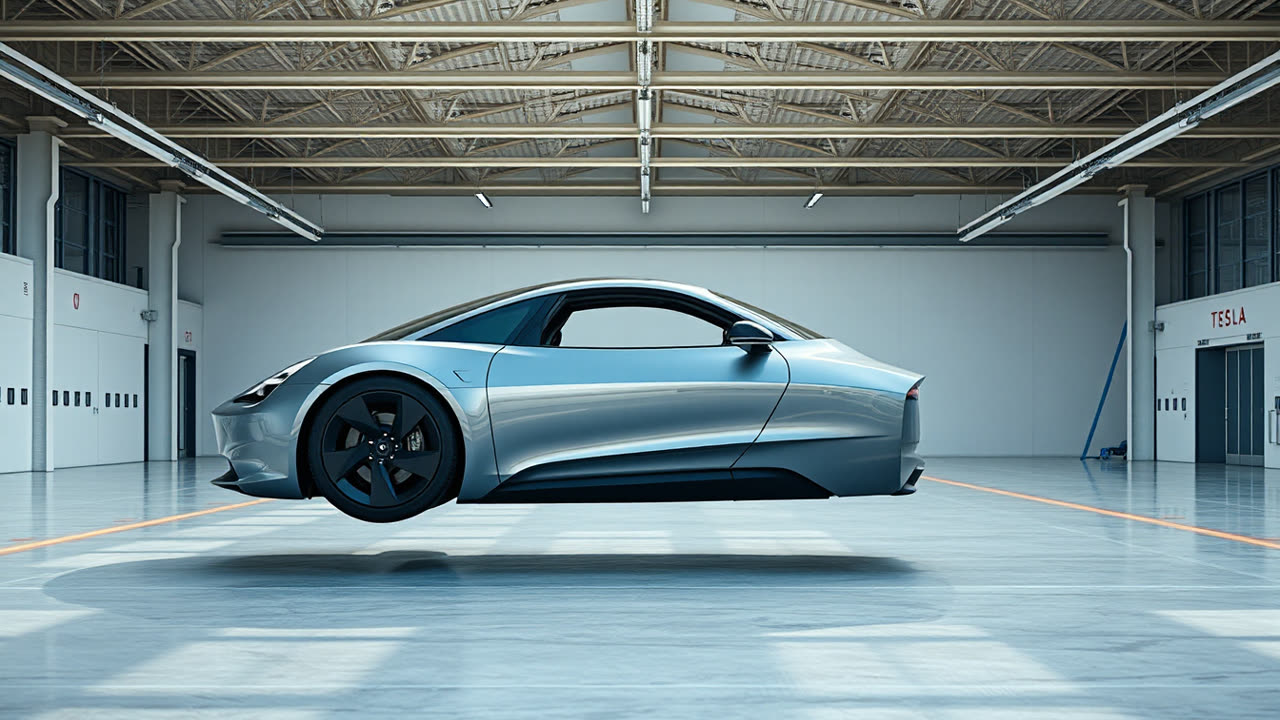
Tesla is reportedly poised to showcase its next-generation Roadster as early as this month, with an audacious demonstration that includes the vehicle lifting off the ground — notably, without a driver inside. This revelation, initially reported by The Information, suggests a significant leap beyond conventional automotive performance, leveraging advanced thruster technology developed by SpaceX. While the exact parameters of the "flight" remain speculative, the mere prospect of a production-intent vehicle achieving vertical lift-off, even briefly, marks a pivotal moment in the convergence of aerospace and automotive engineering.
The significance of this purported demonstration extends far beyond mere spectacle. For users, it redefines the very concept of a "performance car," hinting at a future where personal transportation transcends two dimensions. The "SpaceX package," long promised by Elon Musk, envisions cold gas thrusters integrated into the Roadster, dramatically enhancing acceleration, cornering, and potentially enabling short hops. While regulatory hurdles for widespread public use of such a feature are immense, the initial impact on perception and brand identity is immediate. Tesla, already a disruptor in electric vehicles, would solidify its image as an innovator willing to push boundaries previously confined to science fiction. Early adopters, particularly those in the ultra-luxury performance segment, would gain access to a vehicle offering unparalleled bragging rights and a genuinely novel driving experience, albeit likely one with significant operational constraints.
For the industry, this demonstration, even if limited, represents a potent challenge to established norms and rival manufacturers. While companies like Porsche, Rimac, and Lucid continue to push the envelope of electric hypercar performance, none have publicly indicated plans for integrated flight capabilities in a production vehicle. The new Roadster, with its claimed sub-two-second 0-60 mph acceleration and over 1,000 km (620 miles) of range, already sets a formidable benchmark for traditional metrics. Adding a "flying" component, however rudimentary, shifts the goalposts entirely, forcing competitors to consider not just faster acceleration or longer range, but entirely new modes of locomotion. This could accelerate research into advanced propulsion systems, lightweight materials, and energy density solutions across the entire automotive supply chain. It also underscores the increasing influence of aerospace technologies, particularly from companies like SpaceX, on the future of ground transportation.
The current Roadster, first unveiled as a concept in 2017 with revised specifications announced in 2019, has been subject to numerous delays, a common theme for ambitious Tesla projects. Initial promises included a top speed exceeding 250 mph and a quarter-mile time of 8.8 seconds. The "SpaceX package" with ten small rocket thrusters was always part of the long-term vision, intended to replace the rear seats. This latest development suggests that Tesla is finally ready to move beyond conceptual renders and deliver on some of its most audacious claims. Compared to its predecessor, the original Tesla Roadster (2008-2012), which was essentially a modified Lotus Elise, the new Roadster is an entirely bespoke design, showcasing Tesla's maturity as a vehicle manufacturer and its ability to integrate cutting-edge technology directly into its chassis and powertrain. Its rivals, such as the Rimac Nevera and Lucid Air Sapphire, offer blistering acceleration and advanced EV technology, but none have ventured into the realm of integrated aerial mobility.
Looking ahead, the successful execution of such a demo would undoubtedly create immense buzz, but the path to widespread adoption of "flying cars" remains fraught with significant challenges. Regulatory frameworks for vehicles operating in three dimensions are virtually non-existent for private ownership and would require extensive development, testing, and public acceptance. Issues of airspace management, noise pollution, safety protocols, and liability would need to be meticulously addressed. Furthermore, the energy demands and practical limitations of a thruster-equipped vehicle for routine daily use are substantial. It is more probable that the initial impact will be symbolic, serving as a halo product that elevates Tesla's brand and pushes the boundaries of what is considered possible in personal transportation. The technology demonstrated, particularly in cold gas thrusters and advanced vehicle control systems, could eventually trickle down into other applications, perhaps in emergency services, specialized industrial vehicles, or even refined versions of advanced driver-assistance systems. Ultimately, this demo, if it materializes as reported, will serve as a powerful statement of intent, not just for Tesla, but for the entire automotive industry, signaling a future where the sky is no longer the limit for ground vehicles.