Tesla Robotaxi Crashes with Human Remote Operator at Controls
A Tesla ‘Robotaxi’ recently crashed into a tree stump in Houston, with data confirming a human remote operator was in control, marking the third such incident for the company.
✨ This content was summarized and interpreted by AI; it may contain errors — please verify accuracy with the original sources. Learn more
Listen to this story
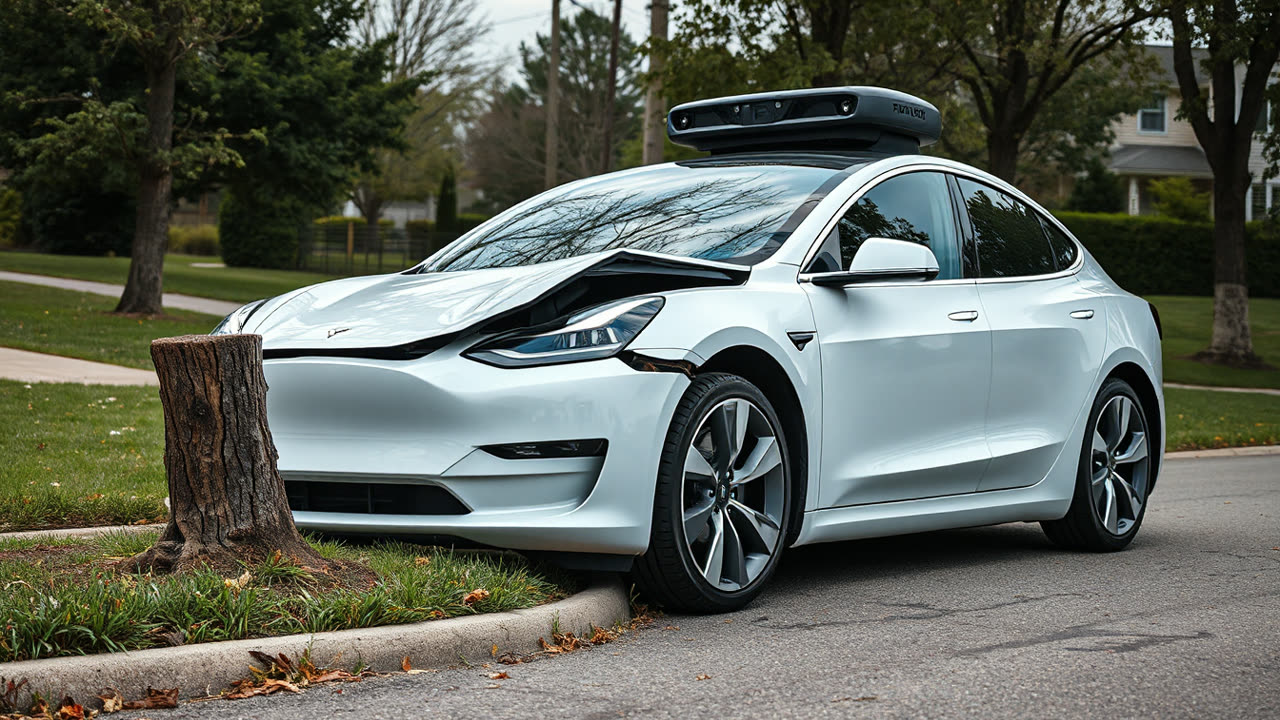
A Tesla ‘Robotaxi’ operating in Houston recently crashed into a tree stump, with data filed with the National Highway Traffic Safety Administration (NHTSA) indicating a human remote operator was in control at the time. This incident marks the third such crash Tesla has reported involving a human operator intervening in or directly controlling a vehicle designated for autonomous service, raising significant questions about the true autonomy and safety net of its burgeoning Robotaxi fleet.
The Houston crash, detailed in one of four new "Robotaxi" incident reports filed by Tesla with NHTSA, underscores a critical tension in the autonomous vehicle (AV) industry: the reliance on human intervention even as companies push for fully driverless operations. While the exact circumstances of the Houston collision—including the speed, environmental conditions, and the specific actions leading to the impact with the tree stump—have not been fully disclosed, the involvement of a remote operator suggests a scenario where either the autonomous system encountered an unresolvable situation, or the operator made a critical error in their remote control. This incident, alongside the two prior reported crashes involving human operators, casts a shadow over the "Robotaxi" moniker, implying a level of autonomy that may not yet be consistently achieved.
The implications for users are multifaceted. For potential Robotaxi passengers, these incidents erode confidence in the promise of a truly driverless experience, suggesting that a human element, prone to its own set of errors, remains a necessary but imperfect fallback. The very concept of a "Robotaxi" hinges on superior safety and reliability compared to human-driven vehicles, yet a pattern of remote operator-involved crashes introduces a new vector of risk. For the broader public, particularly those skeptical of autonomous technology, such reports reinforce concerns about the maturity and safety of AVs, potentially slowing public acceptance and regulatory progress. This perception challenge is critical, as widespread adoption is contingent not just on technological capability, but on public trust.
From an industry perspective, these incidents highlight fundamental challenges in scaling autonomous driving. Tesla's approach, heavily reliant on its Full Self-Driving (FSD) beta software and a vision-only system, contrasts with rivals like Waymo and Cruise, which often employ a suite of lidar, radar, and high-definition maps in geo-fenced operational design domains (ODDs). While Tesla aims for a universal solution, the necessity of remote human intervention—whether for teleoperation in complex scenarios or to mitigate system failures—suggests its FSD system, even in its latest iterations, is not yet robust enough for unsupervised, widespread Robotaxi deployment. This reliance on remote operators adds significant operational costs and complexity, undermining the economic advantages touted for fully autonomous fleets. Each remote intervention requires highly trained personnel, sophisticated low-latency communication networks, and a rapid response infrastructure, all of which contribute to the operational overhead and potentially bottleneck scalability.
Historically, the autonomous vehicle industry has grappled with the "long tail" of unexpected events—rare, complex scenarios that are difficult for AI to predict and manage. Remote operators are intended to bridge this gap, providing a human safety net for these edge cases. However, the reported crashes involving these operators suggest that this safety net itself is not infallible. It raises questions about the training, response times, and situational awareness of remote personnel, who are detached from the immediate physical environment of the vehicle. Compared to earlier generations of autonomous prototypes that often had a safety driver physically present, the remote operator model introduces a different set of challenges, including potential latency in control commands, reduced sensory input for the operator, and the psychological burden of making high-stakes decisions from afar.
Looking ahead, these incidents will likely intensify scrutiny from regulators like NHTSA, which is already closely monitoring AV safety. The data from these reports could influence future regulatory frameworks, potentially leading to stricter requirements for remote operation protocols, operator training, and the disclosure of intervention metrics. For Tesla, the path forward for its Robotaxi ambitions may necessitate a re-evaluation of its FSD capabilities and the role of human oversight. While CEO Elon Musk has consistently projected an imminent future of widespread Robotaxi deployment, the reality of these operational challenges suggests a longer, more arduous development cycle. The industry as a whole will need to address the inherent complexities of human-machine interaction in semi-autonomous systems, perhaps pushing towards more sophisticated AI that can handle a broader range of edge cases, or refining remote operation interfaces to minimize human error. The ultimate success of Robotaxis hinges not just on technological prowess, but on building a system where human intervention, when necessary, is flawlessly executed, or ideally, becomes a vanishingly rare occurrence.