Tesla Robotaxi Failures Mount, Alienating Fans and Drawing Regulatory Scrutiny
Tesla's autonomous ride-hailing service in Texas is plagued by escalating operational failures and user frustrations, even among its most loyal supporters, intensifying regulatory investigations into its Full Self-Driving technology.
✨ This content was summarized and interpreted by AI; it may contain errors — please verify accuracy with the original sources. Learn more
Listen to this story
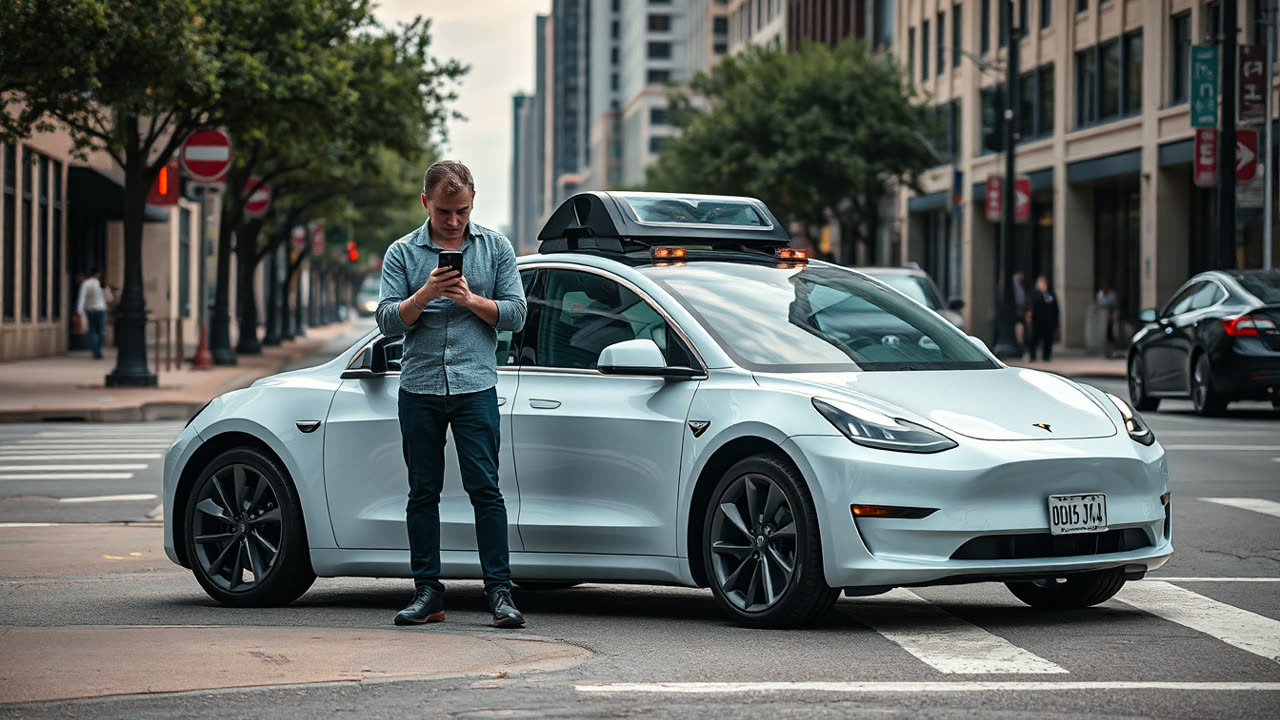
A Tesla ‘Robotaxi’ recently quoted a self-described “Tesla Ambassador” a staggering 66 minutes for a mere 2.3-mile journey in Austin, Texas, ultimately leaving him to abandon the ride and summon an Uber. This frustrating experience, detailed in an August 22, 2026, post by Reggie Overton that amassed over 630,000 views, highlights a growing wave of operational failures plaguing Tesla’s autonomous ride-hailing service in Texas, with complaints increasingly emanating from the company’s most ardent supporters. The incident, which saw Tesla support unable to reroute the vehicle and a refund only issued after the public outcry, is far from isolated. Another four-time Tesla owner in Texas recounted multiple harrowing experiences in mid-August, including being dropped three miles from his destination, encountering an "end of shift" message at 9:30 PM, and filming a Robotaxi "glitching out and getting stuck in the literal middle of the road" on August 21. These real-world malfunctions directly contradict recent assurances from Tesla’s head of AI, who, weeks prior, claimed the Robotaxi program boasted an “impeccable safety record” with “zero notable incidents.”
The implications of these widespread failures are profound, impacting both user trust and the broader autonomous vehicle (AV) industry. For users, the promise of convenient, self-driving transportation is being eroded by fundamental reliability issues, safety concerns, and inadequate customer support. Being stranded or forced to take lengthy, circuitous routes by a supposed "robotaxi" is not merely an inconvenience; it represents a betrayal of the core value proposition of autonomous mobility. The fact that refunds appear contingent on viral social media exposure, rather than a robust, scalable support process, underscores a critical operational immaturity that cannot sustain a commercial ride-hailing service. Such experiences, particularly among loyal Tesla evangelists, risk alienating a crucial segment of early adopters and fostering widespread skepticism about the readiness of autonomous technology.
For the industry, Tesla’s struggles cast a long shadow, intensifying already significant regulatory scrutiny. The National Highway Traffic Safety Administration (NHTSA) has been conducting an escalating investigation into Tesla’s Full Self-Driving (FSD) features since October 2024, now upgraded to an engineering analysis. This probe encompasses alleged traffic law violations—such as running red lights and driving into opposing lanes—and the system’s failure to detect reduced visibility conditions. As of October 2025, the investigation cited 58 incidents, including 14 crashes and 23 injuries, linked to FSD. A fatal crash in Katy, Texas, on June 19, 2026, where a Tesla Model 3 struck a residential home, is also under investigation by the NTSB, with the driver claiming FSD was engaged, a claim Tesla disputes, citing pedal misapplication. These mounting safety concerns and legal liabilities, including a Florida jury finding Tesla 33% liable for a 2019 fatal Autopilot crash and awarding $243 million in damages, threaten to slow the pace of AV deployment and invite stricter governmental oversight across the board.
Tesla's approach to autonomous driving fundamentally differs from many of its rivals, a distinction now starkly highlighted by these operational challenges. The company's Full Self-Driving system relies exclusively on a "vision-only" architecture, utilizing eight external cameras without supplementary lidar or pre-built high-definition maps. This strategy aims for a generalized AI trained on billions of miles of real-world driving data from its customer fleet. In contrast, competitors like Alphabet's Waymo employ a multi-sensor suite, integrating lidar, radar, and cameras with meticulously detailed HD maps, operating within precisely defined geofenced areas. This more cautious, "aerospace-like" methodology has yielded impressive safety statistics, with Waymo logging over 12 million autonomous miles with only one minor at-fault incident and no fatalities, while delivering over 100,000 paid robotaxi rides weekly across four U.S. cities. While Tesla's FSD hardware costs under $5,000 per vehicle, significantly less than Waymo's estimated $150,000 sensor package, the trade-off appears to be in reliability and safety in complex, unpredictable urban environments. Tesla's FSD remains predominantly a Level 2/3 system, still requiring human supervision, whereas Waymo has achieved Level 4 autonomy in its operational domains.
Looking ahead, Tesla is poised to launch its purpose-built, two-seat "Cybercab" robotaxi—designed without a steering wheel or pedals—in Austin on September 3, 2026. This vehicle, with a target price of $30,000, embodies Tesla's long-term vision of a unified AI platform, sharing its core AI5 chip, FSD computer-vision architecture, and Cortex 2.0 supercomputer with the Optimus humanoid robot. While Tesla reportedly expanded its national Robotaxi fleet by 50% in August 2026, signaling a shift towards scaled operations, the current wave of negative experiences indicates that scaling a system prone to "bugs" and critical errors will only amplify existing problems. The Cybercab's radical design, eliminating conventional controls, will undoubtedly heighten regulatory scrutiny, demanding an unimpeachable safety record that the current FSD system has yet to demonstrate. The immediate challenge for Tesla is not merely to roll out more vehicles, but to fundamentally mature its autonomous software to a level of reliability that genuinely instills confidence, even among its most ardent supporters. Failure to do so risks further erosion of trust, increased regulatory intervention, and potentially ceding leadership in the autonomous mobility race to rivals employing more measured, albeit slower, deployment strategies. The future of Tesla's Robotaxi hinges on transcending its "beta" reputation and proving that its vision-only approach can consistently deliver safe, efficient, and truly autonomous transportation.