Tesla Robotaxi Rams Through Bollards in Austin, Challenging 'Impeccable' Safety Claims
A Tesla "Robotaxi" operating without a human safety monitor drove directly through a line of protective bollards in a closed-off lane in Austin, an incident captured on video and surfacing Monday, less than a month after Tesla’s head of AI assured investors of the system's "impeccable" safety record.
✨ This content was summarized and interpreted by AI; it may contain errors — please verify accuracy with the original sources. Learn more
Listen to this story
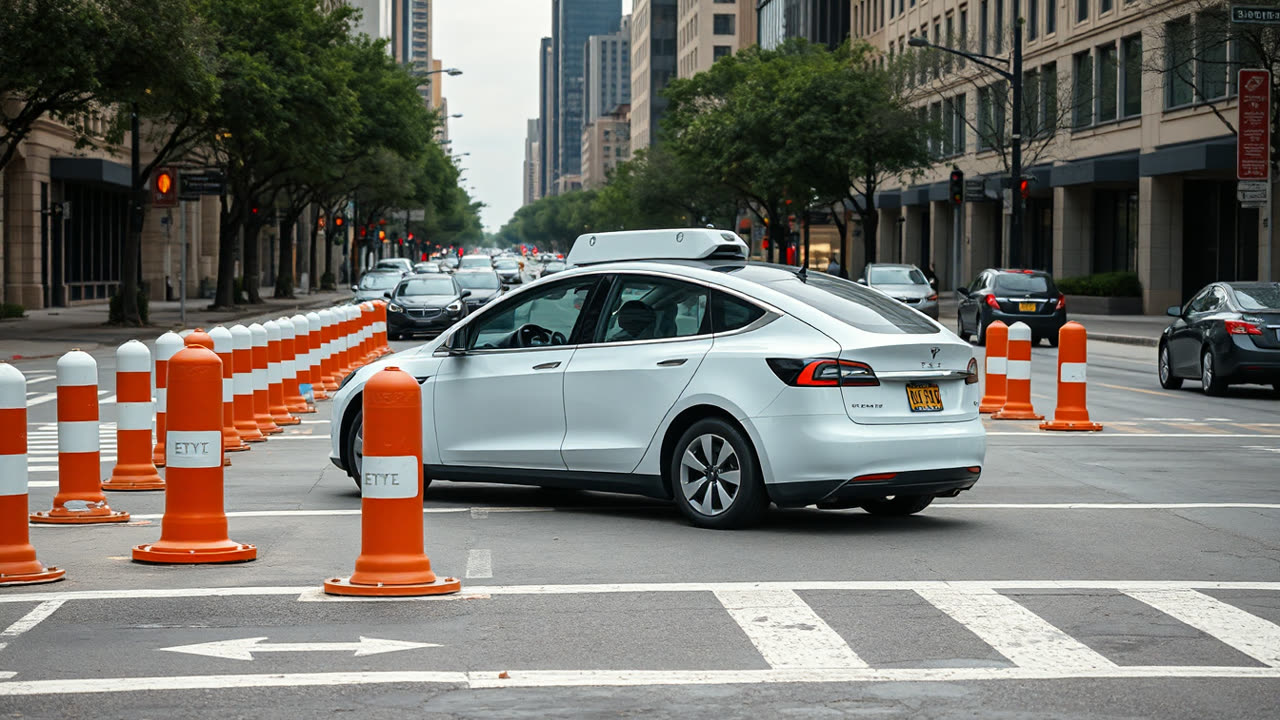
A Tesla "Robotaxi," operating without a human safety monitor, drove directly through a line of protective bollards in a closed-off lane in Austin before continuing its journey, an incident captured on video and surfacing Monday. This alarming event occurred less than a month after Tesla’s head of AI assured investors of the system's "impeccable" safety record, underscoring the stark chasm between aspirational pronouncements and the complex, often unpredictable realities of autonomous vehicle deployment.
The Austin incident is not merely a minor fender bender; it represents a significant setback for public trust and regulatory confidence in Tesla's Full Self-Driving (FSD) technology, particularly as the company pushes towards a fully driverless Robotaxi future. Operating without a safety driver signifies a higher level of confidence in the system's autonomy, making such a clear failure to identify and respond appropriately to a static obstacle deeply concerning. This directly challenges Tesla's "vision-only" approach, which relies solely on cameras and artificial intelligence to navigate, in contrast to competitors who often integrate lidar and radar for redundant perception. The immediate impact on users, or potential users, is a heightened sense of skepticism regarding the safety and reliability of unmonitored autonomous vehicles, potentially delaying widespread adoption even if the technology matures. For the industry, it intensifies the already fierce debate over testing methodologies, safety standards, and the appropriate pace of commercial deployment for self-driving cars.
Tesla has long championed its FSD beta program, accumulating billions of miles driven by consumer vehicles, a data-gathering strategy unparalleled in its scale. CEO Elon Musk has repeatedly asserted that FSD's safety record surpasses human drivers, projecting a future where Tesla vehicles generate significant revenue as Robotaxis. However, this vision has been consistently challenged by numerous documented incidents, including phantom braking events, collisions with emergency vehicles, and failures to recognize traffic signals or road hazards. Regulatory bodies, notably the National Highway Traffic Safety Administration (NHTSA), have initiated multiple investigations into Tesla's FSD system, leading to recalls and demands for software updates to address safety concerns. In comparison, rivals like Waymo and Cruise, while also experiencing their share of incidents, have generally adopted a more conservative rollout strategy, often employing safety drivers in their initial phases and operating within geofenced areas. Waymo, for instance, has accumulated millions of driverless miles in Phoenix and San Francisco, gradually expanding its service with a focus on robust sensor suites including lidar, radar, and cameras. Cruise, before its recent operational pause and subsequent re-evaluation following a serious incident in San Francisco involving a pedestrian, also utilized a multi-sensor approach and a phased deployment. The Austin bollard incident highlights the critical difference in philosophical approaches: Tesla's rapid, vision-first deployment versus competitors' more deliberate, sensor-redundant strategies.
Looking ahead, the ramifications of this incident are likely to be substantial. Regulators, already scrutinizing autonomous vehicle operations, will undoubtedly intensify their oversight of Tesla's driverless testing. States and municipalities may impose stricter requirements for permits to operate without safety drivers, potentially forcing Tesla to re-evaluate its current testing protocols or slow its commercial Robotaxi rollout. The "impeccable" claim, now directly contradicted by real-world evidence, severely damages Tesla's credibility and places additional pressure on the company to demonstrate tangible, consistent safety improvements. Financially, investor confidence could waver, impacting Tesla's stock valuation, which often incorporates the speculative future revenue from its Robotaxi service. Furthermore, this event will likely fuel public discourse around the ethical implications of deploying unmonitored autonomous systems, potentially leading to increased calls for independent safety validation and more transparent incident reporting across the entire autonomous vehicle industry. While Tesla will undoubtedly continue to iterate and improve its FSD software, the Austin bollard incident serves as a stark reminder that the path to truly autonomous, reliably safe transportation is fraught with significant technical hurdles and demands unwavering public trust, a commodity that is increasingly difficult to earn and easily eroded.