Tesla's "Cyber" Roadster: A Polarizing Design Shift for its Ultra-Luxury Hypercar
Tesla's long-delayed second-generation Roadster, set for an October 1, 2026 unveiling, appears poised to adopt the company's polarizing "Cyber" design language, risking market alienation while streamlining manufacturing.
✨ This content was summarized and interpreted by AI; it may contain errors — please verify accuracy with the original sources. Learn more
Listen to this story
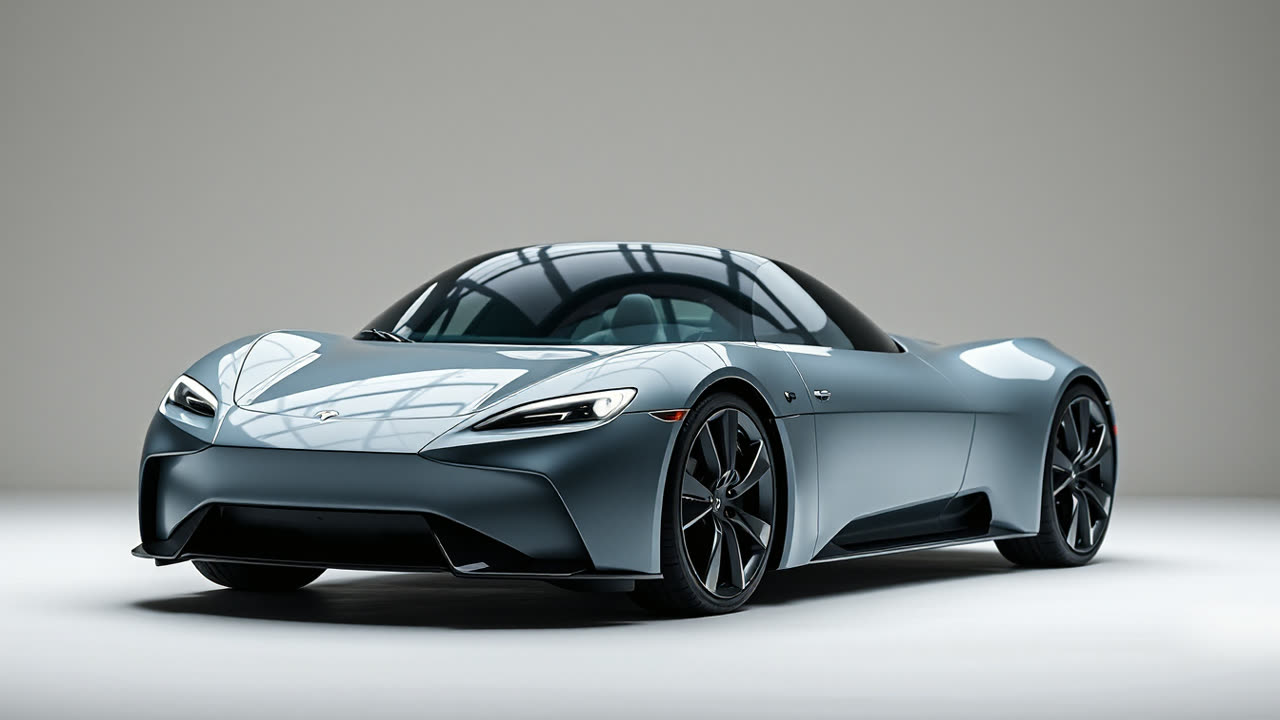
Tesla's long-anticipated second-generation Roadster, set for an October 1st, 2026 unveiling, appears poised to adopt the company's polarizing "Cyber" design language, a stylistic pivot that risks alienating a segment of its ultra-luxury target market while potentially streamlining manufacturing. This aesthetic shift, hinted at by a recent teaser from Electrek, suggests a departure from the sleeker, more conventional supercar silhouette first revealed in 2017, raising questions about its aerodynamic performance, market reception, and the strategic rationale behind imposing a utilitarian design on a vehicle designed for extreme speed and exclusivity.
The original 2017 Roadster concept promised groundbreaking specifications: a 0-60 mph time of 1.9 seconds, a top speed exceeding 250 mph, and an astounding 620 miles of range, all at an initial price point of $200,000 for the base model and $250,000 for the Founders Series. These figures, while still impressive today, set an incredibly high bar for the production model, especially given the rapid advancements in the high-performance EV segment over the past eight years. Competitors like the Rimac Nevera have since achieved production-ready 0-60 mph times of 1.74 seconds and a top speed of 258 mph, albeit at a significantly higher price of over $2 million. The Lucid Air Sapphire, priced around $250,000, offers 1,234 horsepower and a 0-60 mph time of 1.89 seconds, demonstrating that extreme performance is no longer the sole domain of hypercars. This evolving landscape means the new Roadster must not only meet its original audacious claims but also justify any design compromises, particularly those related to aerodynamics, which are critical for achieving and sustaining hypercar-level speeds and range.
The "Cyber" design, characterized by its sharp angles, flat panels, and unpainted stainless steel exoskeleton, has been a defining, if divisive, feature of the Cybertruck. While it offers manufacturing benefits by simplifying stamping processes and potentially reducing tooling costs, its application to a high-performance sports car presents unique challenges. Aerodynamics are paramount in a vehicle aiming for record-breaking speeds and range, and the blunt, angular surfaces inherent in the "Cyber" aesthetic are generally less efficient than the sculpted, flowing lines of traditional supercars. Tesla will need to demonstrate innovative solutions, perhaps through active aero elements or underbody optimization, to mitigate the inherent aerodynamic drag penalties. The success of the Cybertruck's design in a pickup truck market, where utility often outweighs pure aesthetic appeal, does not guarantee a similar reception in the rarefied world of ultra-luxury sports cars, where visual elegance and a sense of bespoke craftsmanship are often as important as raw performance.
For users, the "Cyber" Roadster represents a bold, potentially polarizing choice. Those drawn to the Cybertruck's futuristic, almost brutalist aesthetic will likely embrace it, seeing it as a continuation of Tesla's design ethos. However, traditional supercar enthusiasts, who value the sensual curves and aerodynamic purity of vehicles from brands like Ferrari, McLaren, or even Porsche, may find the design jarring and functionally compromised. The original Roadster concept, with its sleeker lines, offered a more universal appeal, blending extreme performance with a recognizable sports car silhouette. The shift to a "Cyber" aesthetic could narrow its market appeal, pushing it towards a niche of buyers who prioritize novelty and a distinct, almost industrial design over conventional supercar aesthetics.
From an industry perspective, this move signals Tesla's continued willingness to defy established design norms, a strategy that has yielded both immense success and considerable controversy. If the "Cyber" Roadster can achieve its promised performance metrics despite its unconventional shape, it could force rivals to reconsider their design paradigms, potentially inspiring a new wave of geometrically focused automotive aesthetics. However, if the design compromises performance or significantly limits its market, it could serve as a cautionary tale about the limits of design homogenization across different vehicle segments. The long delay in the Roadster's production, now more than eight years, also highlights the complexities of bringing such an ambitious vehicle to market, a challenge compounded by the decision to overhaul its design so late in the development cycle.
Looking ahead, the October 1st unveiling will be critical. Tesla must not only confirm the "Cyber" design but also provide definitive, validated performance figures that either meet or exceed the lofty 2017 promises. The market will be watching closely to see how Tesla addresses the aerodynamic challenges and if the new design truly enhances, rather than detracts from, the overall hypercar experience. Furthermore, pricing and production timelines will be crucial; the initial $200,000 price point, while high, was considerably lower than many hypercar rivals, and any significant increase due to design complexity or material costs could further narrow its competitive advantage. The success of the "Cyber" Roadster will ultimately hinge on whether Tesla can convince a discerning, high-end clientele that its unconventional design is not merely a stylistic choice, but an integral part of a new paradigm in hyper-performance electric vehicles.