Tesla's Cybercab Gets Starlink, Addressing Key Connectivity Challenge
Tesla's robotaxi ambitions take a significant leap forward with the unveiling of the first Cybercab featuring an integrated Starlink antenna, promising ubiquitous high-bandwidth connectivity for autonomous fleets.
✨ This content was summarized and interpreted by AI; it may contain errors — please verify accuracy with the original sources. Learn more
Listen to this story
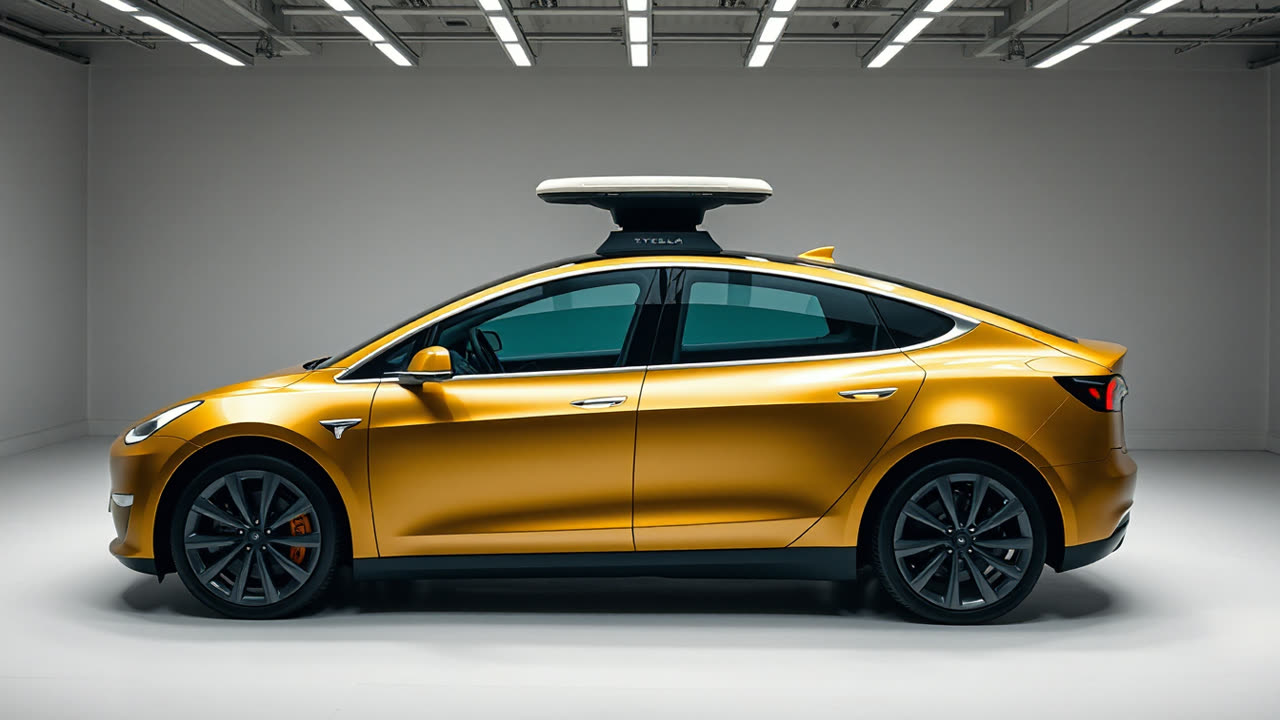
Tesla's robotaxi ambitions took a significant leap forward today with the unveiling of the first Cybercab featuring an integrated Starlink antenna, a development teased by Tesla’s robotaxi account with photographs of a gold-hued prototype at Gigafactory Texas. The low-profile satellite antenna, seamlessly integrated into the vehicle's roofline, signals a strategic move to address one of the most critical, yet often overlooked, challenges in scaling autonomous fleets: ubiquitous, high-bandwidth connectivity. This integration is not merely an aesthetic addition; it represents a foundational shift in how Tesla envisions the operational reliability and user experience of its long-promised autonomous ride-hailing service, potentially offering a robust, low-latency data link independent of terrestrial cellular infrastructure.
This move holds profound implications for both users and the broader autonomous vehicle industry. For future Cybercab passengers, Starlink integration promises an unparalleled level of in-car connectivity, enabling seamless high-definition streaming, uninterrupted video conferencing, and robust gaming experiences even in areas with sparse or non-existent cellular coverage. This transforms the Cybercab from a mere transportation utility into a mobile, connected workspace or entertainment hub, enhancing its value proposition significantly. From an operational standpoint, reliable satellite connectivity is paramount for autonomous systems. Robotaxis generate vast amounts of real-time sensor data, require constant map updates, and necessitate continuous communication with fleet management systems. While 5G networks offer high speeds, their coverage remains inconsistent, particularly outside dense urban centers. Starlink’s global reach and lower latency compared to traditional satellite internet provide a critical redundancy and primary connectivity solution, ensuring that Cybercabs can operate safely and efficiently across diverse geographies, from suburban routes to potentially more remote areas where cellular dead zones are common. This could dramatically expand the serviceable area for Tesla's robotaxi network, accelerating its deployment beyond pilot cities.
Historically, Tesla's Full Self-Driving (FSD) development has relied on a combination of on-board processing and cellular connectivity for data offloading and software updates. However, the demands of a truly autonomous, always-on robotaxi service push the limits of existing cellular networks, especially when considering fleets of thousands of vehicles concurrently uploading gigabytes of data. Rivals like Waymo and Cruise primarily operate in geofenced urban areas where 4G and 5G coverage is relatively robust, often supplementing with local Wi-Fi hotspots at depots. However, none have publicly announced or demonstrated such a deeply integrated, proprietary satellite connectivity solution for their operational vehicles. Waymo, for instance, has focused on robust on-board compute and sophisticated sensor arrays, relying on existing telecommunications for necessary external communication. Tesla's vertical integration of Starlink positions it uniquely, offering a closed-loop ecosystem for hardware, software, and now, critical connectivity, potentially providing a significant competitive advantage in reliability and operational cost by reducing reliance on third-party network providers.
The journey to this point has been protracted, with Tesla CEO Elon Musk first promising a million robotaxis by 2020, a target that proved highly ambitious. The development of FSD Beta has progressed through numerous iterations, facing challenges related to corner cases, regulatory scrutiny, and public perception of safety. The Cybercab itself, distinct from current Tesla vehicles, has been hinted at as a purpose-built autonomous vehicle designed for maximum utility and efficiency in a ride-hailing context, potentially featuring a minimalist interior and optimized for passenger experience rather than driver controls. The Starlink integration now adds a crucial piece to this complex puzzle, addressing a fundamental infrastructure gap.
Looking ahead, the immediate next steps will likely involve extensive real-world testing of these Starlink-equipped Cybercabs. Performance benchmarks in varying environmental conditions, including urban canyons and adverse weather, will be critical to validate the antenna's efficacy. Regulatory approvals for operating satellite-connected vehicles on public roads will also be a key hurdle, potentially requiring new frameworks for data transmission and emergency communication. Furthermore, the cost structure of Starlink connectivity for a large robotaxi fleet will be a significant factor in the service's overall profitability and pricing model for consumers. While the initial unveiling focuses on the Cybercab, the successful integration of Starlink could also pave the way for similar connectivity solutions in other Tesla vehicles, or even broader applications for autonomous systems beyond transportation. This development signals Tesla’s commitment to self-sufficiency and an aggressive push to establish a truly ubiquitous and resilient autonomous ride-hailing network, potentially redefining the landscape of future mobility.