Tesla's Cybercab Launch: Redefining Autonomy and Urban Mobility
Tesla is set to formally launch its Cybercab, a revolutionary gold two-seater designed entirely without a steering wheel or pedals, poised to fundamentally redefine the company's future and the automotive industry.
✨ This content was summarized and interpreted by AI; it may contain errors — please verify accuracy with the original sources. Learn more
Listen to this story
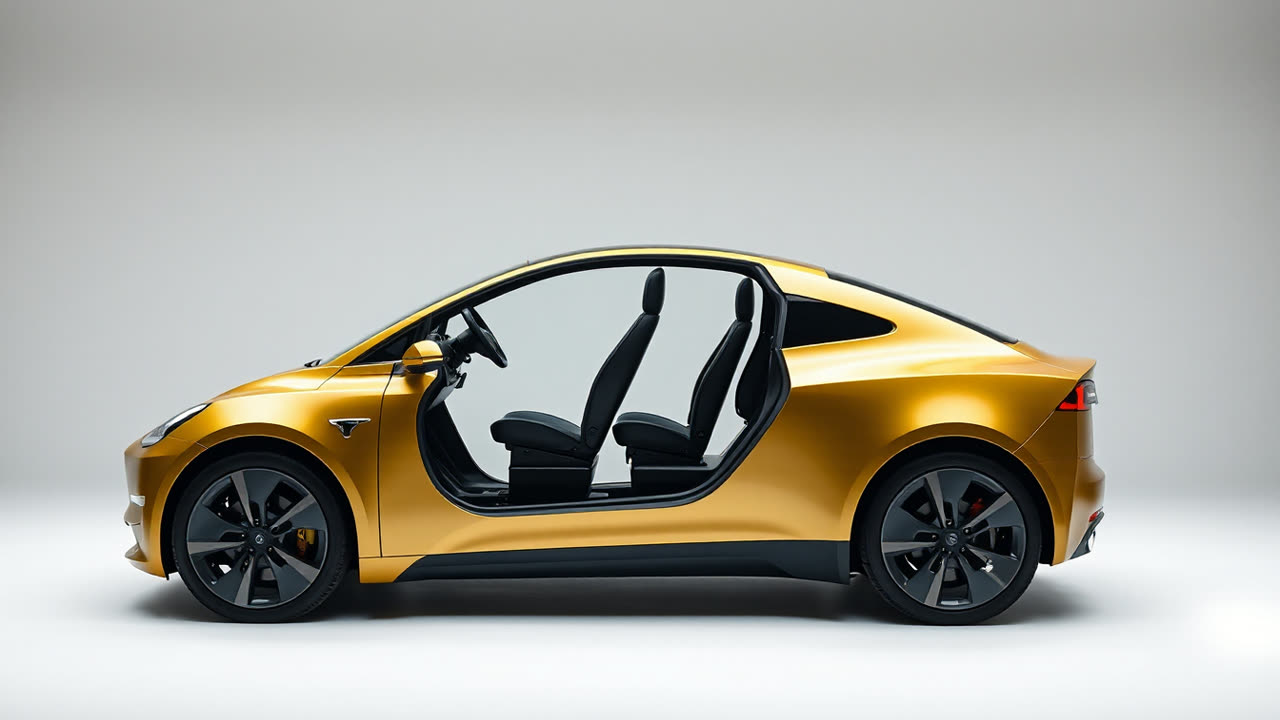
Tesla is poised to formally launch its Cybercab, a striking gold two-seater designed entirely without a steering wheel or pedals, marking a pivotal moment that could fundamentally redefine the company's trajectory and the broader automotive landscape. This radical departure from traditional vehicle design underscores Tesla's commitment to a fully autonomous, ride-hailing future, moving beyond personal car ownership to a service-based transportation model. The Cybercab's imminent debut represents the culmination of years of development in artificial intelligence and vehicle autonomy, positioning Tesla to disrupt urban mobility networks on an unprecedented scale.
The significance of the Cybercab extends far beyond its unconventional aesthetics; it embodies Tesla's vision for a dedicated robotaxi fleet, a move that could unlock immense new revenue streams and dramatically alter the company's valuation. By eliminating the driver, Tesla aims to slash operational costs for ride-hailing services, potentially making autonomous rides significantly cheaper and more accessible than human-driven alternatives. This cost advantage could accelerate the adoption of robotaxis, particularly in dense urban environments where parking and traffic congestion make personal car ownership increasingly impractical. For users, the Cybercab promises a seamless, on-demand transportation experience, potentially reducing reliance on private vehicles and expanding access to mobility for non-drivers. The lack of traditional controls also frees up interior space, potentially allowing for more flexible cabin designs focused on passenger comfort or productivity during transit.
Historically, Tesla's Full Self-Driving (FSD) software has faced scrutiny and regulatory hurdles, with its evolution from a driver-assistance system to a fully autonomous solution proving more challenging than initially projected. Early iterations of FSD required constant driver supervision, but the Cybercab's design implies a level of autonomy that eliminates the need for human intervention entirely. This leap represents a critical validation of Tesla's AI and sensor suite, suggesting a maturity in its self-driving technology capable of navigating complex urban scenarios reliably and safely. Previous generations of Tesla vehicles, while highly advanced, were still fundamentally designed for human operation, with autonomous capabilities layered on top. The Cybercab, by contrast, is engineered from the ground up as an autonomous entity, optimizing every aspect for driverless operation.
Comparing the Cybercab to existing or planned rival offerings highlights Tesla's aggressive strategy. While companies like Waymo and Cruise have deployed robotaxi services in limited geographies, often using modified conventional vehicles with extensive sensor arrays, Tesla's approach with a purpose-built autonomous vehicle is distinct. Waymo, for instance, operates fully autonomous services in cities like Phoenix and San Francisco, utilizing Jaguar I-PACE and Chrysler Pacifica vehicles equipped with lidar, radar, and cameras. Cruise, a subsidiary of General Motors, also offers driverless rides in San Francisco, though it has faced recent operational challenges and regulatory scrutiny. Tesla's strength lies in its vertically integrated approach, controlling both hardware and software, and its vast network of real-world driving data collected from millions of FSD-enabled vehicles. This data advantage could accelerate the Cybercab's deployment and scalability. The "gold" finish, while visually striking, could also serve a practical purpose, potentially enhancing visibility or differentiating the fleet in a crowded urban landscape.
The immediate future for Tesla hinges on the Cybercab's successful and scalable deployment. Initial launches are likely to be confined to specific urban areas, subject to rigorous regulatory approvals and public acceptance. Tesla's ability to demonstrate the vehicle's safety and reliability will be paramount in gaining consumer trust and overcoming potential public skepticism surrounding fully driverless transport. Furthermore, the economic model of the Cybercab service – pricing, subscription options, and maintenance – will dictate its market penetration. If Tesla can achieve its ambitious cost-per-mile targets, the Cybercab could rapidly displace traditional taxis and ride-sharing services, generating significant recurring revenue for the company. The long-term outlook suggests a profound transformation of urban infrastructure, with cities potentially redesigning streetscapes to accommodate autonomous fleets and reduce parking demand. Tesla's "fork in the road" moment isn't just about a new product; it's about pioneering a new paradigm for personal and public transportation, with the Cybercab as its leading edge. The success or failure of this venture will not only reshape Tesla but also set a precedent for the entire autonomous vehicle industry, determining the pace at which driverless mobility becomes a global reality.