Tesla's Cybercab Set for Public Rides in Austin by August 2026
Tesla's highly anticipated Cybercab, a purpose-built two-seater autonomous vehicle devoid of a steering wheel or pedals, is scheduled to begin public rides in Austin, Texas, by late August 2026.
✨ This content was summarized and interpreted by AI; it may contain errors — please verify accuracy with the original sources. Learn more
Listen to this story
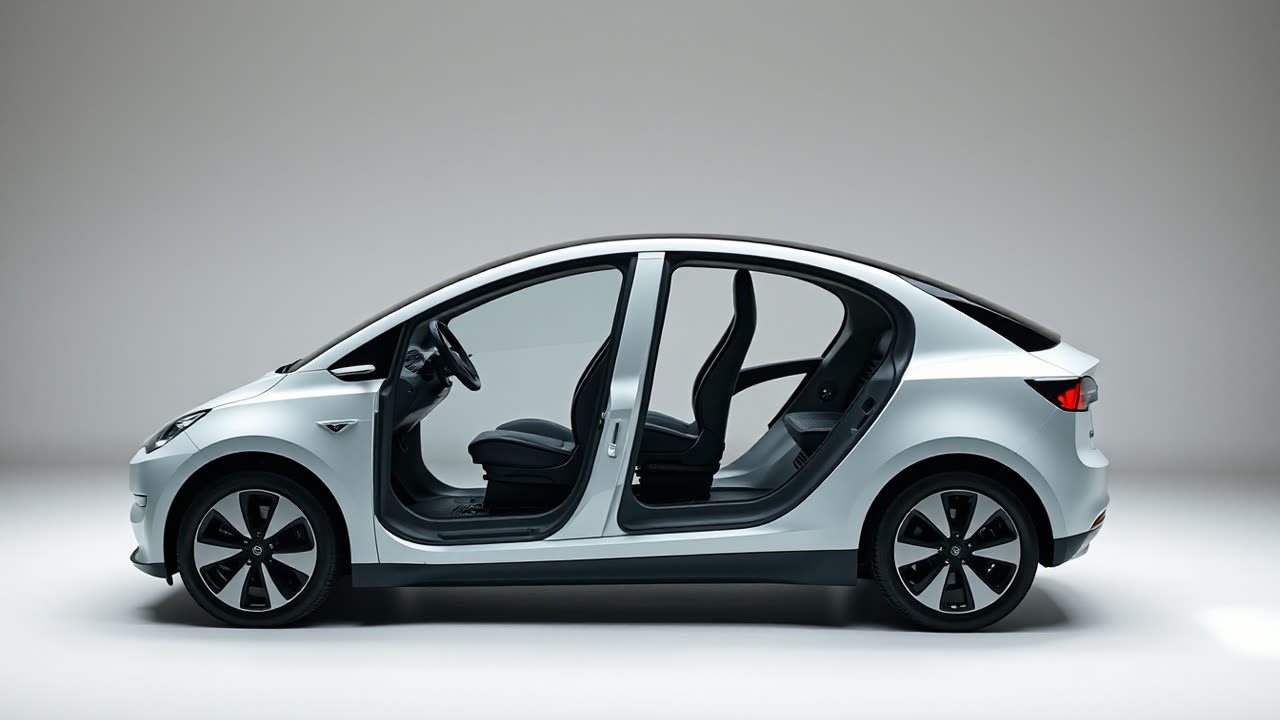
Tesla is poised to commence public rides of its highly anticipated Cybercab in Austin, Texas, by late August 2026, marking a pivotal moment in the company's ambitious robotaxi strategy. This two-seater, purpose-built autonomous vehicle, notably devoid of a steering wheel or pedals, has been undergoing pilot production since February 2026 at Gigafactory Texas, with hundreds of test units already spotted on public roads in Silicon Valley and Austin as early as March 2026. The initial rollout will prioritize employee rides on public roads before integrating the Cybercabs into Tesla's existing Austin Robotaxi service. Tesla has even launched a lottery, running until August 23rd, offering current Robotaxi riders a chance to attend the Cybercab launch event, indicating a formal public-facing debut is imminent.
This launch signifies a critical shift for Tesla, moving beyond its "Full Self-Driving (Supervised)" (FSD) beta, which still requires human driver supervision, to a vehicle designed from the ground up for Level 4 and Level 5 autonomy, necessitating no human intervention. The Cybercab's design prioritizes passenger experience, featuring a spacious interior with generous legroom, a large 21-inch center display for entertainment and ride information, and scissor doors. It boasts a 48 kWh battery, offering an estimated range of 293 miles (472 km), and claims an impressive efficiency of 5.5 mi/kWh (8.9 km/kWh), making it one of the most energy-efficient vehicles Tesla builds. The company is also planning for inductive charging, eliminating the need for traditional charging ports.
The implications for users and the industry are profound. For users, the Cybercab promises a potentially cheaper, more convenient, and potentially safer mode of urban transportation. Elon Musk has previously estimated robotaxi rides could eventually cost as low as $0.30 to $0.40 per mile at scale, a significant disruption to traditional ride-hailing services. While current Tesla Robotaxi rates in Austin are higher, with a base fare of $3.25 and $1 per mile, the long-term cost target remains aggressive. The absence of a steering wheel and pedals fundamentally transforms the passenger experience, offering a futuristic, lounge-like environment. However, public trust and acceptance of a truly driverless vehicle remain a significant hurdle, especially given past scrutiny of Tesla's FSD system and its classification as a Level 2 driver-assistance system, not fully autonomous, in consumer vehicles.
In terms of industry impact, the Cybercab's launch intensifies the race in the autonomous vehicle (AV) market, which is projected to grow from USD 104.6 billion in 2026 to USD 378.4 billion by 2033, at a compound annual growth rate of 20.2%. Tesla's rivals, such as Waymo and Cruise, have been operating commercial robotaxi services for some time. Waymo, a subsidiary of Alphabet, currently operates in 10 US metropolitan areas with 3,871 robotaxis, providing approximately 500,000 paid rides per week and aiming for 1 million weekly rides by the end of 2026. Waymo has also logged over 200 million fully autonomous miles. Zoox, an Amazon subsidiary, is also a significant player, with its own purpose-built robotaxis and manufacturing capacity. These competitors generally employ a LiDAR-heavy approach, contrasting with Tesla's vision-only strategy for its consumer FSD, though the Cybercab's sensor suite for full autonomy is more robust.
Tesla's manufacturing approach for the Cybercab is also a significant differentiator. Utilizing an "Unboxed" process at Gigafactory Texas, Tesla aims to reduce factory footprint by 40% and labor costs by 30% compared to traditional assembly lines. The company targets an ambitious annual production goal of 2 million Cybercabs at full capacity, with an internal goal of building one every 10 seconds, and has already listed an installed annual capacity above 125,000 units. This manufacturing innovation, coupled with a target price under $30,000 (with Elon Musk narrowing it to approximately $25,000), positions the Cybercab for potential mass-market disruption if the autonomous technology proves reliable and scalable.
However, significant challenges remain. Regulatory approval for truly unsupervised autonomous vehicles is complex and varies by jurisdiction. While Tesla has expanded its unsupervised operating area in Austin, and is preparing for additional US metros, the company's FSD system in consumer vehicles is still classified as SAE Level 2, requiring driver supervision. Regulatory bodies in Europe, for instance, have been slower to approve FSD beyond supervised modes due to stringent UNECE regulations and the need for adaptation to diverse European road conditions. The National Highway Traffic Safety Administration (NHTSA) has also investigated Tesla's FSD for traffic violations, highlighting ongoing safety concerns. The Cybercab's success hinges entirely on the robustness and safety of its autonomous driving system, which must operate flawlessly without human intervention. Tesla's reported 380,000 cumulative driverless miles across its hubs pales in comparison to Waymo's 200 million rider-only driverless miles, underscoring the scale of validation still required.
Looking ahead, the Cybercab's launch in Austin marks a crucial real-world test for Tesla's long-held robotaxi vision. The company's ability to scale its operations beyond initial employee rides and establish a commercially viable, safe, and widely accepted robotaxi service will be closely watched. Success would not only validate Tesla's vision-first approach to autonomy and its innovative manufacturing processes but also profoundly reshape urban mobility, potentially reducing personal car ownership and transforming ride-hailing economics. Failure, or even significant delays, could undermine investor confidence and allow competitors like Waymo and Zoox to further solidify their lead in the burgeoning autonomous vehicle market. The coming months will determine if the Cybercab truly represents the dawn of a new era in transportation or another incremental step in the long and challenging journey toward full autonomy.