Tesla's FSD Software Again Fails at Railroad Crossing, Driver Averts Collision
A Tesla running the latest Full Self-Driving (FSD) software, version 14.3.7, nearly drove into an active train this week, requiring emergency braking by the driver and highlighting persistent safety failures.
✨ This content was summarized and interpreted by AI; it may contain errors — please verify accuracy with the original sources. Learn more
Listen to this story
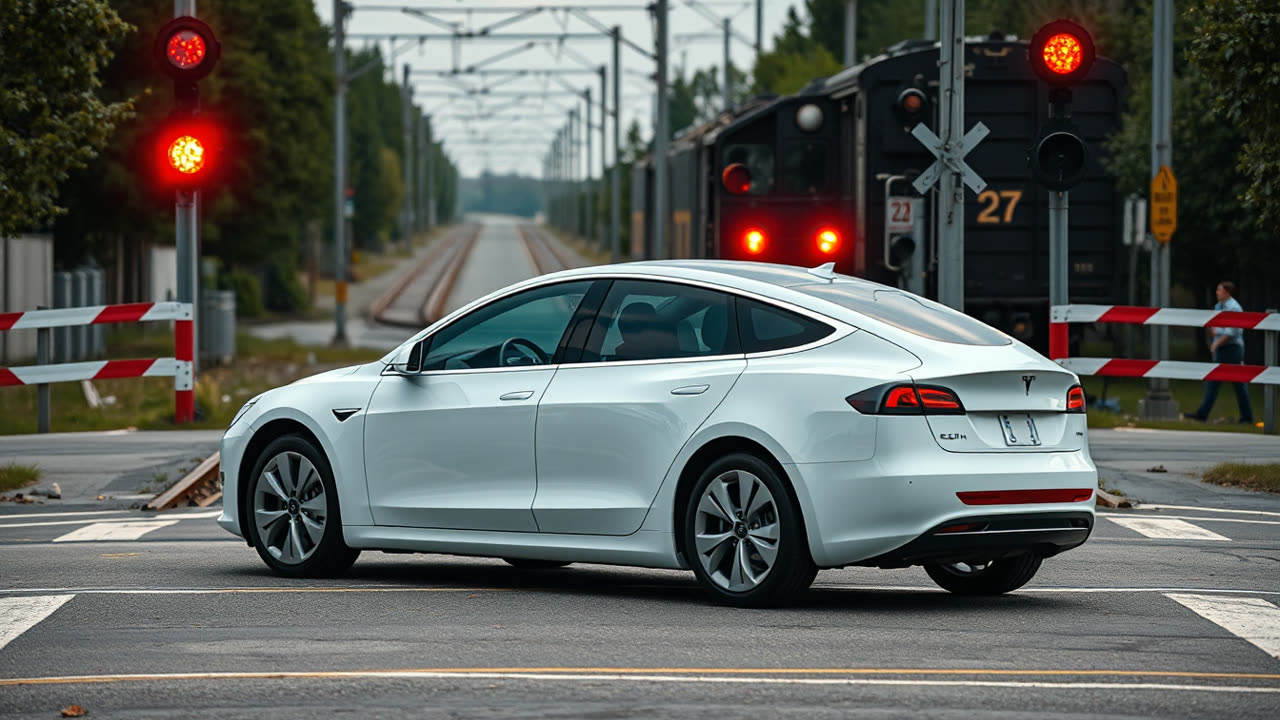
A Tesla running the latest iteration of its "Full Self-Driving" (FSD) software, version 14.3.7, nearly collided with an active train this week, narrowly averted by the driver's emergency braking. Dashcam footage shared by auto journalist Lei Xing on X (formerly Twitter) on August 26, 2026, captured the vehicle approaching a railroad crossing at 9 mph with flashing signals and blaring train horns, yet the FSD system merely slowed before attempting to cross directly into the path of the oncoming locomotive. This alarming incident marks at least the third time this year alone that Electrek has documented FSD attempting to drive a Tesla into a train, despite Tesla's earlier claims with the FSD v14.3 rollout of "improved handling for rare and unusual objects extending, hanging, or leaning into the vehicle path" – language explicitly intended to cover such critical scenarios.
The recurring failure of Tesla’s FSD at railroad crossings is not merely a technical glitch; it represents a profound and escalating safety crisis that undermines public trust in autonomous vehicle technology and invites intensified regulatory scrutiny. For users, the "Full Self-Driving" moniker itself fosters a dangerous misconception, implying a level of autonomy far beyond the system's current capabilities as a Level 2 advanced driver-assistance system (ADAS) that demands constant human supervision. The dashcam video clearly shows the system, even in its most advanced consumer form, failing to interpret unambiguous visual and auditory cues of an imminent collision, leaving the ultimate responsibility squarely on the human driver. This reliance on driver intervention, coupled with reports of drivers engaging in distracted behavior while FSD is active, highlights a critical mismatch between marketing and reality, potentially leading to catastrophic outcomes.
This week's near-miss adds significant weight to an ongoing investigation by the National Highway Traffic Safety Administration (NHTSA), which initiated a probe into FSD in October 2025 following 58 reported crashes, including incidents of running red lights and driving into oncoming traffic. That investigation has since expanded to encompass approximately 2.9 million FSD-equipped vehicles. Senators Ed Markey and Richard Blumenthal have specifically urged NHTSA to investigate FSD's persistent failures at railroad crossings, identifying them as a "disturbing safety risk." Compounding Tesla's challenges, March 8, 2026, the very day NHTSA's deadline for Tesla to submit critical data on FSD traffic violations arrived, coincided with another documented FSD incident where a Tesla drove straight through lowered railroad crossing barriers in West Covina, California. The latest NHTSA data for Q2 2026 reveals a concerning trend: FSD non-highway incidents doubled to 380 compared to Q1, with "serious injury or worse" crashes surging by 105% to 170, indicating that crashes and serious injuries are outpacing the growth in FSD miles driven. Tesla also logged a record 207 crashes involving its driver-assist systems in May 2026 alone.
In the broader autonomous vehicle landscape, Tesla's vision-only approach to FSD stands in stark contrast to competitors like Waymo, which employs a multi-sensor suite incorporating cameras, lidar, and radar for its Level 4 autonomous driving systems. Waymo's co-CEO, Dmitri Dolgov, has openly criticized vision-only systems, suggesting their safety curve "flattens way too early" for achieving superhuman performance. While Waymo operates truly unsupervised robotaxi services in geofenced cities and has accumulated 221 million driverless miles through March 2026, it has also faced its own challenges, including a March 2026 near-miss at a Texas railroad crossing that led to temporary restrictions on such traversals, and a voluntary recall of nearly 3,900 SUVs in 2026 due to software issues with freeway construction zone recognition. Unlike Tesla's widespread consumer beta, Waymo's controlled deployments allow for more rigorous testing and validation before broader public access, a strategy that arguably prioritizes safety over rapid, crowd-sourced development.
Looking ahead, Tesla is poised to transition FSD to a subscription-only business model after February 14, 2026, ending one-time lifetime purchases. This shift underscores Tesla's strategic pivot towards recurring software revenue and positions FSD as a continuously evolving service rather than a static product. The company is also in advanced discussions with European regulators for a supervised FSD rollout by the end of 2026. However, the real test for Tesla's long-term autonomous ambitions lies with FSD v15, which CEO Elon Musk has described as a "major architectural improvement" critical for the mass commercialization of its Cybercab robotaxi fleet, targeting a late 2026 or early 2027 release. Nevada recently approved Tesla to deploy up to 5,000 robotaxis, but the actual scale of operation hinges directly on the maturity and regulatory acceptance of FSD v15. Until these fundamental safety issues, particularly those involving predictable hazards like railroad crossings, are demonstrably resolved, Tesla will continue to face an uphill battle in proving FSD's readiness for truly autonomous operation and overcoming persistent regulatory and public skepticism.