Tesla's FSD Supervised System Expands to Czech Republic
Tesla is set to deploy its Full Self-Driving (FSD) Supervised system in the Czech Republic, marking a strategic expansion of its advanced driver-assistance technology within the European Union.
✨ This content was summarized and interpreted by AI; it may contain errors — please verify accuracy with the original sources. Learn more
Listen to this story
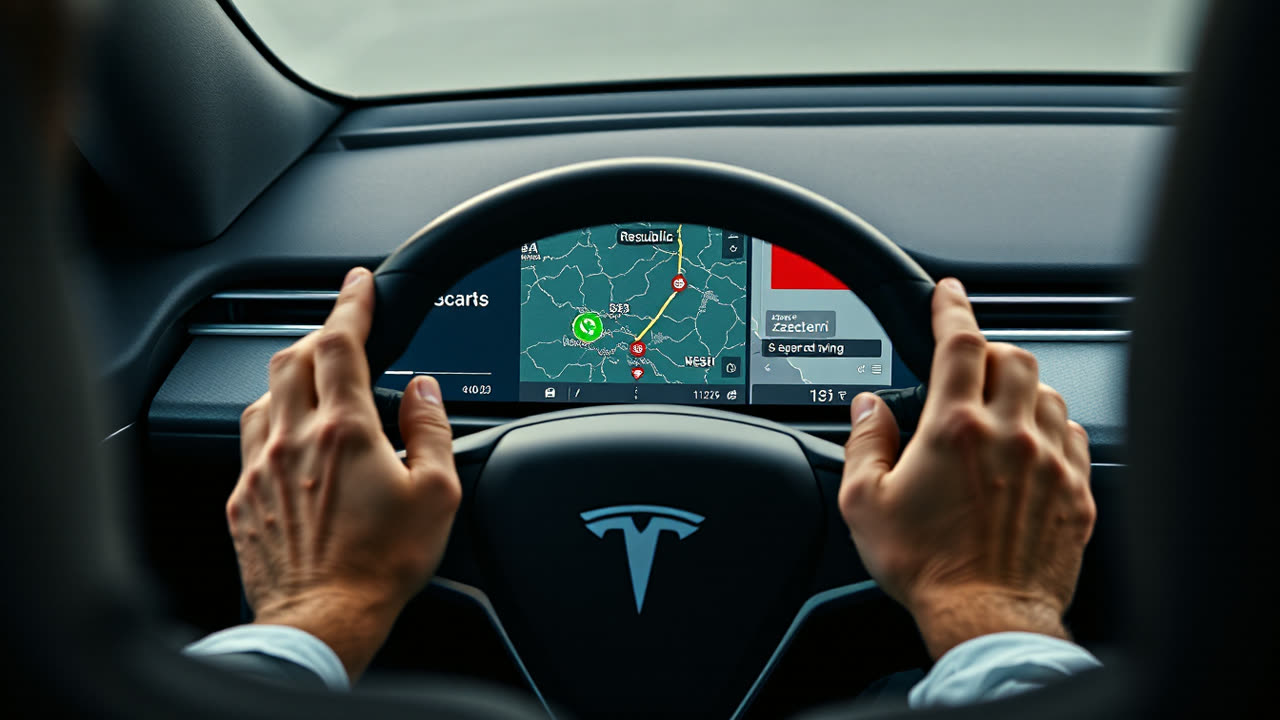
Tesla's Full Self-Driving (FSD) Supervised system is poised for imminent deployment in the Czech Republic, marking a strategic expansion of the automaker's advanced driver-assistance technology within the European Union. This move signals Tesla's continued effort to broaden its FSD footprint beyond North America, leveraging smaller, potentially more amenable regulatory environments within the fragmented EU landscape. The Czech Republic's relatively less stringent regulatory environment for Level 2 driver-assistance systems, compared to larger EU nations like Germany or France, likely positions it as an ideal testing ground for broader European acceptance.
This expansion holds significant implications for both users and the wider automotive industry, despite FSD Supervised remaining a Level 2 system requiring active driver attention. For users in the Czech Republic, it represents access to one of the most sophisticated, albeit still supervised, driver-assistance packages, promising enhanced highway navigation, automatic lane changes, and advanced parking features. The data gathered from real-world usage in a new geographical context will be invaluable for Tesla's iterative development model, potentially accelerating the system's refinement for diverse European road conditions, signage, and driving behaviors. Industry-wide, it underscores the ongoing divergence in autonomous driving strategies: while some manufacturers pursue highly constrained, geofenced Level 3 systems, Tesla continues its "data-driven" approach, pushing the boundaries of Level 2 capabilities globally.
Tesla's FSD Supervised, despite its "full self-driving" moniker, mandates constant driver vigilance and hands-on readiness, a crucial distinction often overlooked in public discourse. This contrasts sharply with systems like Mercedes-Benz's Drive Pilot, which achieved Level 3 conditional automation certification in Germany and parts of the United States, allowing drivers to legally disengage from driving tasks under specific, limited conditions, such as congested highway traffic below 60 km/h. Mercedes-Benz's system utilizes a redundant sensor suite, including lidar, to meet the stringent safety requirements for Level 3, whereas Tesla's FSD relies primarily on a vision-only system, a philosophical and technological divergence that continues to fuel debate within the autonomous driving community. The regulatory approval for Level 3 systems like Drive Pilot in Germany, and subsequently in Nevada and California, highlights a willingness among certain regulators to certify systems that demonstrably meet a higher safety threshold, even if their operational design domain (ODD) is highly restricted.
The current iteration of FSD Supervised has seen continuous improvements in its ability to navigate complex urban environments, handle unprotected left turns, and respond to dynamic traffic situations, primarily through extensive neural network training on vast datasets. However, it still occasionally exhibits "phantom braking" or requires driver intervention in unpredictable scenarios, reinforcing its Level 2 classification. The pricing of FSD, currently at $12,000 as an upfront purchase or $99/month subscription in the US, reflects Tesla's perceived value of the software, yet its supervised nature means it doesn't offer the true hands-off, eyes-off convenience of Level 3 systems. This cost, coupled with the ongoing responsibility of supervision, presents a unique value proposition that Tesla is banking on for its broader appeal.
The move into the Czech Republic, a smaller market, could be a calculated strategy to build regulatory trust and gather operational data without immediately confronting the more entrenched and cautious regulatory bodies of larger EU economies. Larger countries like Germany, with their robust automotive industries and established regulatory frameworks, have historically been more circumspect about autonomous driving technologies, particularly those that do not adhere to conventional certification pathways. The United Nations Economic Commission for Europe (UNECE) Regulation No. 157 (UN R157) provides a framework for Level 3 systems, which many EU nations are adopting, creating a clear, albeit challenging, path for manufacturers. Tesla's FSD, as a Level 2 system, operates under a different set of regulations, primarily general vehicle safety rules, which can vary more widely across member states. This regulatory fragmentation within the EU means that approval in one country does not automatically translate to others, necessitating a country-by-country, or at least region-by-region, approach.
Looking ahead, Tesla's trajectory in the EU will likely involve a dual strategy. First, a continued, incremental rollout of FSD Supervised in countries where regulatory hurdles are manageable, allowing for data collection and system refinement. Second, an eventual pivot towards seeking Level 3 or even Level 4 certification for specific operational design domains, which would necessitate significant adjustments to its current vision-only architecture, potentially incorporating lidar or radar to satisfy redundancy and safety requirements. The company's long-term vision of truly autonomous robotaxis hinges on achieving higher levels of autonomy, but the path to widespread acceptance in Europe is paved with complex regulatory challenges, diverse road infrastructure, and varying consumer expectations. The Czech Republic rollout is less a breakthrough and more a careful, strategic step in a much longer, more arduous journey towards truly self-driving cars on European roads. The ultimate success will depend not only on technological prowess but also on Tesla's ability to navigate the intricate web of European regulations and build trust with both authorities and consumers.