Tesla's FSD v15 Heralded as "Step-Change," Cybercab and Optimus Set for 2027 Launch
Tesla executives informed JPMorgan that Full Self-Driving v15 represents a "step-change" in autonomous capabilities, while targeting 2027 for the commercial launch of its Cybercab robotaxi service and Optimus humanoid robot.
✨ This content was summarized and interpreted by AI; it may contain errors — please verify accuracy with the original sources. Learn more
Listen to this story
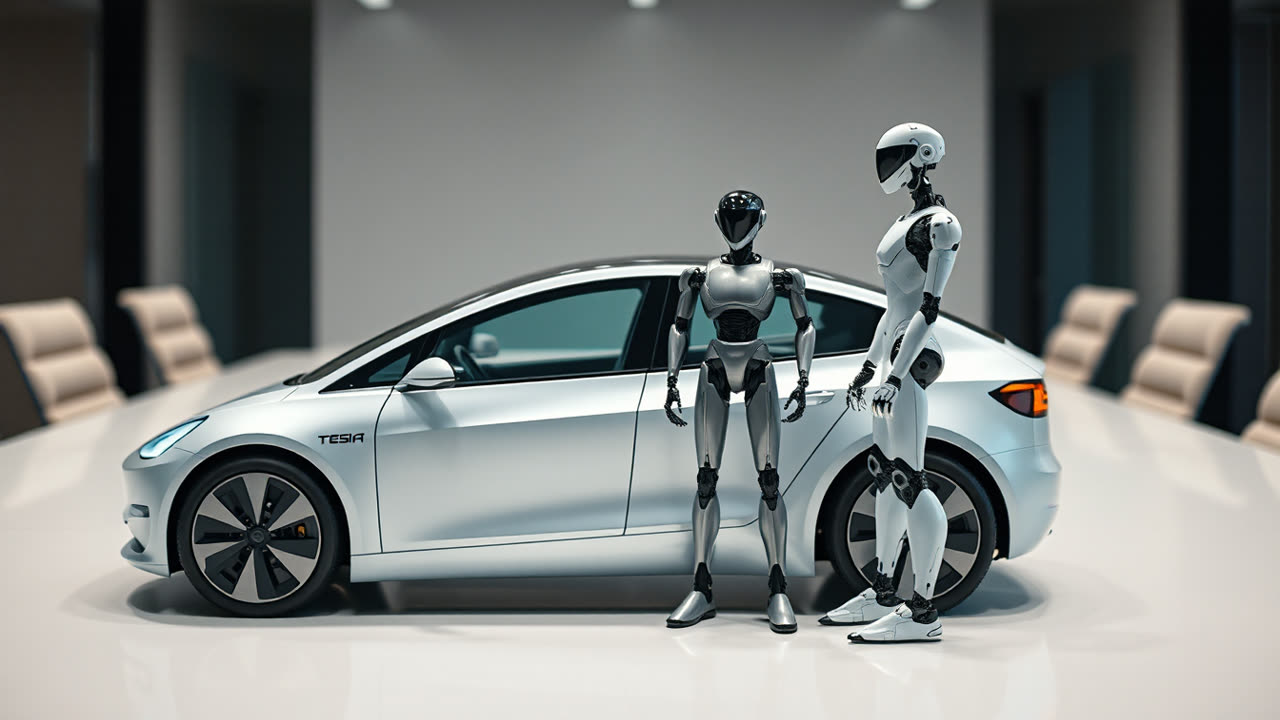
Tesla’s Full Self-Driving (FSD) v15 is heralded as a "step-change" in autonomous driving capabilities, a claim emerging from a recent meeting between Tesla executives and JPMorgan at the company's Fremont factory. This assertion, coupled with updated timelines for the Cybercab and the Optimus humanoid robot, signals a pivotal moment for the electric vehicle giant as it attempts to solidify its position not just in automotive, but in the broader AI and robotics landscape.
The declaration regarding FSD v15 suggests a significant leap beyond previous iterations, addressing long-standing criticisms about the system's reliability and its ability to handle complex, unpredictable urban environments. While specific technical details from the JPMorgan meeting remain proprietary, the "step-change" implies a shift towards a more robust, generalized AI solution, potentially moving past the limitations of rule-based programming and narrow AI. This could manifest in significantly reduced disengagement rates, improved decision-making in ambiguous scenarios, and a smoother, more human-like driving experience. For users, this could finally deliver on the promise of true hands-off, eyes-off driving in a wider range of conditions, transforming daily commutes and long-distance travel. The industry implications are profound, potentially accelerating regulatory approval processes and setting a new benchmark for competitors like Waymo, Cruise, and Mobileye, which have largely focused on geofenced or highly controlled environments for their autonomous deployments.
Tesla's current hardware, HW4, is reportedly integral to these advancements, providing the computational backbone necessary for FSD v15's enhanced AI models. Introduced in 2023, HW4 significantly upgraded processing power, camera resolution, and radar capabilities over its HW3 predecessor, allowing for more data ingestion and faster, more sophisticated neural network processing. This synergy between advanced software and powerful, purpose-built hardware is a cornerstone of Tesla's strategy, differentiating it from rivals who often rely on third-party suppliers for critical components. The company's vertical integration, from chip design to software development and vehicle manufacturing, grants it unparalleled control over optimization and rapid iteration, positioning it to capitalize quickly on breakthroughs like FSD v15.
Alongside FSD, Tesla outlined an ambitious roadmap for its Cybercab, with internal targets pointing towards a 2027 launch for the robotaxi service. This timeline, if met, would place Tesla in direct competition with established autonomous ride-hailing services, many of which have faced substantial operational challenges and regulatory hurdles. Unlike existing services that often utilize modified conventional vehicles, the Cybercab is expected to be a purpose-built, driverless vehicle, potentially offering optimized interior space, lower operational costs, and a distinctive user experience. The success of Cybercab hinges directly on the maturity and reliability of FSD v15, as the economic viability of a fully autonomous ride-hailing fleet depends on the complete removal of human safety drivers. This move could disrupt traditional taxi and ride-sharing markets, offering a significantly cheaper and more widely available transportation option, especially in urban centers.
Perhaps the most futuristic element of Tesla’s updated vision is the Optimus humanoid robot, which the company expects to begin selling commercially in 2027. This timeline marks a significant acceleration from earlier projections and underscores Tesla’s intent to become a major player in general-purpose robotics. Optimus, designed to perform repetitive and dangerous tasks, is envisioned for deployment in manufacturing, logistics, and eventually, even domestic settings. Its commercial availability in 2027 would place Tesla at the forefront of the burgeoning humanoid robotics market, competing with specialized robotics firms and potentially even challenging the labor market in various industries. The impact on manufacturing could be transformative, enabling fully automated factories and addressing labor shortages, while also raising complex societal questions about the future of human employment.
Looking ahead, the success of FSD v15 will be critical to unlocking the potential of both Cybercab and Optimus. A truly reliable FSD system would not only validate Tesla’s long-term AI strategy but also generate substantial recurring revenue through software subscriptions and robotaxi services. The commercialization of Optimus, meanwhile, represents a diversification beyond automotive, leveraging Tesla's AI and manufacturing expertise into a new, potentially massive market. The next 12-18 months will be crucial for Tesla to demonstrate tangible progress on these fronts, turning ambitious timelines and "step-change" claims into demonstrable, widespread reality. The market will be watching closely for concrete metrics on FSD v15's performance, the first public demonstrations of Cybercab operations, and the initial specifications and pricing for Optimus, as these will ultimately determine whether Tesla can truly deliver on its expansive vision for an AI-driven future.