Tesla's Robotaxi Service Launches in Miami Amidst Persistent Scaling Challenges
Tesla officially launched its Robotaxi service in Miami within a highly constrained geofenced area, starkly highlighting the company's ongoing difficulties in scaling its autonomous ambitions.
✨ This content was summarized and interpreted by AI; it may contain errors — please verify accuracy with the original sources. Learn more
Listen to this story
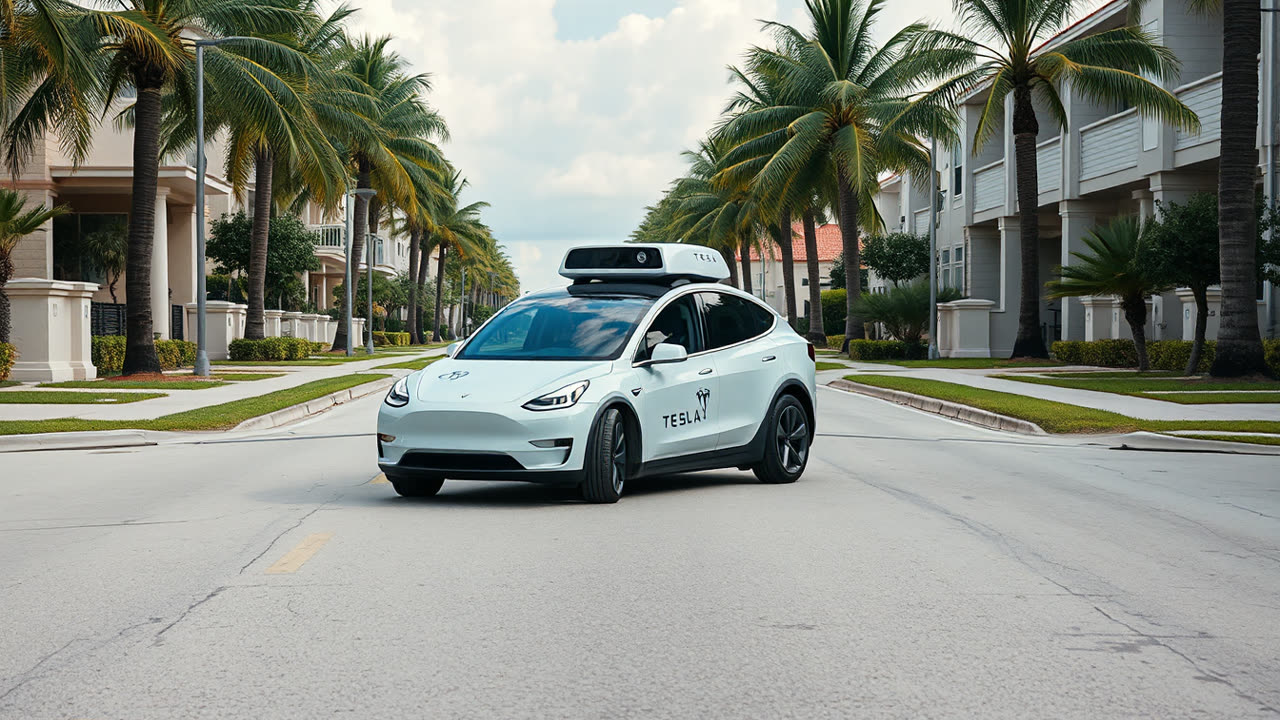
Tesla officially launched its Robotaxi service in Miami on July 3, 2026, within a notably constrained geofenced area, a move that starkly highlights the persistent scaling challenges facing the company's autonomous ambitions. The initial Miami zone, spanning approximately 10 to 14 square miles, focuses on western and central Miami, including routes around Miami International Airport, but conspicuously omits major areas like downtown Miami and Miami Beach. This limited deployment in Florida, the third state for Tesla's Robotaxi network after Texas and California, contrasts sharply with CEO Elon Musk's long-standing projections of widespread autonomous vehicle adoption.
The Miami rollout arrives amidst ongoing difficulties in scaling operations in Texas, where the service debuted in Austin in June 2025. Despite earlier promises of hundreds, if not thousands, of robotaxis, Texas Department of Motor Vehicles data from May 2026 revealed only 42 registered autonomous vehicles across the state for Tesla's service. This figure pales in comparison to competitors like Waymo, which has registered 577 automated vehicles in Texas. Reports indicate Tesla's unsupervised fleet in Austin has been shrinking, not growing, with active vehicles reportedly declining from a peak of around 25 to roughly 14. Users in Austin frequently face long wait times, with cars often unavailable.
Tesla attributes these scaling issues primarily to safety validation, with plans to wait for improvements in its rewritten Full Self-Driving (FSD) v15 software before aggressive expansion. This cautious approach, while understandable given regulatory scrutiny and a reported crash rate worse than human drivers in unsupervised operation, underscores the vast gap between Tesla's ambitious vision of an AI-driven robotics platform and its current operational reality. While Tesla's purpose-built Cybercab is expected later in 2026, the company's track record of missed deadlines and the slow, incremental nature of its Robotaxi expansion suggest that widespread, truly autonomous ride-hailing remains a distant prospect, leaving competitors like Waymo with a significant lead in real-world deployment.