Tesla Semi Enters High-Volume Production, Electrifying Heavy-Duty Trucking
After a decade of anticipation, the Tesla Semi has officially begun high-volume production, marking a critical turning point for electric heavy-duty transport and signaling a significant disruption to the diesel trucking industry with its superior total cost of ownership.
✨ This content was summarized and interpreted by AI; it may contain errors — please verify accuracy with the original sources. Learn more
Listen to this story
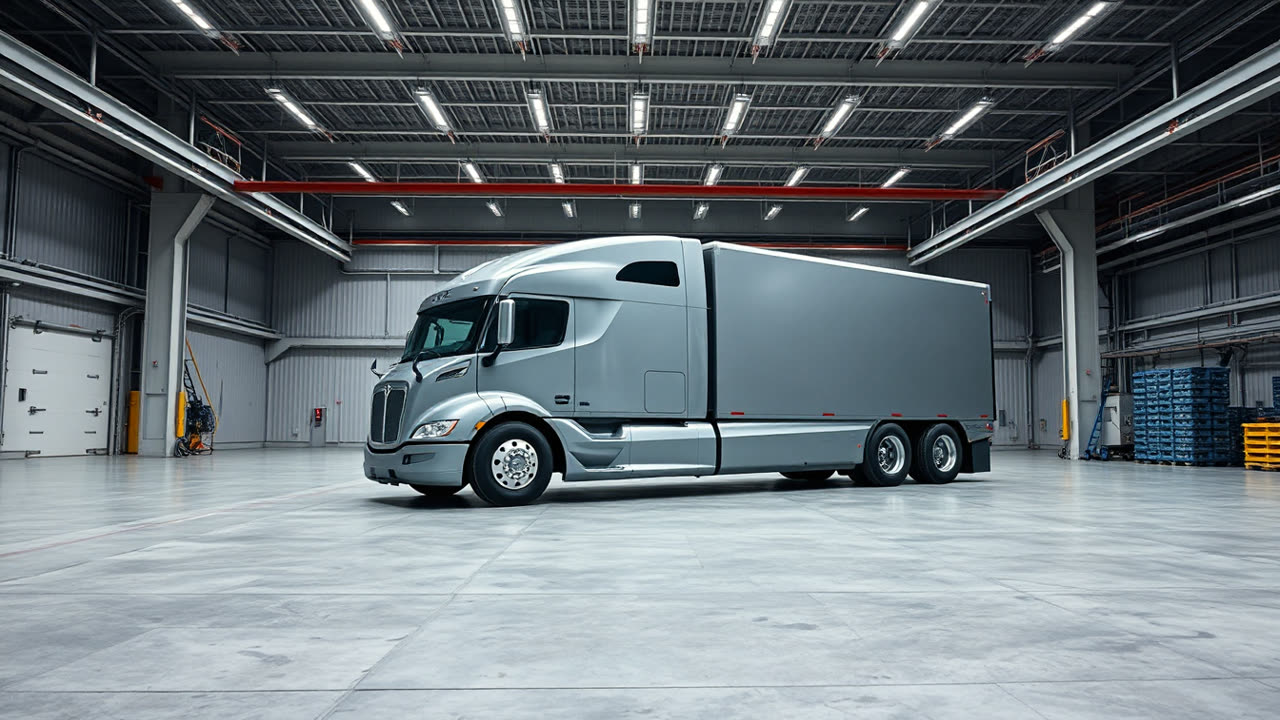
Nearly a decade after its initial concept unveiling, the Tesla Semi has officially commenced high-volume production as of April 2026, marking a pivotal moment for electric heavy-duty trucking. The long-awaited Class 8 truck is now rolling off the assembly line at a dedicated 1.7 million-square-foot facility adjacent to Gigafactory Nevada in Sparks, with Tesla targeting an annual capacity of 50,000 units once fully ramped. This significant manufacturing milestone was formally celebrated with an invite-only "Semi Rollout" event on Thursday evening, September 24, 2026, at the Sparks factory, which included factory tours and ride-alongs in the production vehicle, confirming that customer deliveries are now actively underway.
The commencement of volume production fundamentally shifts the narrative for the Tesla Semi, moving it from a protracted promise to a tangible market contender, poised to disrupt the entrenched diesel trucking industry. For fleet operators, the core appeal lies in the demonstrably superior total cost of ownership (TCO). A Bernstein analysis from Spring 2026 indicated that the Tesla Semi holds a 3% TCO advantage over a comparable Freightliner Cascadia diesel truck in the current fuel environment, a substantial margin in an industry where profit margins typically hover between 2% and 5%. This advantage is primarily driven by drastically lower energy costs; the Semi's fuel cost is estimated at 15-25 cents per mile, compared to 50-70 cents for a diesel equivalent. For a truck logging 200,000 miles annually, this translates to potential fuel savings approaching $72,000 per year. Electrek's May 2026 analysis further projected savings between $147,000 and $404,000 over five to ten years of ownership, heavily influenced by fluctuating electricity and diesel prices, with diesel currently surging above $5.35 per gallon nationally and over $7.50 in California. Beyond fuel, electric drivetrains promise 40-60% lower maintenance costs, potentially saving an additional $8,000-$12,000 annually per truck. Despite an initial sticker price of approximately $290,000 for the 500-mile Long Range version—significantly higher than a $175,000 diesel truck—the breakeven point for fleets able to absorb the upfront cost can be under two years. Crucially, robust incentive programs, such as California's HVIP offering $84,000 to $351,000 per qualifying unit, can reduce the effective out-of-pocket cost to under $200,000, narrowing the gap against diesel to as little as $25,000 before operational savings even begin.
The Tesla Semi arrives with impressive specifications for its 2026 production model. The Long Range variant boasts a 500-mile range at a full 82,000 lbs (37,195 kg) gross combined weight, powered by an 822 kWh battery pack utilizing 4680 cells with NCMA chemistry. A Standard Range model offers 325 miles of range with a 548 kWh battery, appealing to regional haul and drayage operations where shorter, predictable routes are common. Both variants are Class 8 trucks with an 82,000 lbs GCW rating. Charging infrastructure, a historical bottleneck for electric heavy-duty vehicles, is rapidly expanding. Tesla's proprietary Megacharger network, capable of delivering 1.2 MW of power, allows the Long Range Semi to recover approximately 70% of its charge, or 300 miles of range, in just 30 minutes—fast enough to align with federally mandated driver rest breaks. The first public Megacharger opened in Ontario, California, in March 2026, and Tesla is aggressively expanding, with 64 new sites added across 15 states, aiming for a total of 66 planned locations by early 2027. Furthermore, Tesla's "Semi Charging for Business" program enables fleet operators to purchase and install their own Megachargers for around $188,000, fostering a decentralized yet robust charging ecosystem.
Early pilot deployments, notably with PepsiCo since late 2022, have already seen dozens of Semis collectively log over a million miles in daily service, validating real-world efficiency and performance. The market is responding to the Semi's availability; recent significant orders include Einride's commitment for 500 units, with deployments starting this month across key freight corridors, and WattEV's order for 370. Perhaps the most impactful development is the record-breaking order from the Zero-Emission Truck Shipper-Carrier Alliance Leading Electrification (ZET SCALE), which selected Tesla as the primary OEM for up to 2,500 Class 8 electric tractors, with initial deliveries expected in Q4 2026. This colossal order, involving founding shippers like Microsoft and PepsiCo, is poised to nearly double the existing U.S. electric Class 8 fleet and underscores a growing industry confidence in the Semi's capabilities and TCO advantages.
While Tesla currently holds a range advantage over many competitors, with its 500-mile offering surpassing the 600-670 km (373-416 miles) ranges of rivals like Volvo's FH Aero Electric, Windrose R700, and BYD's new ETT 44, the competitive landscape is rapidly evolving. BYD's ETT 44, unveiled in September 2026, promises a 373-mile range and an impressive 1.5 MW charging rate, capable of replenishing 20-80% in just 20 minutes. Other established players like Daimler, PACCAR, Volvo, Kenworth, MAN, and Scania are also advancing their electric truck offerings, signaling a fierce race for market share. However, Tesla's integrated ecosystem, including its Megacharger network and future autonomous driving capabilities, which Morgan Stanley analysts predict could lower costs by 20% per mile, could provide a significant long-term competitive edge.
Looking ahead, Tesla aims to deliver "many thousands" of Semis throughout 2026, with analyst estimates ranging from 5,000 to 15,000 units for the year. The company also plans a European launch by late 2027, expanding its global footprint. The sustained expansion of the Megacharger network, particularly through strategic partnerships like those with Pilot Travel Centers and Forum Mobility, will be critical to support the increasing fleet adoption and address range anxiety for long-haul routes. The long-gestating Tesla Semi is no longer a futuristic concept but a present-day reality, poised to electrify the heavy-duty trucking sector and fundamentally reshape the economics and operational paradigms of freight transport.