The Durabook Z14I-DX3: A Triple-Screen Rugged Workstation Redefines Field Computing
Weighing 9.8 kg, the Durabook Z14I-DX3 introduces an unprecedented triple 14-inch sunlight-readable touchscreen array, setting a new standard for portable computing in extreme environments.
✨ This content was summarized and interpreted by AI; it may contain errors — please verify accuracy with the original sources. Learn more
Listen to this story
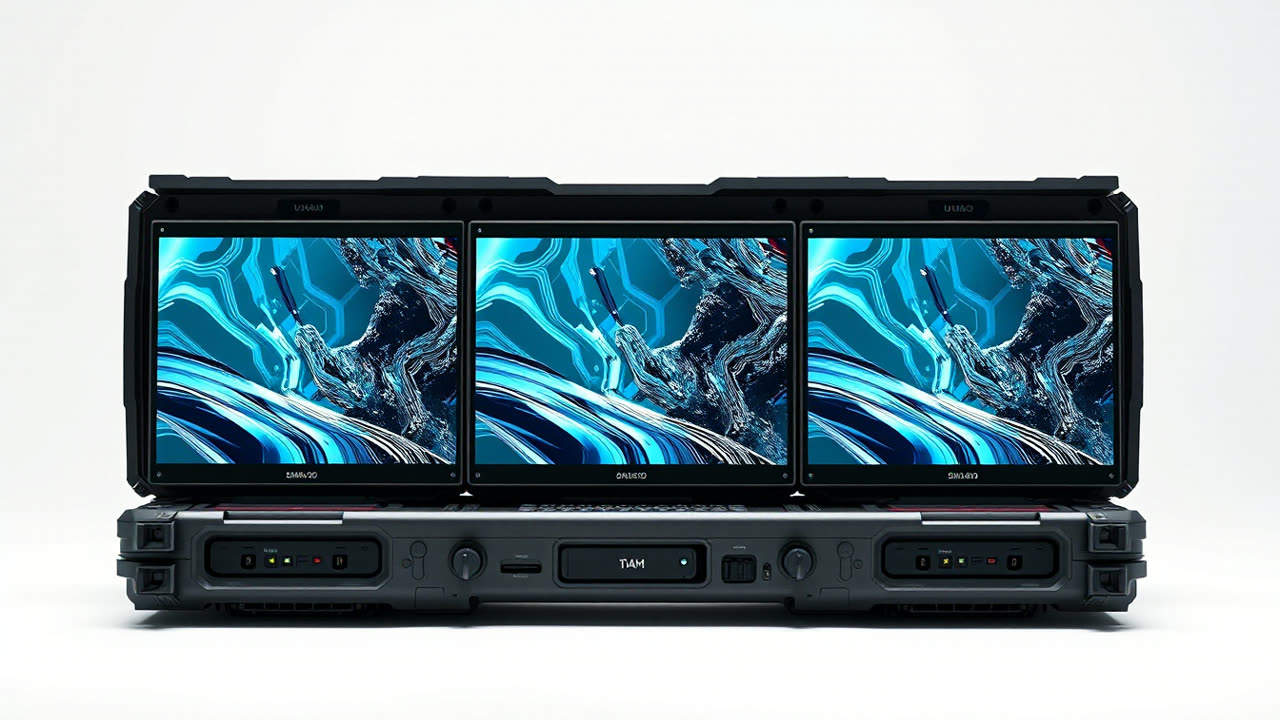
The Durabook Z14I-DX3 rugged mobile workstation, weighing a substantial 9.8 kg, introduces an unprecedented triple 14-inch sunlight-readable touchscreen array, signaling a significant evolution in portable computing for extreme environments. This formidable machine is engineered with an Intel 13th Gen Raptor Lake-HX processor, offering up to a 24-core Intel Core i9-13900HX, and can be configured with NVIDIA's professional-grade RTX 5000 Ada Generation mobile graphics, pushing the boundaries of what a field-deployable system can achieve in terms of processing and graphical power. Its design, which allows two auxiliary screens to fold out from the central display, addresses a long-standing demand for multi-monitor setups in demanding operational contexts, such as military command centers, emergency response vehicles, and complex industrial diagnostics.
The integration of three high-brightness (up to 1200 nits) 14-inch FHD (1920x1080) displays into a single MIL-STD-810H, IP66, and optional ANSI/UL 121201 certified chassis fundamentally alters workflow paradigms for professionals operating outside traditional office settings. For military personnel, this means simultaneous access to tactical maps, drone feeds, and secure communication channels without toggling between applications or relying on cumbersome external monitors. Emergency services can display vital patient data, incident command software, and real-time mapping concurrently, significantly improving situational awareness and decision-making speed. Industrial field engineers can run diagnostics, access schematics, and view sensor data side-by-side, streamlining complex troubleshooting and maintenance tasks. The sheer screen real estate, combined with the ruggedization, mitigates the compromises typically associated with mobile deployments, where single, smaller screens often limit productivity. This paradigm shift isn't merely about convenience; it's about enhancing operational efficiency and safety in mission-critical scenarios where every second and every piece of information counts.
Compared to its predecessor, the single-screen Durabook Z14I, the DX3 variant represents a generational leap, not just an iterative upgrade. While the original Z14I was already a robust 14-inch rugged laptop featuring Intel 11th Gen processors and discrete graphics options, the DX3's distinguishing feature is its triple-display architecture, a capability largely absent in the mainstream rugged market. Main rivals like Panasonic's Toughbook 40 and Getac's X600, while offering exceptional ruggedness and high-performance components, primarily stick to single-screen designs, often with larger 15.6-inch or 16-inch displays. For instance, the Toughbook 40, a 14-inch rugged laptop, focuses on modularity and a powerful 11th Gen Intel Core i7 processor, but does not offer an integrated multi-screen solution. Similarly, the Getac X600, a 15.6-inch rugged mobile workstation, boasts up to Intel 11th Gen Core i9 processors and NVIDIA Quadro RTX 3000 graphics, but again, without the integrated triple-screen setup. The Z14I-DX3's unique selling proposition lies in its ability to deliver a desktop-like multi-monitor experience in a single, highly protected, portable package, differentiating it significantly from competitors that rely on traditional laptop form factors. The inclusion of an NVIDIA RTX 5000 Ada Generation GPU further elevates its capabilities, enabling advanced simulations, AI processing, and complex data visualization directly in the field, tasks previously confined to less portable, non-rugged workstations.
Powering this multi-display behemoth is a hot-swappable battery system, crucial for sustained operations in environments where power outlets are scarce or non-existent, a feature common among premium rugged devices but essential here given the increased power draw from three displays and high-end components. Connectivity is equally robust, with support for Wi-Fi 6E, Bluetooth 5.3, optional 4G LTE/5G, and a comprehensive array of I/O ports including Thunderbolt 4, USB 3.2 Gen 2, HDMI, and optional legacy ports like VGA and RS-232, ensuring compatibility with a wide range of peripherals and legacy systems vital in industrial and military applications. The 9.8 kg weight, while substantial, is a necessary trade-off for the reinforced chassis, advanced cooling, and the expansive screen real estate, positioning it more as a "luggable" workstation than a typical laptop.
Looking ahead, the Durabook Z14I-DX3 sets a new benchmark for integrated multi-screen rugged computing, likely inspiring competitors to explore similar form factors or modular multi-display solutions. The immediate impact will be felt in specialized sectors, where the premium price point (expected to be significantly higher than single-screen rugged laptops, though not yet publicly disclosed) will be justified by enhanced operational effectiveness. This innovation paves the way for increasingly complex data analysis and visualization to be performed directly at the point of need, rather than relying on back-office processing. Future iterations could see even lighter materials, higher resolution displays, or perhaps more flexible multi-screen configurations, but for now, the Z14I-DX3 stands as a testament to the evolving demands and capabilities within the rugged mobile workstation market, pushing the boundaries of what is considered truly portable and powerful in extreme conditions.