The Unseen Power: Why Wattage, Not Just mAh, Defines Laptop Power Bank Utility
A laptop power bank's true utility hinges not merely on its stated capacity in milliampere-hours (mAh), but critically on its ability to deliver sufficient wattage through its output ports.
✨ This content was summarized and interpreted by AI; it may contain errors — please verify accuracy with the original sources. Learn more
Listen to this story
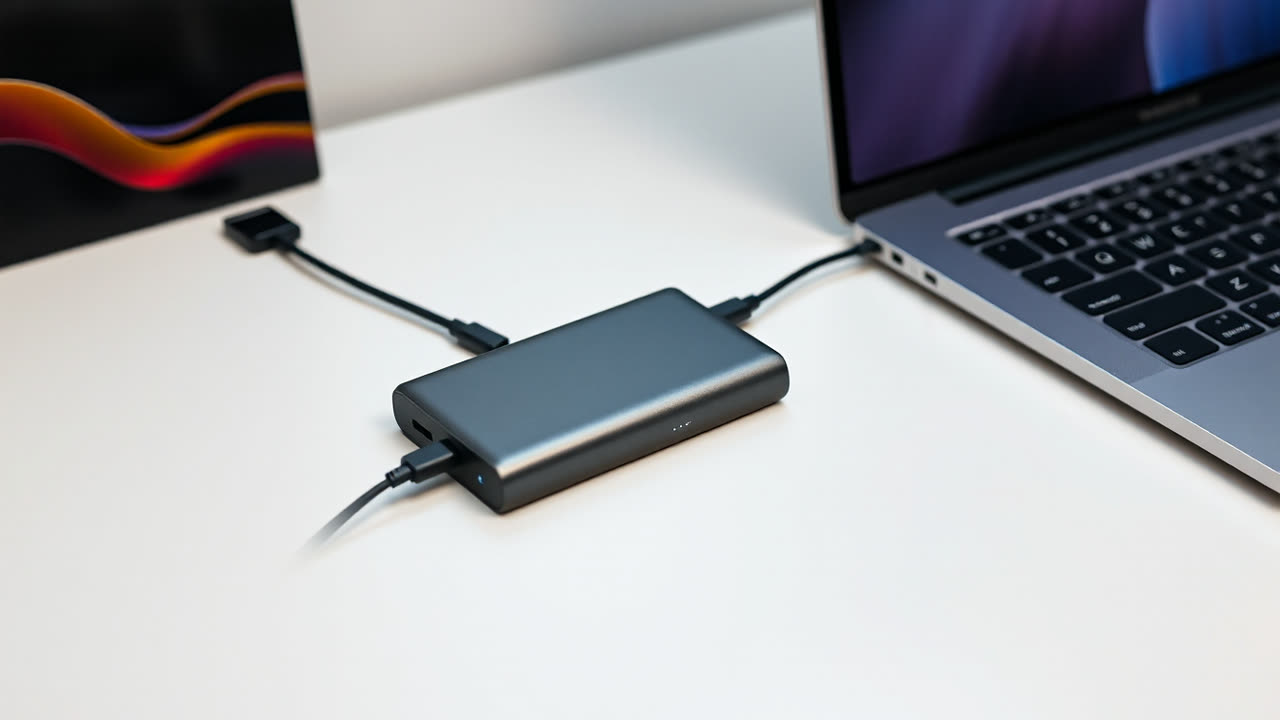
A laptop power bank's true utility hinges not merely on its stated capacity in milliampere-hours (mAh), but critically on its ability to deliver sufficient wattage through its output ports, a factor often overlooked but paramount to preventing a connected laptop from slowly draining its battery despite being "charged." The widespread adoption of USB-C Power Delivery (PD) has revolutionized portable charging, moving beyond the proprietary barrel jacks and low-wattage USB-A ports of the past to enable universal, high-speed power transfer, fundamentally altering how mobile professionals and power users maintain productivity on the go.
The core distinction lies in understanding that a laptop, particularly a modern ultrabook or a mid-range gaming machine, demands a specific minimum wattage to operate under load and simultaneously charge its internal battery. For instance, many ultrabooks, like the Dell XPS 13 or MacBook Air, require at least 30-45W, while more powerful models such as a 14-inch MacBook Pro or a performance Windows laptop often demand 60W, 90W, or even 100W for optimal charging and operation. Gaming laptops, with their dedicated GPUs and high-performance CPUs, can necessitate 100W to 240W, making them particularly challenging to power adequately from standard portable sources. A power bank might boast a hefty 20,000mAh capacity, yet if its USB-C PD output is capped at, say, 18W or 30W, it will, at best, trickle charge a 65W laptop or, at worst, merely slow down the battery drain during intensive tasks. The energy density of a 20,000mAh power bank typically translates to around 74Wh (at 3.7V nominal voltage), which is substantial enough to fully recharge many ultrabooks once, but only if the delivery mechanism is robust enough.
This emphasis on power delivery wattage rather than just raw capacity matters immensely for users and the broader tech industry. For users, it means the difference between genuinely untethered productivity and carrying a bulky "brick" that fails to meet their actual power needs. The frustration of a laptop battery percentage slowly ticking down despite being plugged into a power bank is a common pain point that stems directly from insufficient wattage. For the industry, it has spurred a rapid evolution in portable power solutions. Manufacturers are now competing on higher wattage output, leading to a proliferation of power banks supporting USB-C PD 3.0 and the newer PD 3.1 Extended Power Range (EPR) standard. PD 3.0 typically supports up to 100W, while PD 3.1 EPR pushes this limit to an astounding 240W over a single USB-C cable, a game-changer for even demanding gaming laptops. This technological leap, often facilitated by gallium nitride (GaN) components, allows for smaller, more efficient power banks and wall chargers capable of delivering previously unprecedented power levels in a compact form factor.
Compared to earlier generations, modern high-wattage power banks are a paradigm shift. Just a few years ago, portable chargers were primarily designed for smartphones and tablets, offering maximum outputs of 10W to 18W. Laptop charging on the go often required bulky, proprietary car adapters or specialized, expensive power solutions. The advent of USB-C PD in the mid-2010s, with its reversible connector and negotiation protocols for varying voltages and currents, laid the groundwork for this revolution. Early USB-C PD power banks typically topped out at 45W or 60W, sufficient for many ultrabooks but still falling short for more powerful machines. Today, leading brands like Anker, Zendure, and Baseus offer power banks boasting 100W, 140W, and even 200W USB-C PD outputs, some with multiple high-wattage ports, allowing simultaneous fast charging of a laptop, tablet, and smartphone. This multi-device capability, combined with capacities often exceeding 25,000mAh (92.5Wh) or even 27,000mAh (99.9Wh, just under the airline carry-on limit), positions them as true mobile power hubs.
Looking ahead, the trajectory is clear: higher power, greater efficiency, and more intelligent power management. The continued adoption of USB-C PD 3.1 EPR will see 240W power banks become more commonplace, effectively making almost any laptop truly portable without reliance on a wall outlet. Further integration of GaN technology will continue to shrink the physical size of these powerful devices, making them even more portable. We can anticipate smarter power banks with advanced telemetry, potentially offering detailed real-time power consumption data and optimized charging profiles for connected devices. The push for sustainability might also lead to power banks with more easily replaceable cells or components. Ultimately, the future of portable laptop charging is one where the power bank is not just a backup, but an integral, high-performance component of a truly mobile workstation, capable of meeting the diverse and demanding power needs of the next generation of computing devices.