Thermal Grizzly WireView Adapter Melts 8-Pin PCIe Connectors on AMD RX 7900 XTX, Reigniting Power Delivery Concerns
A Thermal Grizzly WireView adapter connected to an AMD Radeon RX 7900 XTX experienced a thermal failure of three 8-pin PCIe connectors, highlighting persistent power delivery challenges beyond the 12VHPWR standard.
✨ This content was summarized and interpreted by AI; it may contain errors — please verify accuracy with the original sources. Learn more
Listen to this story
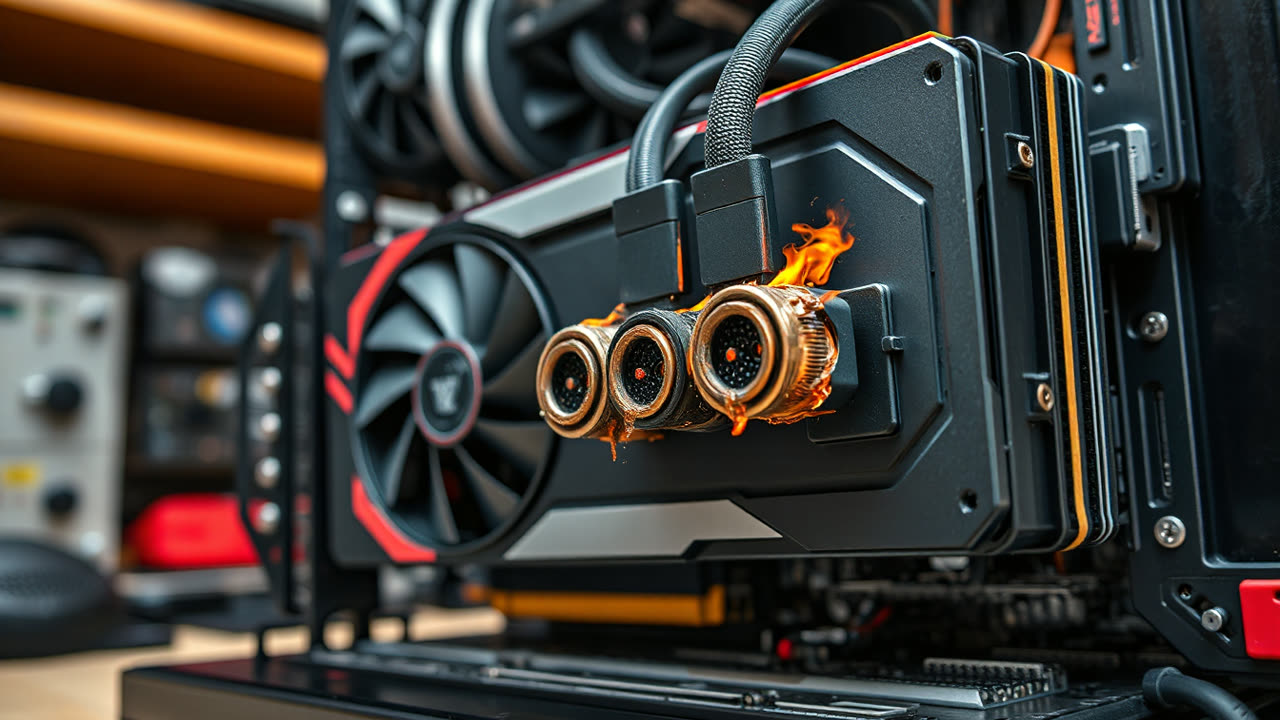
The reported thermal failure of three 8-pin PCIe connectors on a Thermal Grizzly WireView adapter, while connected to an AMD Radeon RX 7900 XTX graphics card, underscores a critical and persistent challenge in high-performance computing: the safe and reliable delivery of ever-increasing power to demanding components. This incident, involving ostensibly robust and widely adopted 8-pin connectors rather than the more recently scrutinized 12VHPWR standard, sends a chilling reminder that even established power solutions are not immune to catastrophic failure under specific, potentially unforeseen, conditions. The fact that Thermal Grizzly, a company renowned for its thermal solutions and quality PC accessories, is investigating the burnout further highlights the complexity of pinpointing definitive causes, which can range from manufacturing defects in the adapter itself to user error in installation, or even subtle design interactions with the GPU's power draw characteristics.
This event holds significant implications for both end-users and the PC hardware industry, extending beyond the initial concern for the individual components involved. For consumers, it erodes confidence in the perceived safety and reliability of their high-value investments. The Radeon RX 7900 XTX, a flagship GPU at its launch, represents a substantial financial outlay, and the potential for an accessory to compromise its integrity, or worse, pose a fire hazard, is deeply unsettling. The incident also casts a shadow on the use of *any* adapters in critical power pathways, regardless of connector type, prompting users to reconsider direct connections where possible. Furthermore, it reinforces the need for vigilance when dealing with high-power draw components, emphasizing correct installation practices and awareness of potential thermal stress, particularly in confined or poorly ventilated cases.
From an industry perspective, the WireView failure adds another layer of complexity to the ongoing debate surrounding GPU power delivery standards. While much of the recent focus has been on the 12VHPWR connector and its subsequent revision (12V-2x6) following numerous melting incidents predominantly with NVIDIA's RTX 40-series cards, this 8-pin event demonstrates that the issue isn't solely confined to newer, higher-density connectors. The Radeon RX 7900 XTX itself utilizes two 8-pin power connectors, capable of delivering up to 300W (150W per connector) in addition to the 75W from the PCIe slot, for a theoretical maximum of 375W. Some custom AIB models might employ three 8-pin connectors to provide even more headroom, pushing the theoretical limit to 450W plus 75W from the slot. The Thermal Grizzly WireView adapter, designed to provide real-time power consumption monitoring, introduces an additional physical interface and potential points of failure, especially if the internal wiring or contact points are not perfectly aligned or rated for sustained peak loads. This incident could prompt more stringent testing and certification for third-party accessories that sit in the critical power path.
Historically, the 8-pin PCIe connector has been a workhorse, serving multiple generations of high-performance graphics cards with relative reliability. Its design, derived from the EPS12V standard, was considered robust for its intended power rating. However, as GPU power envelopes have steadily climbed, even these "proven" connectors are being pushed to their limits, particularly when combined with adapters or used in configurations that introduce additional resistance or stress. The Radeon RX 7900 XTX, with a typical board power of around 355W, operates at the upper end of what two 8-pin connectors can comfortably sustain, especially during transient power spikes that can momentarily exceed average draw. Rival cards, particularly NVIDIA's higher-end RTX 40-series, have embraced the 12VHPWR (or 12V-2x6) standard precisely to address the increasing power demands with fewer, more compact connectors. While 12VHPWR has had its own well-documented challenges, its underlying intent was to provide a more robust and future-proof power delivery solution for GPUs consuming 450W and beyond. The WireView incident with 8-pin connectors suggests that simply reverting to older standards isn't a panacea and that the underlying issues of material quality, connection integrity, and thermal management are universal across connector types.
Looking ahead, this specific incident with an 8-pin adapter will likely intensify scrutiny on all components within the power delivery chain, not just the GPU and PSU. It could accelerate the industry's move towards more standardized and robust internal power monitoring solutions, potentially integrated directly into GPUs or power supplies, reducing the reliance on external adapters that add complexity and potential failure points. Furthermore, the PCI-SIG, the body responsible for PCIe standards, may consider refining specifications for auxiliary power connectors, perhaps introducing stricter guidelines for material quality, contact plating, and thermal tolerances, even for existing designs like the 8-pin. Manufacturers of both GPUs and accessories will face increased pressure to provide clearer warnings and guidance regarding power requirements, compatible accessories, and the risks associated with improper installation or the use of sub-standard components. Ultimately, the industry must continue to innovate in power delivery, ensuring that as GPUs become more powerful, their energy needs are met not just efficiently, but above all, safely, a challenge that clearly remains front and center.