Toyota's Electric Truck Survives 1,675-Pound Caravan Drop, Redefining EV Durability
Toyota's new electric pickup truck, reportedly the 'Hilux Revo BEV,' demonstrated extreme resilience by driving away unfazed after a 1,675-pound caravan was dropped directly onto it, challenging perceptions of EV toughness.
✨ This content was summarized and interpreted by AI; it may contain errors — please verify accuracy with the original sources. Learn more
Listen to this story
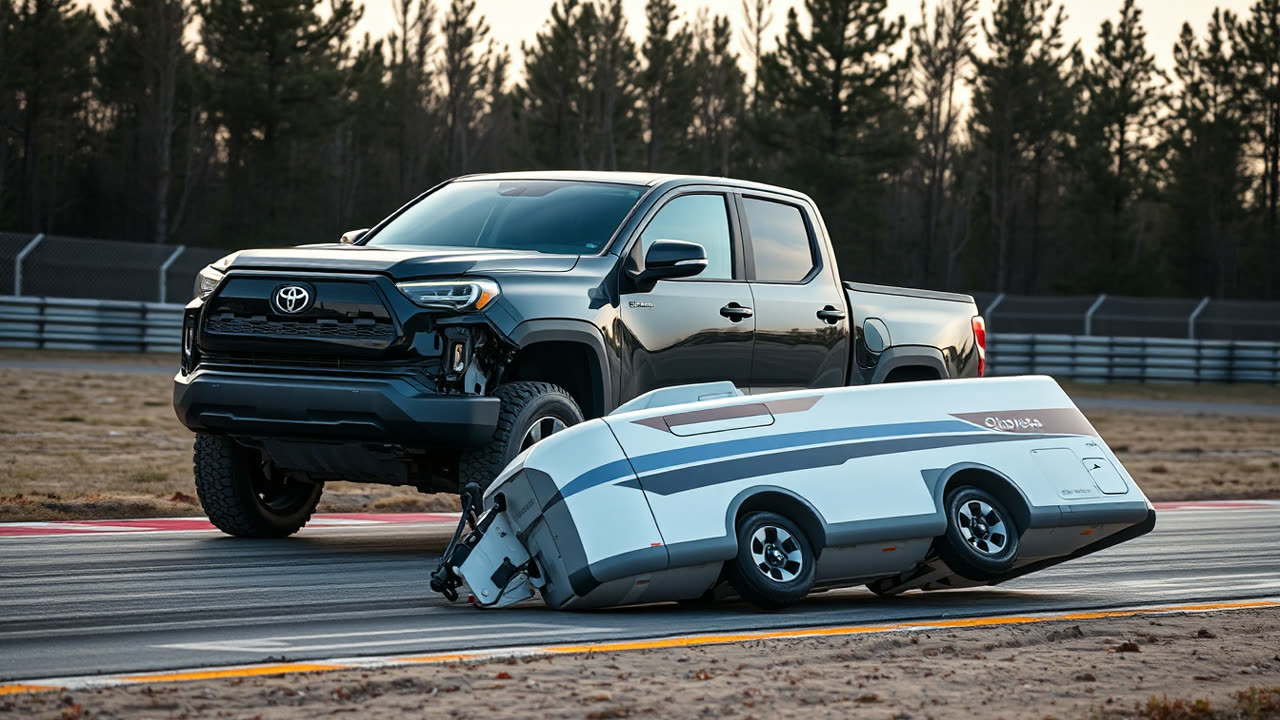
Toyota's latest electric pickup truck, yet to be officially named for global markets but reportedly referred to internally as the "Hilux Revo BEV" or a similar moniker, withstood the direct impact of a 1,675-pound caravan dropped from an unspecified height, driving away seemingly unfazed in a recent demonstration video. This dramatic display, intended to underscore Toyota's claim of producing "the world’s toughest pick-up," marks a significant strategic pivot for the Japanese automaker, traditionally cautious in its full-electric vehicle rollout. The stunt, widely circulated online, immediately positions Toyota's new EV truck as a formidable contender in the rapidly expanding and increasingly competitive electric truck segment, directly challenging perceptions of EV durability and reinforcing the brand's long-standing reputation for robust engineering.
The sheer audacity of the test and the truck's apparent resilience address a critical, often unspoken, concern among potential electric truck buyers: the perceived fragility or unproven durability of battery-electric platforms compared to their long-established internal combustion engine (ICE) predecessors. While EVs offer instant torque and quieter operation, the integration of heavy battery packs and complex electrical systems has led some consumers to question their ability to withstand the extreme conditions and heavy-duty work for which pickups are renowned. By subjecting its new EV truck to such a brutal, visually compelling impact, Toyota directly confronts this skepticism, aiming to instill confidence not just in its specific model but potentially in the broader category of electric work vehicles. For users, this translates into a promise of reliability and longevity, particularly for those in construction, agriculture, or utility sectors where vehicle downtime can be catastrophic. The demonstration suggests that Toyota is not just building an electric truck, but an electric *Toyota* truck, leveraging decades of trust built on models like the Hilux and Tacoma.
This move is particularly impactful when contrasted with the approaches of key rivals. Ford's F-150 Lightning, while a commercial success, has focused its marketing on utility, smart features, and Pro Power Onboard capabilities, rather than extreme crash resilience beyond regulatory requirements. Similarly, Rivian's R1T has carved out a niche as an adventure vehicle, emphasizing performance and off-road prowess. General Motors’ Silverado EV and GMC Sierra EV are still entering the market with promises of range and towing, but without such a dramatic, public durability spectacle. Tesla's Cybertruck, with its stainless-steel exoskeleton, has certainly championed durability and unconventional design, undergoing its own "bulletproof" and sledgehammer demonstrations. However, the Cybertruck's radical aesthetic and production challenges have also drawn scrutiny. Toyota's caravan drop, by contrast, is a more traditional, almost visceral, demonstration of structural integrity, appealing to a different segment of the truck market that values proven, understated toughness over futuristic flair. It also echoes the legendary durability tests performed on past Toyota pickups, creating a powerful lineage between its ICE heritage and its electric future.
The timing of this demonstration is crucial, coming as the electric truck market matures and consumer choices proliferate. Toyota, having been perceived by some as slow to fully embrace battery electric vehicles, is now signaling its intent to be a dominant force, not merely a participant. This explicit focus on durability could be a potent differentiator in an increasingly crowded field, especially in markets where trucks are tools, not just toys. It also sets a new benchmark for competitors, who may now feel compelled to showcase similar levels of robustness or risk being perceived as less capable. The underlying engineering required to absorb such an impact without compromising structural integrity or critical EV components like the battery pack and electric motors is substantial, suggesting advanced chassis design, potentially integrated body-on-frame or a highly reinforced unibody structure, and sophisticated crumple zones or energy absorption systems.
Looking ahead, this caravan drop is likely just the first salvo in Toyota's aggressive marketing campaign for its new electric truck. We can anticipate further demonstrations highlighting towing capacity, payload, range under extreme conditions, and perhaps even innovative battery protection features. Toyota will need to translate this initial shock-and-awe into tangible sales, which will depend on competitive pricing, widespread availability, and a robust charging infrastructure strategy. The success of this truck will also be a litmus test for Toyota's broader EV strategy, demonstrating whether its cautious, deliberate approach, prioritizing durability and reliability, can effectively compete with rivals who have prioritized rapid deployment and cutting-edge technology. Ultimately, the unfazed departure of that electric truck after absorbing a 1,675-pound blow sends a clear message: Toyota is here to prove that its electric future will be as tough as its storied past.