Toyota's Historic China Pivot: Next-Gen Lexus EV to Debut from Shanghai
Toyota breaks decades of tradition, choosing China as the launchpad for its next-generation Lexus electric SUV, signaling a profound shift in global automotive innovation.
✨ This content was summarized and interpreted by AI; it may contain errors — please verify accuracy with the original sources. Learn more
Listen to this story
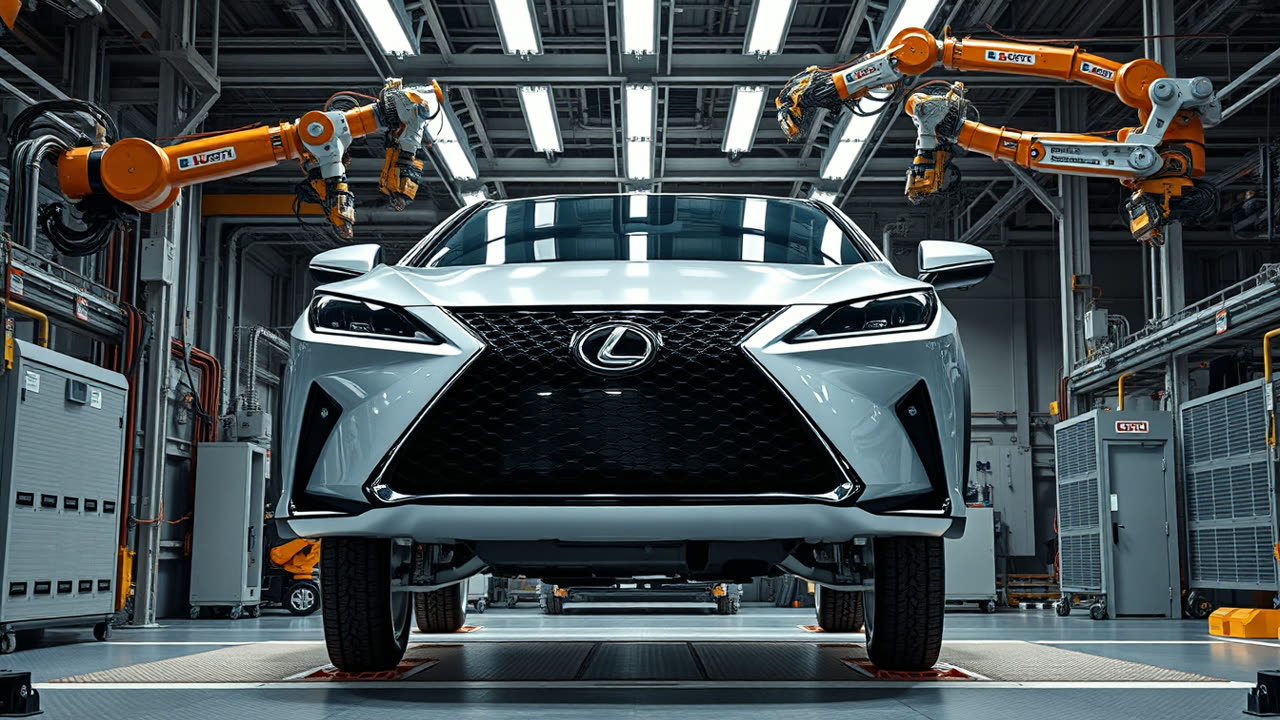
Toyota, a company synonymous with manufacturing prowess and a staunch defender of its Japan-first development philosophy, is now set to launch its next-generation electric vehicle (EV) from China, marking a profound strategic pivot that underscores the shifting epicentre of global automotive innovation. This unprecedented move will see a new Lexus-branded electric SUV begin production in autumn 2027 at a dedicated, wholly foreign-owned factory in Shanghai's Jinshan District, a facility that stands as only the second of its kind in China, following Tesla's Gigafactory. Initial monthly output is slated for 1,000 units, rapidly scaling to tens of thousands annually by 2028.
This decision shatters decades of Toyota's ingrained practice, which traditionally dictated that advanced, strategic models like the Prius hybrid and Mirai hydrogen fuel-cell vehicle would debut in Japan. The forthcoming Lexus EV will incorporate advanced manufacturing techniques, notably gigacasting, a Tesla-pioneered method that molds large sections of the vehicle body as a single piece. This technique is projected to reduce body weight by up to 20%, accelerate production timelines, enhance structural rigidity, and potentially extend driving range by several percentage points. Furthermore, Toyota plans to source over 95% of the components—including batteries, motors, and software—from local Chinese supply chains, dramatically boosting development speed and cutting costs.
This strategic reorientation is not merely an operational adjustment; it signifies Toyota's capitulation to the undeniable gravitational pull of China’s EV market and its advanced manufacturing ecosystem. Analysts widely interpret this as a clear indicator that the global EV competition's core has decisively migrated to China. For Toyota, a company that has historically lagged in the pure EV race, this move is a pragmatic and aggressive attempt to regain lost ground and market share in the world's largest and most dynamic EV market. The Japanese brand's collective market share in China has plummeted from approximately 25% in 2020 to around 13% today. Toyota's overall sales in China have been in decline, experiencing a 24.3% drop in July, marking the sixth consecutive monthly decrease, and a 22% decline in the first four months of the year compared to 2023. Despite global electrified vehicle sales rising 15% in July, with EV sales surging 2.1-fold, China alone accounted for a substantial 44% of Toyota's global battery electric vehicle (BEV) sales in early 2026.
The imperative for speed and cost-efficiency is paramount in China, where domestic EV startups routinely develop new models in roughly two years, a stark contrast to the traditional 4-5 year cycles of legacy automakers. By adopting gigacasting, a technology Toyota has been developing since 2023, and leveraging China's robust supply chain, the company aims to match the agility of its Chinese rivals. This localization extends beyond manufacturing to research and development; Toyota has implemented a "ONE R&D" strategy in China, empowering Chinese engineers through a "Regional Chief Engineer (RCE)" system to lead the entire R&D process for both global and jointly developed models. This profound integration reflects China's emergence not just as a consumer market, but as a critical hub for advanced automotive R&D and production, where global players like Volkswagen and Audi are already collaborating with local firms on EV development.
Toyota's prior generation EV strategy, characterized by a "multi-pathway" approach emphasizing hybrids and hydrogen fuel-cell vehicles, has proven insufficient in the face of China's rapid BEV adoption. While this multi-pathway strategy remains for other markets, China's market dynamics demand a dedicated BEV offensive. The company's initial mass-produced EV, the bZ4X, was built on an adapted internal combustion engine (ICE) platform, drawing criticism for its tardiness. However, Toyota has since introduced more competitive models like the bZ3X SUV in China, which garnered over 10,000 pre-orders within its first hour of launch due to aggressive pricing. The company has also announced plans to roll out an iron phosphate lithium battery in 2026-2027, aiming to reduce the bZ4X's production cost by 40%. These efforts, combined with a global target of 10 new BEV models and 1.5 million annual BEV sales by 2026, demonstrate Toyota's accelerating, albeit late, commitment to electrification.
Looking ahead, this move signals a future where Chinese-developed EV technology, even under foreign badges, will increasingly be exported globally. The manufacturing techniques and platforms validated in Shanghai for this Lexus EV are highly likely to underpin future global Lexus EVs. This deeper integration into China's R&D ecosystem could see more China-driven innovations flowing into Toyota's worldwide portfolio. While this strategy offers a pathway for Toyota to regain competitiveness in the crucial Chinese market, it also intensifies the global premium EV segment competition, currently dominated by local giants like BYD—which leads globally with its vertically integrated model and strong cost control—and Tesla. The challenge for Toyota remains significant: despite this aggressive shift, the company must overcome persistent sales declines in its traditional gasoline and hybrid segments within China, navigate fierce price wars, and rapidly innovate to truly contend with the indigenous EV powerhouses that have already captured the lion's share of the market, which accounted for 60% of global EV sales in 2025 and is projected to reach 11.41 million units by 2030.