TrashBench Experiment: 11 Fans, 30°C Drop, Less Than 5 FPS Gain
An extreme experiment strapping 11 fans and a 360mm liquid cooler to an NVIDIA RTX 3080 achieved a 30°C temperature drop but delivered a negligible performance uplift of less than 5 FPS, challenging common enthusiast beliefs about cooling benefits.
✨ This content was summarized and interpreted by AI; it may contain errors — please verify accuracy with the original sources. Learn more
Listen to this story
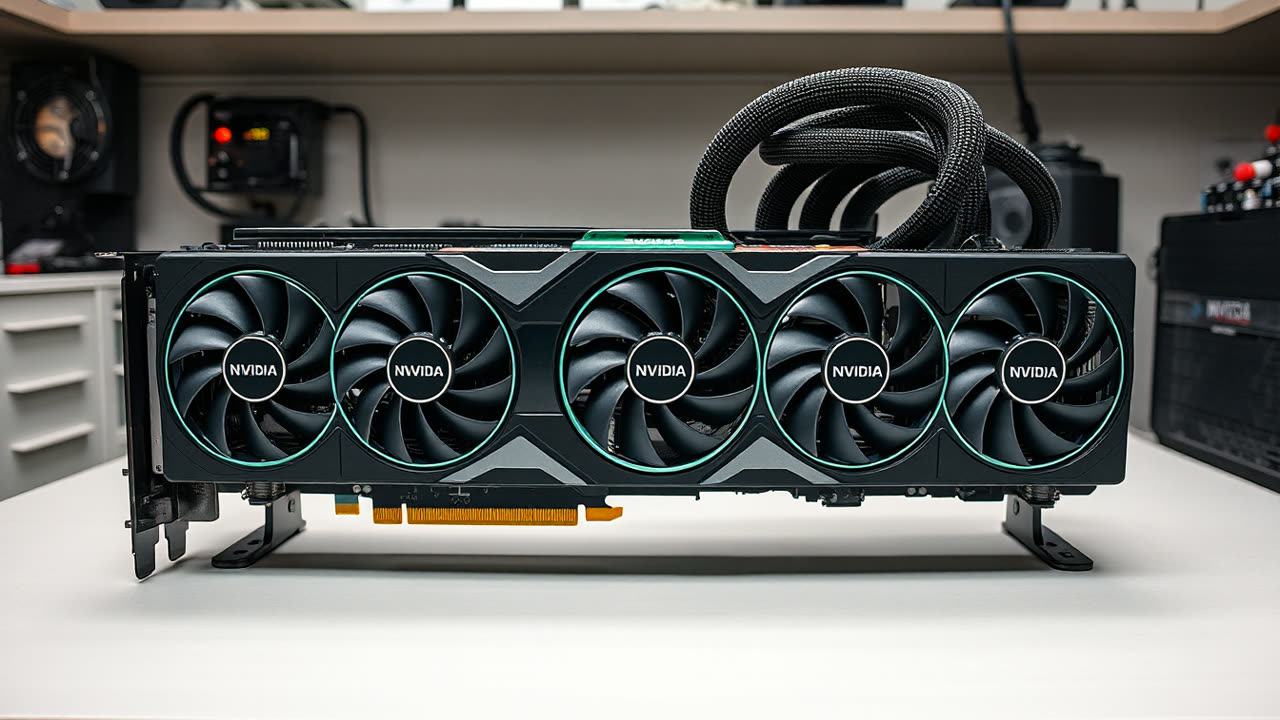
The recent TrashBench experiment, which saw an NVIDIA GeForce RTX 3080 strapped with an unprecedented 11 fans and a 360mm all-in-one (AIO) liquid cooler, yielded a staggering 30°C reduction in GPU core temperature, yet delivered a negligible performance uplift of less than 5 frames per second (FPS) amidst "turbojet noise levels." This extreme modification vividly illustrates the diminishing returns of brute-force cooling once a GPU's thermal throttling limits are sufficiently addressed, fundamentally challenging the common enthusiast perception that lower temperatures invariably translate to significant performance gains.
The core news reveals a critical insight into modern GPU architecture: simply plummeting the core temperature beyond a certain point does not unlock substantial additional clock speed or performance. The RTX 3080, like contemporary high-performance GPUs, employs sophisticated boosting algorithms, primarily NVIDIA's GPU Boost, which dynamically adjusts clock speeds based on a multitude of factors including power limits, voltage, and temperature. While cooling is crucial to prevent thermal throttling and maintain boost clocks, reaching an optimal operating temperature allows the GPU to sustain its maximum achievable boost within its power and voltage envelopes. TrashBench's test likely pushed the GPU far past this "sweet spot," demonstrating that other factors, chiefly power delivery and silicon quality (the "silicon lottery"), become the primary bottlenecks to performance scaling. The stock RTX 3080 typically operates with a TGP (Total Graphics Power) of 320W, and while custom AIB cards might push this slightly higher, the fundamental power limits remain a significant governor on clock speed regardless of how cold the chip runs. For instance, a typical air-cooled RTX 3080 might hit temperatures in the 65-75°C range under load, while a custom liquid loop could bring this down to 45-55°C, usually resulting in a modest clock speed bump and better stability; the TrashBench experiment drove temperatures into the low 30s°C, a realm rarely seen outside of extreme sub-ambient cooling.
This experiment matters profoundly for both users and the industry. For PC enthusiasts and gamers, it serves as a pragmatic reality check. Many invest heavily in elaborate and expensive cooling solutions, from high-end air coolers to intricate custom liquid loops, often with the expectation of significant FPS boosts. The TrashBench results suggest that while adequate cooling is vital for stability, longevity, and to prevent performance degradation from throttling, over-engineering cooling beyond a certain threshold offers little tangible gaming benefit relative to its cost, complexity, and noise output. The "turbojet noise levels" associated with 11 fans underscore the impracticality for daily use, highlighting that the pursuit of ultra-low temperatures can quickly become an exercise in futility for real-world scenarios. Industry-wide, this highlights the sophisticated thermal design already present in modern GPUs. Manufacturers like NVIDIA and AMD invest heavily in optimizing cooler designs, balancing performance, noise, and cost. While their stock coolers may not achieve sub-40°C temperatures, they are engineered to keep the GPU within its optimal operating range where performance is largely maximized without excessive noise or bulk. This experiment indirectly validates their approach, suggesting that further drastic improvements in raw cooling capacity on future generations might yield diminishing returns unless accompanied by breakthroughs in power efficiency or silicon power limits.
Comparing this extreme setup to previous generations or rivals reveals a consistent trend: GPUs have become increasingly power-hungry and thermally dense, yet their performance scaling with temperature plateaus. An older GPU like the GTX 1080 Ti also benefited from better cooling, but the gains were similarly capped by power limits. Current-generation high-end GPUs, such as the RTX 4090 or AMD's RX 7900 XTX, feature even more robust cooling solutions, including larger heatsinks, more efficient fans, and often vapor chambers, designed to manage higher TDPs efficiently. Custom liquid cooling for these newer cards still offers benefits in terms of noise reduction and sustained boost clocks, but the TrashBench experiment indicates that even these sophisticated solutions are hitting a ceiling where raw temperature reduction no longer translates linearly to FPS. The focus has shifted from simply "being cooler" to "being cooler *enough*" to prevent throttling and allow the GPU to hit its specified power targets.
Looking ahead, the implications of this experiment are clear. Future GPU innovation will likely lean more towards increased power efficiency and architectural improvements rather than solely relying on ever-larger or more complex cooling arrays. While direct-die cooling and advanced liquid metal interfaces might offer marginal improvements by reducing thermal resistance at the chip level, the fundamental power limits imposed by silicon design and manufacturing processes will remain the primary barrier to extreme performance scaling. Manufacturers might explore more integrated, compact, and efficient cooling solutions that maintain optimal temperatures without the need for an external fan orchestra. For enthusiasts, the takeaway is to prioritize cooling that is *sufficient* to prevent throttling and maintain stable boost clocks within acceptable noise levels, rather than chasing absolute lowest temperatures. The pursuit of single-digit temperature improvements through extreme measures, as TrashBench demonstrated, is unlikely to translate into a meaningfully superior gaming experience. Instead, innovation in areas like voltage optimization, more efficient silicon, and potentially dynamic power allocation will be the true drivers of the next generation's performance leaps.