U.S. and UK Navies Achieve Historic First: Autonomous Submarine Launches Heavyweight Torpedo
The U.S. Navy and Royal Navy successfully launched a 3,700-pound Mk 48 heavyweight torpedo from Britain’s uncrewed XV Excalibur submarine, marking a pivotal shift in naval warfare doctrine and capabilities.
✨ This content was summarized and interpreted by AI; it may contain errors — please verify accuracy with the original sources. Learn more
Listen to this story
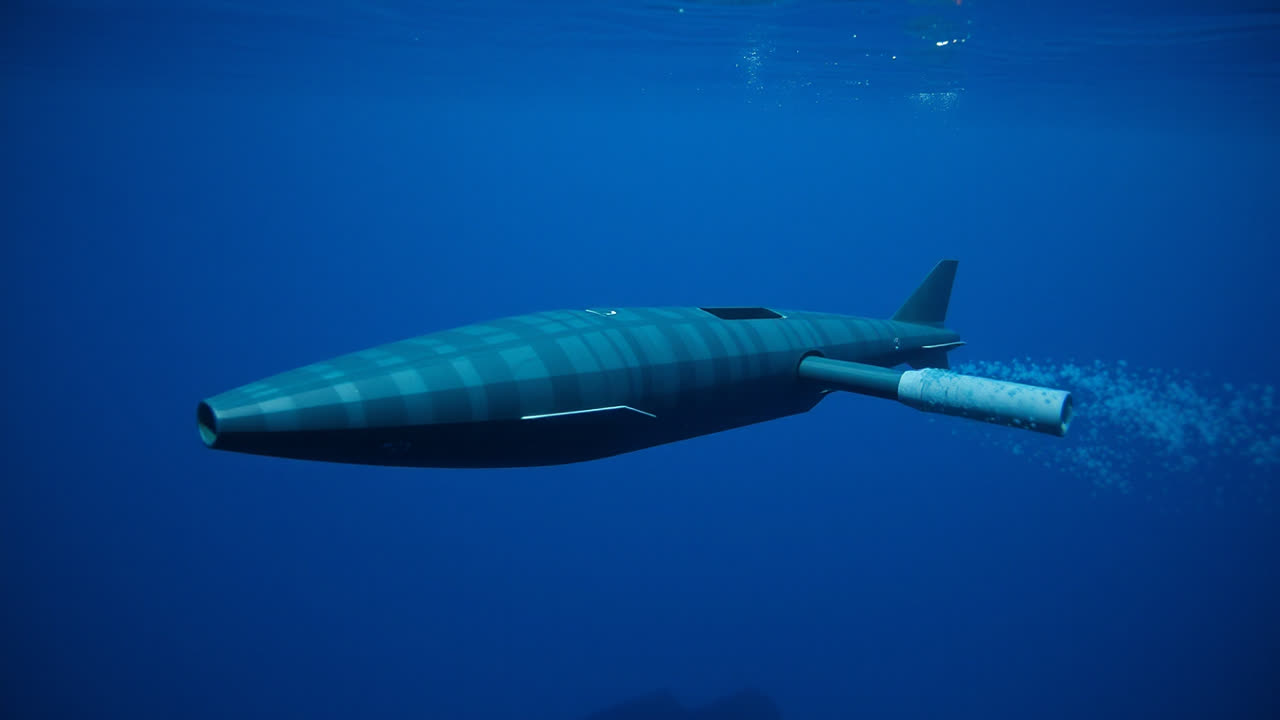
The U.S. Navy and Royal Navy have achieved a historic first, successfully launching a 3,700-pound Mk 48 heavyweight torpedo from Britain’s uncrewed XV Excalibur submarine, an autonomous underwater vehicle (AUV), marking a pivotal shift in naval warfare doctrine and capabilities. This landmark test, conducted as part of Project Broadsword, demonstrated the ability to integrate formidable offensive weaponry with unmanned platforms, proving weapon interchangeability in just seven months. The Mk 48 Mod 7 Advanced Technology (AT) torpedo, a wire-guided weapon designed to sink high-performance submarines and surface ships, represents the pinnacle of conventional underwater ordnance, making its successful deployment from an AUV a significant leap forward in military robotics and maritime defense.
This development carries profound implications for global naval strategy, fundamentally altering the risk-reward calculus of underwater combat. By enabling AUVs like the XV Excalibur, which is a variant of the Manta AUV, to deploy a weapon of the Mk 48's caliber, navies can project power and conduct anti-submarine warfare (ASW) missions in contested environments without exposing human crews to direct threat. This significantly reduces the human cost of conflict, allowing for persistent presence in high-risk zones, such as choke points or enemy littoral waters, where manned submarines would face unacceptable dangers. The ability to deploy such a potent weapon from an autonomous platform also offers a substantial cost-efficiency advantage over traditional manned submarines, which are exponentially more expensive to build, operate, and maintain, while also being constrained by human endurance.
The strategic value of this achievement extends beyond risk reduction and cost-effectiveness. It introduces a new layer of stealth and deception into naval operations. AUVs can operate independently or as part of a networked force, acting as forward scouts, decoys, or distributed weapon platforms, complicating an adversary's detection and targeting efforts. The XV Excalibur, designed for extended endurance and stealth, exemplifies this paradigm shift, offering a persistent, covert presence for intelligence gathering, surveillance, reconnaissance (ISR), and now, direct offensive action. This distributed lethality model, where multiple smaller, less detectable AUVs can saturate an area with torpedoes, poses a far greater challenge to an enemy than a single manned submarine.
Historically, torpedo launches have been the exclusive domain of manned submarines and surface vessels, requiring complex human-controlled fire control systems. The integration of the Mk 48 into an AUV demonstrates a maturity in autonomous systems technology, particularly in navigation, target acquisition, and weapon release protocols. While specific details on the target acquisition and engagement sequence for this test remain classified, the successful launch implies robust command and control capabilities, whether fully autonomous or under remote human supervision. This marks a significant departure from previous AUV deployments, which primarily focused on ISR, mine countermeasures, or logistical support.
Compared to rival nations, the U.S. and UK appear to be at the forefront of integrating heavyweight offensive weaponry onto truly autonomous underwater platforms. While countries like China and Russia are actively developing their own AUV programs, including large displacement UUVs (LDUUVs) and even nuclear-capable autonomous torpedoes like Russia's Poseidon, the public demonstration of a successful, conventional heavyweight torpedo launch from an uncrewed submarine by a Western power sets a clear benchmark. China's HSU-001 AUV, for instance, has been observed for ISR roles, and Russia's Harpsichord-2R is also primarily for deep-sea reconnaissance. The integration of a versatile, combat-proven weapon like the Mk 48 onto a modular AUV platform like the XV Excalibur represents a more immediate and adaptable tactical advantage compared to some of the more specialized or conceptual rival systems.
Looking ahead, this successful test is merely the beginning of a transformative era in naval warfare. The immediate next steps will likely involve further refinement of the autonomous targeting and engagement systems, exploring multi-AUV coordinated attacks, and integrating these capabilities into broader naval exercises and doctrines. The modular nature of the XV Excalibur and the Mk 48 torpedo suggests that other weapon systems could be adapted for autonomous launch, potentially including anti-ship missiles or advanced mine warfare payloads. We can anticipate a surge in investment and development in AUV technologies, focusing on enhanced endurance, deeper operational depths, improved AI for decision-making, and robust cyber-resilience to counter sophisticated electronic warfare threats. The long-term outlook points towards a future where autonomous underwater fleets, operating alongside or independently of manned platforms, will form the backbone of naval power, fundamentally reshaping maritime security and strategic competition across the globe.