Uber Launches London's First Commercial Robotaxi Service, Outpacing Waymo
Uber has officially launched London's first commercial robotaxi service through a partnership with Wayve, featuring Ford Mustang Mach-E vehicles with AI Driver technology and human safety operators, marking a significant milestone for the city's autonomous mobility landscape.
✨ This content was summarized and interpreted by AI; it may contain errors — please verify accuracy with the original sources. Learn more
Listen to this story
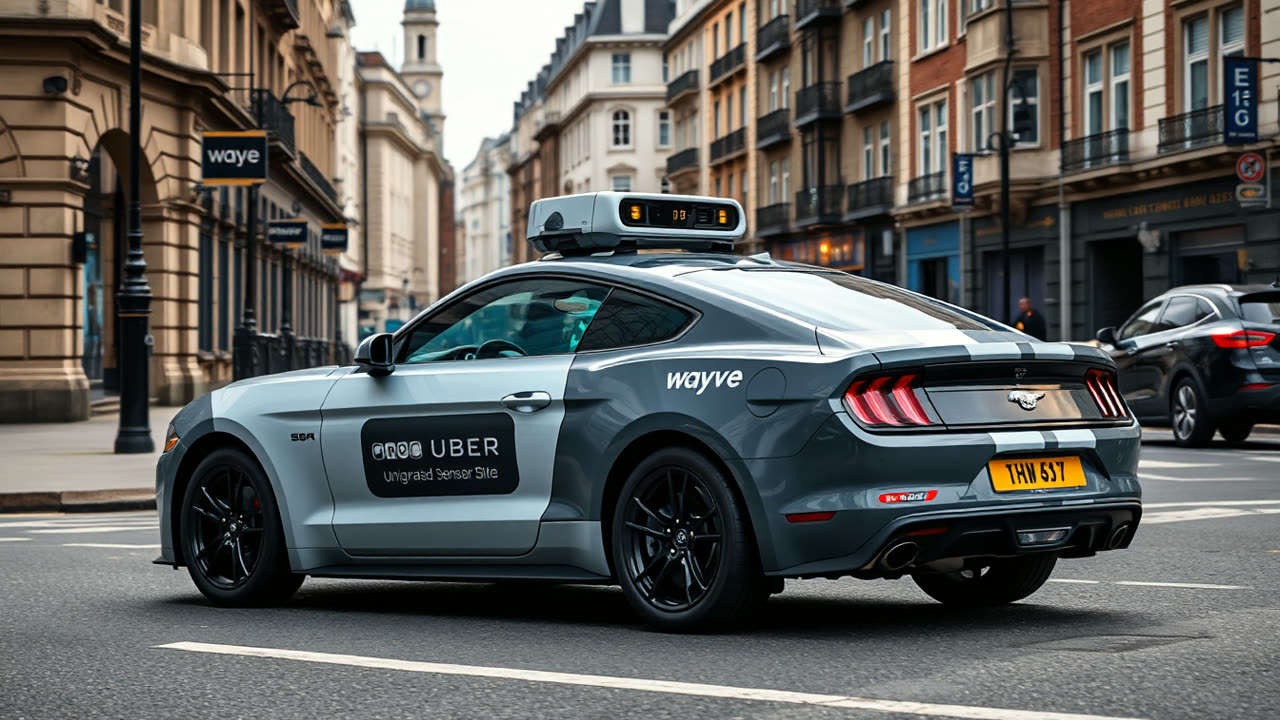
Uber has officially launched London's first commercial robotaxi service, beating out rival Waymo to introduce autonomous vehicles to the city's notoriously complex streets on September 2, 2026. This landmark deployment, facilitated through a strategic partnership with UK-based autonomous driving startup Wayve, initially features Ford Mustang Mach-E vehicles equipped with Wayve's AI Driver technology, though a human safety operator will remain behind the wheel for the foreseeable future. The move marks a significant milestone for both companies and for London, positioning the city as a crucial battleground in the global robotaxi race.
This launch is more than just a new transportation option; it represents a critical validation of Wayve's innovative "embodied AI" approach and a substantial strategic win for Uber's platform-centric vision for autonomous mobility. Unlike traditional autonomous systems that rely heavily on pre-built high-definition maps and extensive sensor arrays, Wayve's technology utilizes end-to-end deep learning, allowing its AI Driver to learn from real-world environments and adapt to unexpected scenarios without prior mapping or explicit training exposure. This approach promises greater scalability and adaptability, potentially accelerating deployment in diverse urban landscapes like London, known for its intricate road network, diverse traffic, and unpredictable human behavior. For users, while the initial service will be limited in scope and still includes a safety driver, it offers a tangible glimpse into a future of enhanced mobility, particularly for those who cannot drive themselves. For the industry, it intensifies the competition and provides a real-world test case for Wayve's differentiated technological strategy.
The London launch underscores Uber's aggressive pivot towards an autonomous future, having committed over $10 billion to autonomous vehicle partnerships and aiming to integrate Wayve-powered robotaxis into more than 10 global markets. This strategy sees Uber acting as a mobility platform rather than a vehicle manufacturer, leveraging external expertise to scale its autonomous offerings. The company recently expanded its robotaxi service to Zagreb, making London its second European foray, demonstrating a clear intent to lead in the autonomous ride-hailing sector. This contrasts sharply with its earlier, more capital-intensive efforts to develop its own self-driving technology, which it eventually divested. Uber's decision to partner with Wayve, an investment it backed with additional milestone-based capital during Wayve's $1.2 billion Series D funding round in February 2026, highlights a calculated bet on Wayve's "AI-first" methodology.
This London debut also highlights Waymo's slower progress in the UK capital. Waymo, Alphabet's autonomous driving subsidiary, had publicly targeted a London launch by September 2026, with small-scale trials of its Jaguar I-PACE fleet beginning in April. However, reports from August 2026 indicated significant delays, primarily due to regulatory and technical hurdles, including the absence of crucial operational guidance from Transport for London (TfL) for fully driverless services. This regulatory vacuum has stalled Waymo's planned transition from "safety driver" mapping to fully autonomous, "no one behind the wheel" paid rides. In contrast, Waymo has continued its robust expansion in the United States, launching public robotaxi services in Denver, San Diego, and Tampa on September 1, 2026, expanding its operational footprint to 14 U.S. cities with a fleet exceeding 4,000 vehicles and a goal of 1 million weekly rides by year-end. This stark difference in pace underscores the divergent challenges of navigating complex international regulatory landscapes versus scaling in established domestic markets.
The regulatory environment in the UK, while progressive with the Automated Vehicles Act 2024 providing a framework for self-driving vehicles, still presents significant barriers for fully driverless operations. The current Uber-Wayve service operates under a provisional license that mandates a human safety driver, reflecting the cautious approach of UK authorities. TfL's reluctance to publish comprehensive guidance for fully driverless permits, citing the need for rigorous safety standards and careful consideration of London's unique urban challenges, has created uncertainty for all operators. This regulatory prudence, while understandable given safety concerns and the complexity of London's roads, risks slowing the UK's ambition to be a global leader in autonomous technology, especially when compared to the faster deployment rates seen in parts of the U.S. and China.
Looking ahead, the immediate focus for Uber and Wayve will be to expand the current pilot, transitioning from safety-monitored rides to fully driverless operations as regulatory approvals evolve. Uber's global partnership strategy will likely see Wayve's AI Driver deployed in other major cities, with Tokyo already eyed for expansion later this year. The entry of autonomous vehicles is projected to significantly impact the UK economy, contributing an estimated £42 billion by 2035 and creating 38,000 jobs. The intensified competition will also force Waymo to redouble its efforts for a London launch, setting the stage for a fascinating direct comparison between its sensor-heavy, HD-map dependent approach and Wayve's AI-first, learning-based system. The ongoing "technology war" among Wayve, Waymo, and other players like Tesla (with its camera-only FSD) will continue to shape the future of autonomous driving, with London now a crucial real-world laboratory for these competing visions. The ultimate success of robotaxis in urban environments will depend not only on technological prowess but also on overcoming regulatory inertia and building profound public trust, a journey that has only just begun in Europe's bustling capitals.