Uber Launches UK's First Supervised Autonomous Rides in London with Wayve
Uber, in partnership with British autonomous driving startup Wayve, launched supervised autonomous rides in London on September 3, 2026, marking the first time such a service has been publicly available in the United Kingdom.
✨ This content was summarized and interpreted by AI; it may contain errors — please verify accuracy with the original sources. Learn more
Listen to this story
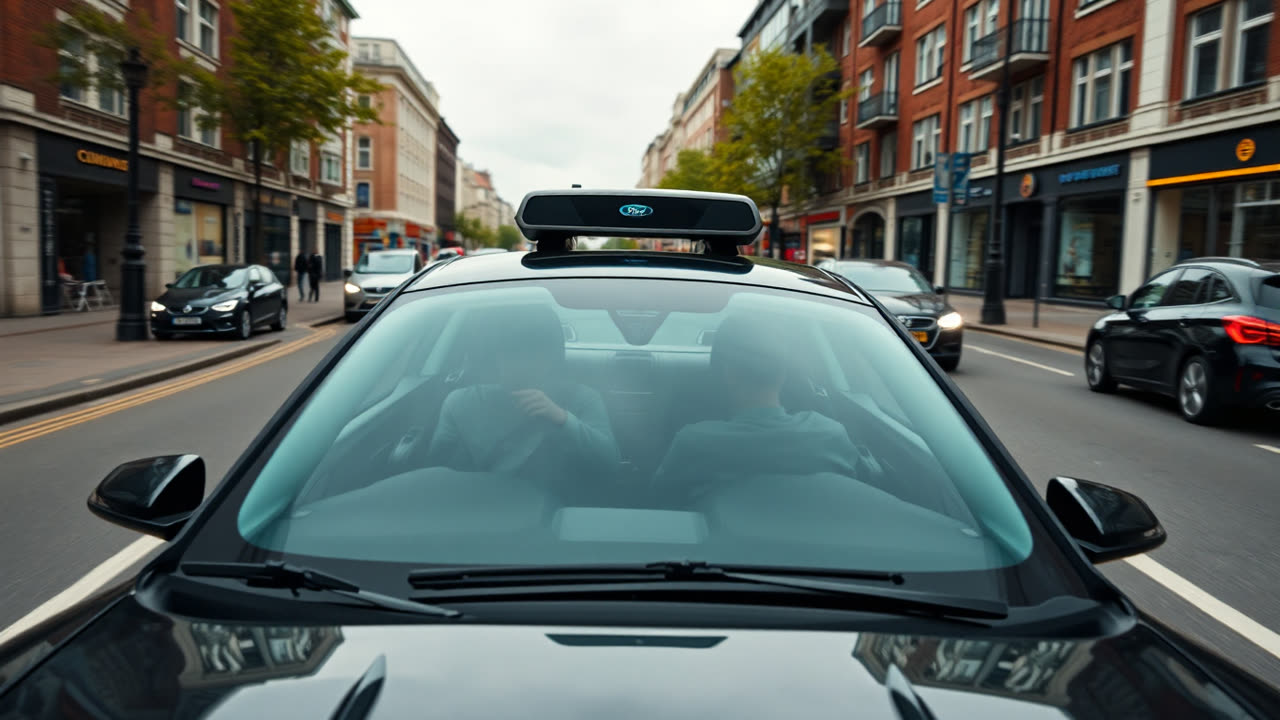
Uber, in partnership with British autonomous driving startup Wayve, launched supervised autonomous rides in London on September 3, 2026, marking the first time such a service has been publicly available in the United Kingdom. This initiative allows Londoners requesting an UberX, Uber Electric, or Uber Comfort ride to be matched with an all-electric Ford Mustang Mach-E equipped with the Wayve AI Driver, at no additional cost. While riders can accept or decline the autonomous vehicle before it arrives, a trained, Transport for London-licensed human safety driver remains behind the wheel, ready to intervene if necessary. The service covers most of London, excluding airports, and features in-vehicle interactive screens displaying the vehicle's planned path in 64 languages. Over 140,000 Londoners have already opted into the program via the Uber app's Trip Preferences. This launch is a significant step in Uber's broader strategy to integrate autonomous vehicles into its global network, with plans to expand Wayve-powered vehicles to 12 markets worldwide, including Tokyo later this year with Nissan LEAFs.
This deployment is more than a mere technological showcase; it represents a crucial strategic pivot for Uber and a tangible validation for Wayve's "AI Driver" technology in one of the world's most challenging urban environments. For Uber, which famously divested its own autonomous driving division (ATG) to Aurora, this partnership model is central to its "hybrid network" vision where autonomous vehicles and human drivers coexist. By collaborating with over 30 AV partners globally, Uber aims to become the largest facilitator of autonomous vehicle trips worldwide by 2029, sidestepping the immense R&D costs and risks associated with developing the core autonomous technology itself. This asset-light approach, despite Uber's recent $10 billion commitment to AV partnerships and fleet ownership, allows it to leverage its established rider base and booking platform, effectively owning the customer relationship while partners focus on the self-driving technology. The London launch, specifically, validates Wayve's "AV2.0" approach, which relies on an AI Driver that learns from experience rather than extensive HD maps or hand-coded rules, making it adaptable to complex, unstructured environments like London's intricate streets, cyclists, and roundabouts.
Compared to its rivals, Uber's strategy in London is distinct. While Waymo, a pioneer in robotaxi services, also plans to launch fully autonomous ride-hailing in London in 2026, their initial testing phase in the city involved human safety drivers. Waymo has a more vertically integrated approach, developing its own Waymo Driver technology and operating its fleets in several U.S. cities like Phoenix, San Francisco, and Los Angeles, with over 100 million fully autonomous miles driven on public roads and more than 10 million paid rides. Addison Lee, a local London private hire company, had ambitious plans as early as 2018 to introduce self-driving services by 2021 in partnership with Oxbotica, mapping over 250,000 miles of London roads, though a widespread commercial rollout without safety drivers has not yet materialized. The UK's regulatory landscape, governed by the Automated Vehicles Act 2024, is cautiously progressive, with pilot schemes for commercial autonomous passenger services (even without safety drivers) beginning in spring 2026. However, full implementation of the Act, allowing for entirely driverless commercial services, is not expected until the second half of 2027, placing Uber and Wayve's current supervised launch within the existing regulatory framework.
The immediate impact on users is a novel experience at no extra cost, offering a glimpse into the future of urban mobility. For the industry, it signifies a critical step in the commercialization and public acceptance of autonomous technology in a major global city. However, public perception remains a significant hurdle. A recent Opinium poll from April 2026 revealed that one in three UK adults believes driverless cars offer no benefits, and 71% would prefer a human driver over a driverless one. While younger demographics show more openness, with 42% of 18-34 year olds willing to use a driverless car after a night out, overall skepticism persists, particularly concerning safety and the interaction with London's unique road dynamics. The government emphasizes that self-driving vehicles must meet a safety standard "at least as high as careful and competent human drivers" and that the technology could reduce road accidents, with human error contributing to 88% of reported collisions.
Looking ahead, the success of these initial supervised trials in London will be pivotal. As the UK government moves towards full implementation of the Automated Vehicles Act in late 2027, the data collected from these "small-scale" pilots will be crucial in building public trust and refining regulatory frameworks. Uber's hybrid model, leveraging partnerships like Wayve, is designed to scale rapidly, with a goal of facilitating AV trips in up to 15 cities globally by the end of 2026. The economic implications are substantial; the broader connected and automated mobility sector is projected to contribute £66 billion annually to the UK economy by 2040 and create 342,000 additional jobs, primarily in areas like maintenance, data management, and operations, while potentially displacing traditional driving jobs. This transition will necessitate retraining programs and careful management of employment shifts. The co-existence of autonomous and human-driven vehicles will define urban transport for the foreseeable future, with companies like Uber strategically positioning themselves to dominate the "distribution layer" – the platform connecting riders to diverse mobility options, whether human-driven or autonomous. London, with its complex infrastructure and demanding traffic, will serve as a critical proving ground, shaping not only the future of Uber's global autonomous ambitions but also the broader trajectory of self-driving technology adoption across Europe.