Ukraine Claims Nvidia AI Chip Found in Russian Cruise Missile
Ukrainian intelligence alleges the S-71 'Monochrome' missile incorporates Nvidia's Jetson Orin NX modules, suggesting AI-powered terminal guidance and raising critical dual-use technology concerns.
✨ This content was summarized and interpreted by AI; it may contain errors — please verify accuracy with the original sources. Learn more
Listen to this story
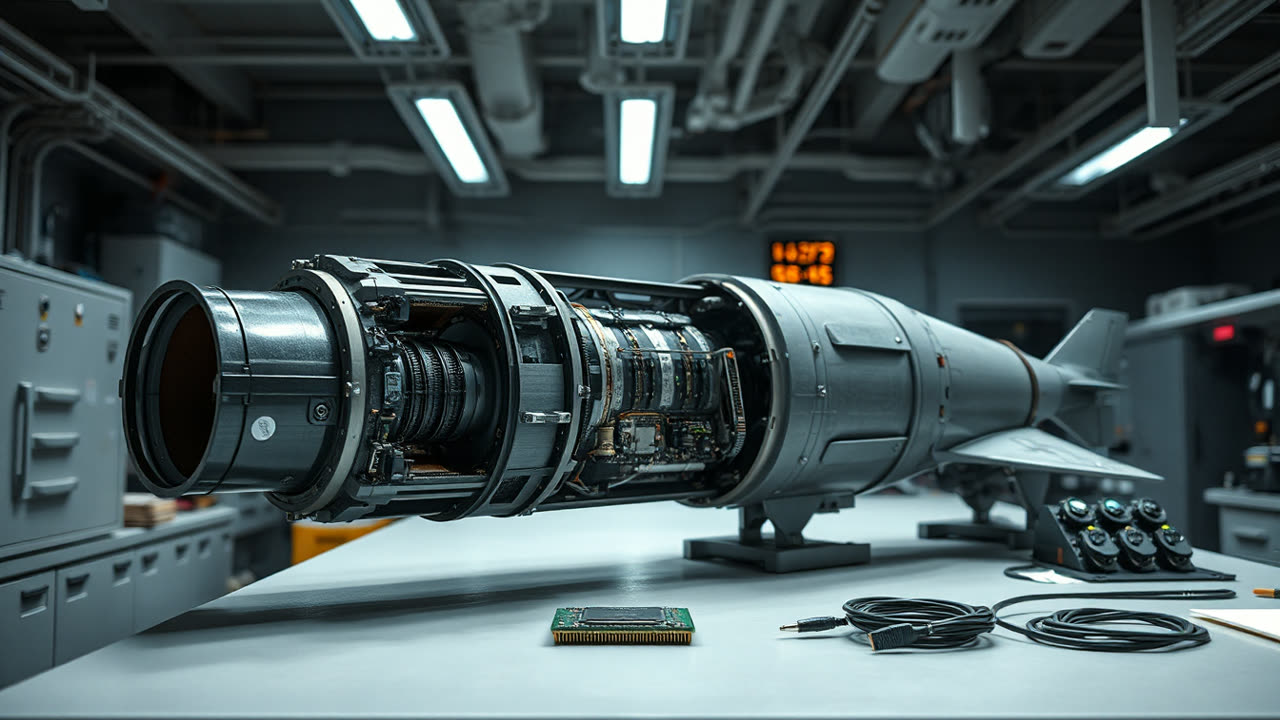
Ukraine intelligence claims to have discovered Nvidia Jetson Orin NX modules, powerful AI-enabled System-on-Modules (SoMs), within Russia's newly developed S-71 'Monochrome' cruise missiles, suggesting a critical advancement in the weapon's terminal guidance systems through artificial intelligence. This alleged integration, if confirmed, represents a significant escalation in the technological sophistication of Russian armaments, moving beyond conventional inertial or GPS/GLONASS navigation to potentially incorporate real-time object recognition and precision targeting capabilities, even in contested electromagnetic environments. The Jetson Orin NX, designed for edge AI applications, offers up to 100 TOPS (tera operations per second) of AI performance, making it capable of complex inferencing tasks typically found in robotics, industrial automation, and advanced autonomous systems. Its presence in a weapon system underscores the dual-use dilemma inherent in cutting-edge technology and raises profound questions about supply chain integrity and the ethics of AI in modern warfare.
The core news illuminates a disturbing trend where commercially available, high-performance computing components designed for civilian innovation are repurposed for military aggression. Nvidia's Jetson Orin NX, launched in 2022, is a compact, energy-efficient platform featuring an Arm Cortex-A78AE CPU and an Ampere architecture GPU with Tensor Cores, optimized for AI workloads. Its capacity for rapid data processing and deep learning inference could theoretically enable a cruise missile to identify specific targets from a pre-loaded database, differentiate between decoys, or even adapt its trajectory in real-time based on visual or other sensor inputs during the terminal phase of its flight. This would significantly enhance accuracy and resilience against countermeasures compared to traditional guidance systems, which rely on pre-programmed coordinates or less sophisticated sensor fusion. The S-71 'Monochrome' missile itself is a relatively new, domestically developed Russian weapon, and the alleged inclusion of such advanced Western components points to ongoing efforts by Russia to circumvent international sanctions and import restrictions, likely through illicit procurement networks involving third countries.
This development matters immensely for several reasons. For the tech industry, it highlights the persistent challenge of controlling the end-use of powerful, dual-use technologies. While Nvidia, like many Western tech companies, has publicly condemned Russia's invasion of Ukraine and ceased sales to the country, the alleged discovery suggests a failure in preventing sophisticated components from reaching military adversaries. This could lead to increased scrutiny and pressure on manufacturers to implement more robust supply chain monitoring and export control mechanisms, potentially impacting the global availability and pricing of such modules. For military strategists, the deployment of AI-powered guidance in cruise missiles signals a shift towards more autonomous and potentially more lethal weapons systems. The ability of a missile to make real-time decisions about its target without constant human intervention raises ethical concerns about accountability and the potential for unintended escalation. Furthermore, if the S-71 'Monochrome' can indeed leverage AI for enhanced precision and evasion, it could pose a greater threat to critical infrastructure and military assets, forcing adversaries to invest more heavily in advanced air defense systems and electronic warfare capabilities.
In terms of background, the use of advanced computing in missile guidance is not new, but the integration of dedicated AI accelerators like the Jetson Orin NX represents a qualitative leap. Previous generations of missile guidance primarily relied on inertial navigation systems (INS) augmented by GPS/GLONASS, or radar-based terminal seekers. While effective, these systems can be jammed, spoofed, or limited by environmental factors. AI, particularly machine vision and deep learning, offers the potential for greater robustness against jamming, improved target discrimination in cluttered environments, and enhanced accuracy against moving targets or those attempting camouflage. Rival nations are undoubtedly pursuing similar AI integration in their own weapon systems, making this alleged Russian deployment a wake-up call for the pace of technological adoption in modern warfare. This incident also echoes past discoveries of Western microelectronics in Russian military equipment, from communications gear to drones, consistently demonstrating Russia's reliance on imported technology for its advanced military hardware despite sanctions.
Looking ahead, this claim will likely trigger intense investigations by intelligence agencies and export control authorities into the specific procurement channels that allowed these Nvidia chips to reach Russia. Nvidia itself may face renewed pressure to tighten its distribution networks and collaborate more closely with governments to prevent such diversions. The broader implications extend to the entire dual-use technology sector, potentially leading to more stringent regulations on the export of high-performance AI hardware to countries deemed high-risk. We can also anticipate an acceleration in the development of countermeasures designed to defeat AI-powered guidance systems, such as advanced electronic warfare, sophisticated decoys, and perhaps even AI-driven defenses. The alleged presence of the Jetson Orin NX in the S-71 'Monochrome' missile serves as a stark reminder that the frontier of AI is not solely in civilian applications but also increasingly defines the future of military capabilities, demanding urgent international dialogue on responsible development and deployment.