Ukraine's $48,000 Drone, Cloned from Chinese Tech, Destroys Russian Strategic Bomber
Ukraine's MICH 2000, a long-range attack drone reverse-engineered from Chinese designs, achieved a pivotal strategic victory by eliminating a Russian Tu-95MS bomber, signaling a profound shift in modern aerial warfare and global security paradigms.
✨ This content was summarized and interpreted by AI; it may contain errors — please verify accuracy with the original sources. Learn more
Listen to this story
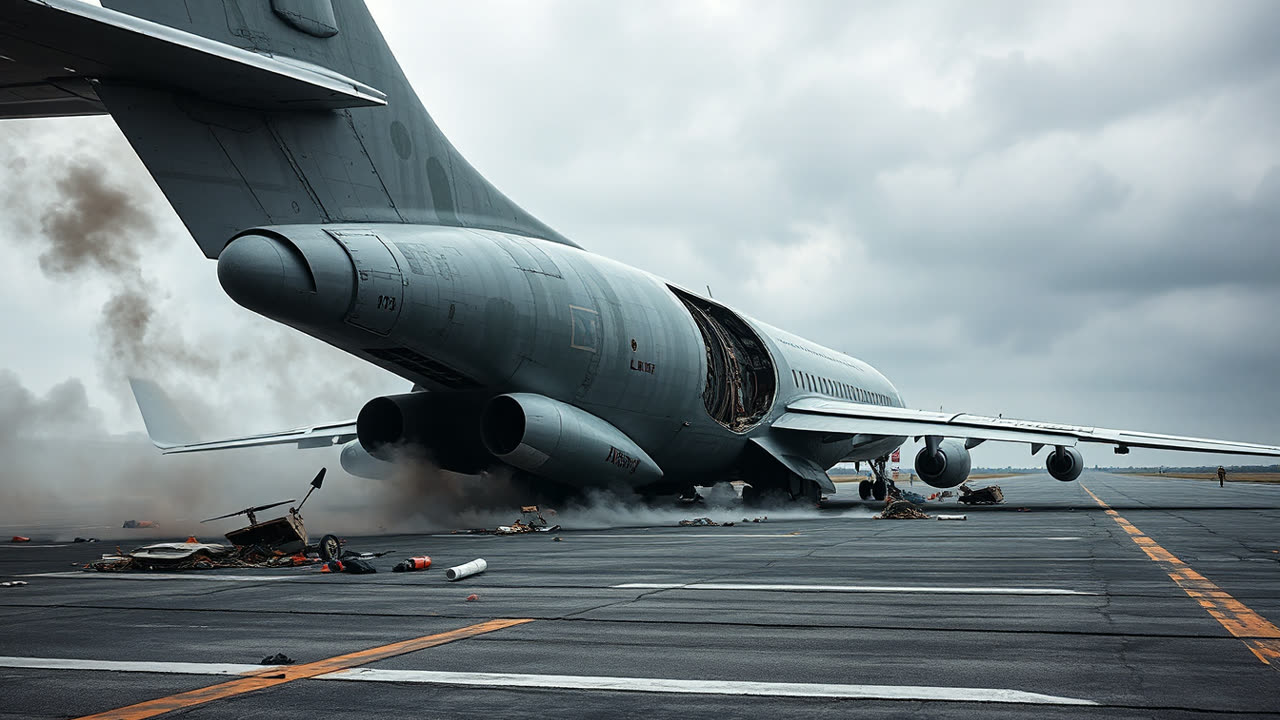
The MICH 2000, a Ukrainian-developed long-range attack drone costing approximately $48,000, recently achieved a significant strategic victory by destroying a Russian Tupolev Tu-95MS strategic bomber at the Engels-2 air base. This drone, reportedly a reverse-engineered clone based on covertly obtained Chinese factory photographs, boasts an impressive 2,000 km operational range, underscoring a pivotal shift in modern aerial warfare. Ukraine's reported annual production capacity of 6,000 flying-wing drones of various types highlights a burgeoning domestic drone industry capable of scaling sophisticated, cost-effective weapons platforms.
This incident profoundly redefines the calculus of air defense and strategic deterrence. The MICH 2000’s low unit cost, especially when compared to the multi-million dollar asset it eliminated, represents an asymmetric advantage that could reshape conflict paradigms. For military strategists, the ability to project lethal force deep into enemy territory with expendable, mass-producible assets fundamentally alters risk assessment for high-value targets. This democratisation of long-range strike capability means that even nations with limited conventional air power can now pose a credible threat to strategic assets previously thought secure. The impact on traditional air forces is particularly acute; the economic burden of maintaining sophisticated air defense networks against a swarm of inexpensive, stealthy drones becomes unsustainable, forcing a re-evaluation of resource allocation and defensive posture.
The provenance of the MICH 2000, allegedly derived from reconnaissance photos of Chinese drone factories, introduces a complex layer of geopolitical and industrial security implications. It highlights the porous nature of global supply chains and the rapid dissemination of technological blueprints, regardless of intellectual property protections. For the drone manufacturing industry, this incident serves as a stark warning about industrial espionage and the potential for reverse engineering to bypass traditional research and development cycles. It could lead to a tightening of security protocols within advanced manufacturing facilities and a greater emphasis on proprietary, non-exportable components to safeguard technological advantages. Moreover, the episode underscores the dual-use nature of many commercial drone technologies, which can be quickly adapted for military applications, blurring the lines between civilian innovation and battlefield capabilities.
Compared to prior generations of Ukrainian drones, which often relied on modified commercial platforms or shorter-range indigenous designs, the MICH 2000 represents a significant leap in indigenous long-range strike capabilities. Earlier Ukrainian efforts, while effective in tactical roles, lacked the reach and payload capacity to consistently threaten targets deep within Russian territory. The MICH 2000’s 2,000 km range places it in a league with more established, and significantly more expensive, cruise missiles or dedicated military-grade unmanned aerial vehicles (UAVs) from major powers. While specific comparisons to rivals like Russia's Lancet or Iran's Shahed drones reveal different operational profiles—Lancets are smaller, shorter-range loitering munitions, and Shaheds, while long-range, are often larger and less agile—the MICH 2000 distinguishes itself by its cost-effectiveness and apparent stealth characteristics, critical for evading detection. Its flying-wing design, a common feature in stealth aircraft, further suggests an emphasis on survivability against advanced air defense systems.
Looking ahead, the successful deployment of drones like the MICH 2000 will inevitably accelerate the global drone arms race. Nations will likely intensify investments in both offensive long-range drone development and sophisticated counter-drone technologies, including advanced electronic warfare systems, directed energy weapons, and AI-driven air defense networks. The proliferation of such capabilities could lead to more frequent, long-distance, and potentially deniable attacks, complicating international relations and crisis management. We can anticipate a future where drone swarms, coordinated by AI, become a standard feature of military operations, overwhelming conventional defenses through sheer numbers and diverse attack vectors. Furthermore, the ethical and legal frameworks governing autonomous weapons systems will face increasing scrutiny as these drones become more sophisticated and less reliant on direct human intervention for targeting decisions, pushing the boundaries of accountability in modern warfare.