Ukraine's Sargan 3000 Achieves First-Ever Drone-on-Drone Naval Kill
Ukraine's naval forces have reportedly achieved a significant first in modern warfare, successfully engaging and destroying a Russian MBeK unmanned surface vessel with a Ukrainian Sargan 3000 combat drone, marking the "first-ever battle of unmanned naval boats."
✨ This content was summarized and interpreted by AI; it may contain errors — please verify accuracy with the original sources. Learn more
Listen to this story
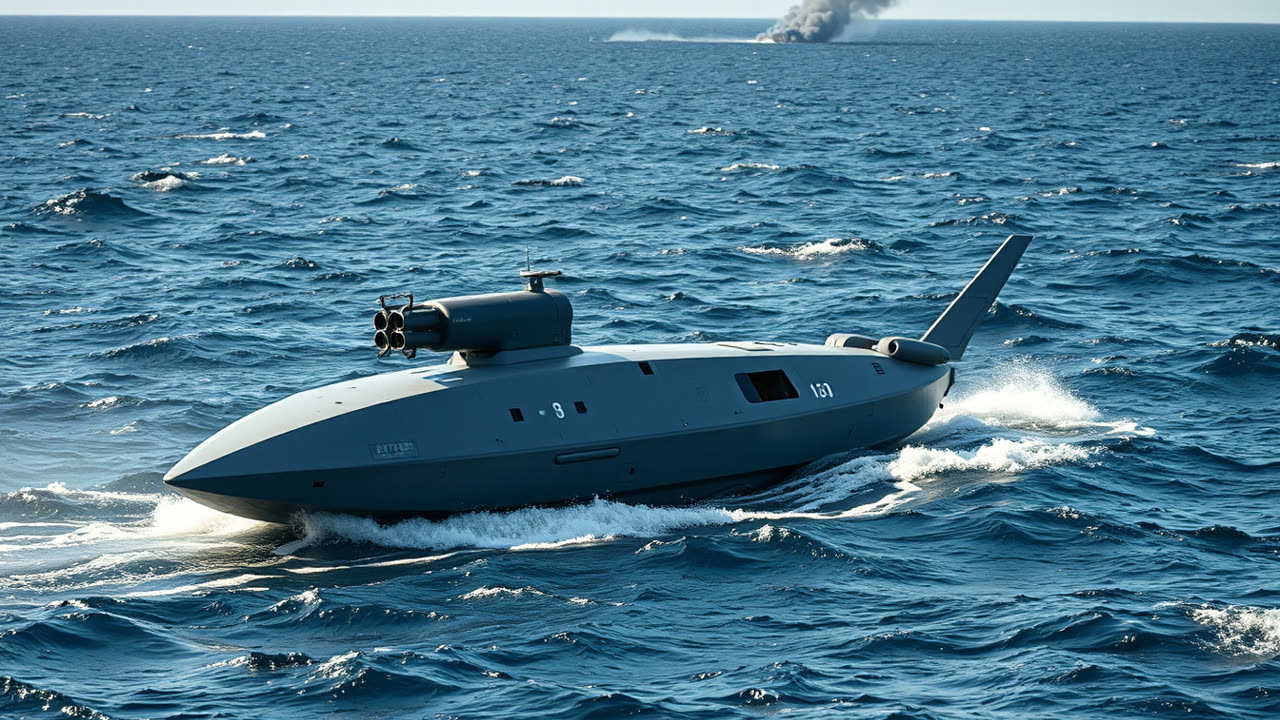
Ukraine’s naval forces have reportedly achieved a significant first in modern warfare, successfully engaging and destroying a Russian MBeK unmanned surface vessel (USV) with a Ukrainian Sargan 3000 combat drone equipped with a 12.7mm automatic turret, marking what the Ukrainian Navy has claimed as the "first-ever battle of unmanned naval boats." This unprecedented engagement, captured on video, demonstrates a critical evolution in maritime conflict, where autonomous systems are no longer merely reconnaissance tools or kamikaze weapons but have begun to directly counter each other in combat.
The incident fundamentally reshapes perceptions of naval warfare, signaling a new era where unmanned platforms will increasingly contest control of maritime domains. Traditionally, naval engagements involved crewed vessels, with later additions of anti-ship missiles and air power. The advent of drone-on-drone combat introduces an entirely new layer of complexity and risk assessment for naval strategists. For military planners, this event underscores the urgent need to develop robust counter-USV doctrines and technologies, moving beyond passive defenses to active, autonomous interdiction. The successful deployment of a weaponized Sargan 3000, capable of identifying and engaging an enemy USV, highlights a shift towards more sophisticated, multi-role drone platforms that can operate independently or with minimal human oversight in contested waters.
The Sargan 3000, while specific details remain somewhat limited, appears to be a versatile platform, capable of carrying various payloads, including the 12.7mm machine gun, suggesting a design philosophy focused on adaptability for different mission profiles, from surveillance to direct engagement. In contrast, the Russian MBeK (likely an acronym for "Multipurpose Unmanned Boat Complex"), though its exact specifications are also not widely publicized, is understood to be part of Russia's broader effort to integrate unmanned systems into its naval operations, often for reconnaissance, patrol, or potentially mine warfare. The direct confrontation between these two systems demonstrates a tactical maturity in drone deployment previously unseen, where one nation's autonomous asset is actively hunting and neutralizing another's. This moves beyond the one-way attacks seen with explosive-laden USVs and introduces a dynamic where both sides are fielding intelligent, armed platforms capable of defensive and offensive maneuvers.
The implications for the defense industry are profound. This engagement will undoubtedly accelerate investment and research into advanced AI for autonomous navigation, target recognition, and weapon systems integration for USVs. Manufacturers will face increased demand for drones with enhanced endurance, stealth capabilities, and modular payload options to adapt to rapidly evolving threat landscapes. Furthermore, the development of sophisticated counter-drone technologies will become paramount. This includes not only kinetic solutions like the Sargan 3000's turret but also electronic warfare (EW) systems to jam communication and navigation, cyber capabilities to hijack or disable enemy drones, and even directed energy weapons. The arms race in unmanned systems is intensifying, with a clear trajectory towards more autonomous and lethal platforms.
Comparing this development to prior generations of naval technology reveals a stark contrast. Historically, naval innovation focused on larger, more heavily armed, and armored vessels. The current trend, exemplified by this drone battle, emphasizes smaller, more numerous, and increasingly autonomous platforms that can operate in swarms or independently, presenting a dispersed and challenging threat to traditional naval assets. Major naval powers like the United States and China have been heavily investing in their own USV programs, with the U.S. Navy exploring concepts like the Large Unmanned Surface Vessel (LUSV) and Medium Unmanned Surface Vessel (MUSV) for various roles, including intelligence, surveillance, reconnaissance, and even missile carriage. China is also rapidly developing its own fleet of unmanned surface and underwater vehicles, aiming to project power and enhance its anti-access/area-denial capabilities. This latest engagement provides real-world validation for the strategic shift towards unmanned systems, forcing all navies to re-evaluate their investment priorities and operational doctrines.
Looking ahead, the "first-ever" drone-vs-drone boat battle portends a future where autonomous systems will play an even more central role in all domains of warfare. We can anticipate a rapid proliferation of armed USVs, leading to complex ethical and legal debates surrounding the use of artificial intelligence in lethal decision-making. Future naval engagements may increasingly resemble chess matches between autonomous systems, with human operators overseeing from a distance or intervening at critical junctures. The development of collaborative drone swarms, capable of overwhelming larger targets through coordinated attacks, will likely be a key area of focus. Furthermore, the need for robust command and control systems, resilient to jamming and cyber-attacks, will become critical as nations seek to maintain superiority in this evolving battlespace. This incident is not merely a tactical victory; it is a strategic harbinger, signaling a fundamental transformation in how wars will be fought at sea, ushering in an era where the drone is both weapon and warrior, hunter and hunted.