Ukrainian Drones Overwhelm Advanced Russian Tank Protection Systems
Despite the deployment of advanced Russian active protection systems (APS) designed to counter sophisticated threats, Ukrainian forces are consistently demonstrating their ability to overwhelm these defenses with swarms of inexpensive, expendable drones, fundamentally challenging contemporary armored warfare doctrine.
✨ This content was summarized and interpreted by AI; it may contain errors — please verify accuracy with the original sources. Learn more
Listen to this story
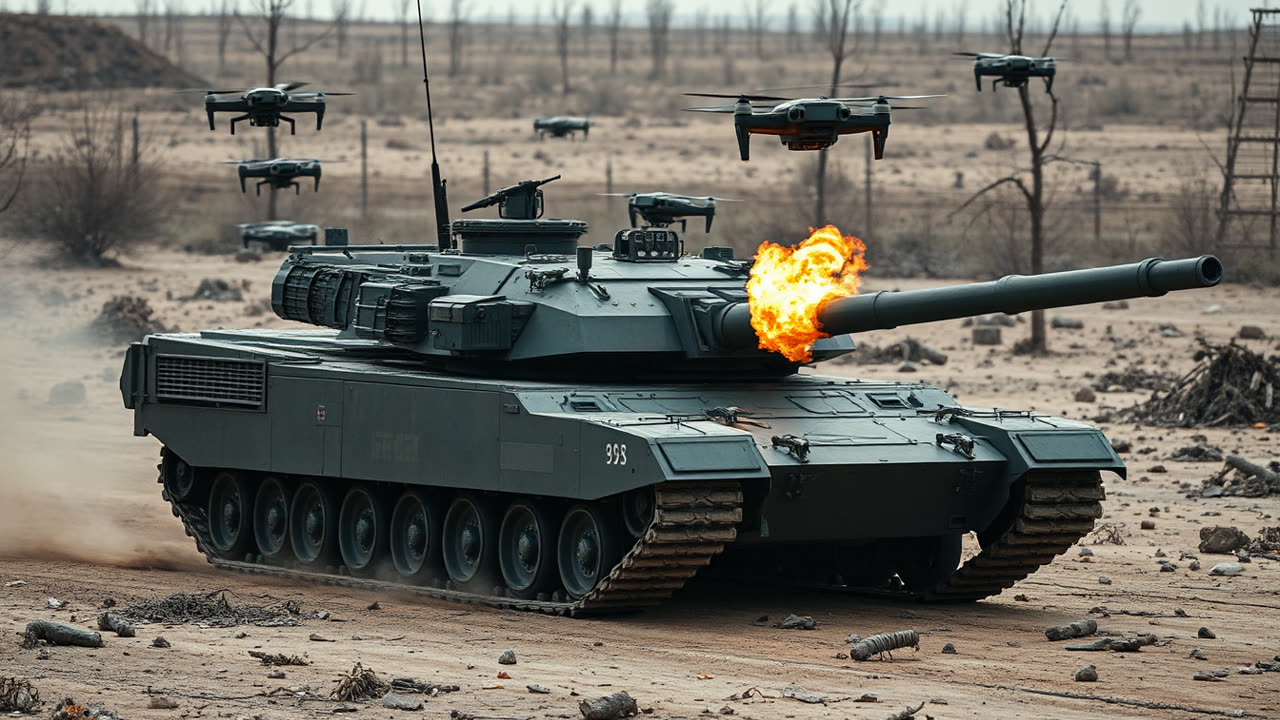
Despite the deployment of advanced Russian active protection systems (APS) designed to counter sophisticated threats, Ukrainian forces are consistently demonstrating their ability to overwhelm these defenses with swarms of inexpensive, expendable drones, fundamentally challenging contemporary armored warfare doctrine. This vulnerability, particularly pronounced against systems like the Afghanit, which equips Russia's T-14 Armata tanks and has seen limited but significant deployment on upgraded T-90M and T-80BVM variants, highlights a critical inflection point in the long-standing arms race between offensive and defensive technologies. Recent reports indicate that even after Russian tanks are fitted with these new APS, which employ radar-guided interceptors to detect and neutralize incoming projectiles, Ukrainian FPV (First-Person View) drones, often costing less than $500, are achieving kill rates that far exceed their monetary investment.
The core of the problem lies in the operational limitations of current APS technology when confronted with saturation attacks. Systems like Afghanit, touted for their ability to intercept anti-tank guided missiles (ATGMs) and even kinetic energy penetrators, rely on a finite number of interceptor charges and a specific engagement envelope. While effective against one or two high-value threats, they struggle to manage multiple, simultaneous, low-signature targets approaching from various vectors. Ukrainian operators are exploiting this by launching coordinated drone attacks, often with one drone acting as a decoy or to trigger an APS response, followed immediately by others delivering explosive payloads to vulnerable areas once the APS is depleted or momentarily overwhelmed. Furthermore, some FPV drones are reportedly capable of "top attack" maneuvers, diving onto the less heavily armored turrets and engine decks, areas where APS coverage might be less robust or where the interceptors are less effective due to the steep angle of attack. The psychological impact on tank crews, operating under constant threat from unseen, buzzing adversaries, also cannot be understated, contributing to reduced situational awareness and increased operational stress.
This development matters profoundly for several reasons, fundamentally reshaping tactical and strategic considerations for modern armies. For users—tank crews and ground forces—it means an unprecedented level of threat from an easily accessible and rapidly evolving adversary. The perceived invulnerability of main battle tanks (MBTs), even those equipped with cutting-edge defensive suites, is eroding, forcing a re-evaluation of combined arms tactics and the very role of tanks on the battlefield. For the defense industry, this presents a monumental challenge and a lucrative, albeit urgent, opportunity. Manufacturers are now scrambling to develop "soft-kill" electronic warfare systems capable of jamming drone control signals or "hard-kill" systems with more numerous, faster-reloading, and multi-directional interceptors. The economic asymmetry is staggering: a $10 million MBT with a multi-million dollar APS is being threatened by a $500 drone, rendering the cost-benefit analysis of traditional armored warfare increasingly untenable. This imbalance could spur innovation in modular, adaptable defense systems and a renewed focus on integrated air defense for ground units, rather than solely relying on tank-centric solutions.
Historically, tank defenses have evolved from passive armor to reactive armor, and then to active protection systems. Earlier Russian APS, such as the Arena, while groundbreaking, faced similar challenges with multiple threats and were largely designed against ATGMs. Western counterparts, like Israel's Trophy APS, widely used on Merkava tanks and integrated into some U.S. Abrams tanks, and Germany's AMAP-ADS, have demonstrated high success rates against rocket-propelled grenades (RPGs) and ATGMs. However, even these systems are being tested by the drone threat, prompting upgrades and new developments. The sheer volume and low radar cross-section of modern FPV drones, coupled with their ability to loiter and choose attack vectors, represent a qualitatively different challenge than the faster, but more predictable, trajectory of a missile or shell. The current situation suggests that while the "new" Russian APS might be an improvement over prior generations against traditional threats, it is still playing catch-up against the rapidly evolving, asymmetric drone threat.
Looking ahead, the arms race will undoubtedly intensify. We can expect to see a multi-pronged approach to counter this drone superiority. First, there will be an accelerated development of advanced "soft-kill" solutions, including more sophisticated electronic warfare suites capable of identifying and disrupting a wider spectrum of drone frequencies and navigation systems, possibly integrated with AI-driven threat assessment. Second, "hard-kill" APS will likely become more layered, potentially incorporating directed energy weapons (lasers or high-power microwaves) for rapid, cost-effective engagement of multiple small targets, alongside kinetically-based interceptors. Third, a greater emphasis will be placed on integrated, layered defense for armored formations, involving dedicated anti-drone vehicles, infantry carrying anti-drone jammers, and perhaps even drone-vs-drone combat, where friendly drones intercept hostile ones. Finally, tank design itself may undergo a renaissance, with a renewed focus on modular armor, stealthier profiles, and distributed sensor arrays to improve situational awareness against ubiquitous aerial threats. The current vulnerability of Russia's advanced APS is not an indictment of the technology's potential, but a stark reminder that military innovation is a relentless, continuous cycle, where even the most cutting-edge defenses can be rapidly outpaced by novel offensive tactics.