Unpacking Wireless Apple CarPlay's Dual-Protocol Connection
Wireless Apple CarPlay leverages a sophisticated dual-protocol approach, initially establishing a connection via Bluetooth before seamlessly transitioning to Wi-Fi for high-bandwidth data transfer; this method has become an industry standard in in-car infotainment systems, fundamentally transforming the user experience with cable-free convenience.
✨ This content was summarized and interpreted by AI; it may contain errors — please verify accuracy with the original sources. Learn more
Listen to this story
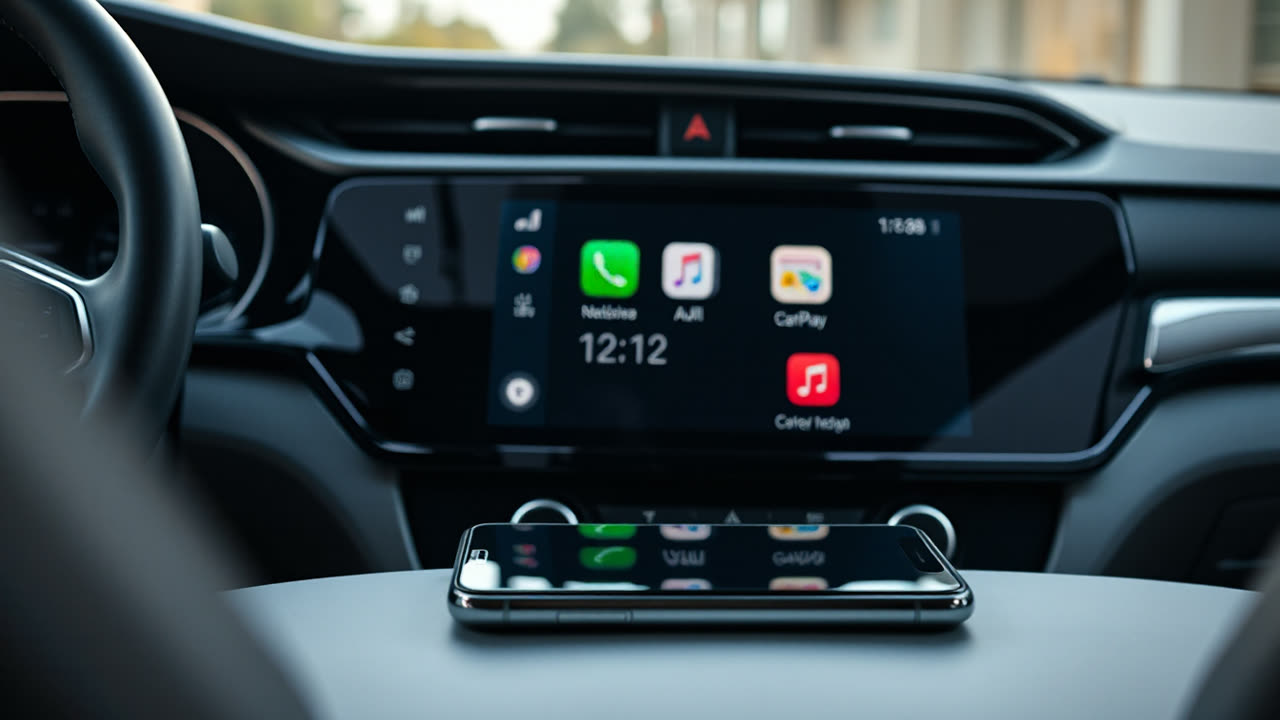
Wireless Apple CarPlay leverages a sophisticated dual-protocol approach, initially establishing a connection via Bluetooth before seamlessly transitioning to Wi-Fi for high-bandwidth data transfer, a method also mirrored by wireless Android Auto for its robust in-car infotainment experience. This hybrid strategy is fundamental to its functionality, with Bluetooth handling the initial pairing, authentication, and communication of Wi-Fi credentials, while the actual heavy lifting of mirroring the iPhone's interface, streaming audio, and transmitting touch commands occurs over a dedicated Wi-Fi connection. This two-step process ensures both ease of initial setup and the necessary bandwidth for a fluid, responsive user experience that wired connections previously monopolized.
The strategic choice to utilize both Bluetooth and Wi-Fi is critical to CarPlay's performance and widespread adoption, addressing the inherent limitations of each technology when used in isolation. Bluetooth, while excellent for low-power, short-range device discovery and control, lacks the throughput for real-time video, high-fidelity audio, and rapid data synchronization required by modern infotainment systems. Wi-Fi, conversely, offers significantly higher bandwidth and lower latency, essential for rendering complex maps, playing lossless audio, and ensuring instantaneous responsiveness to touch inputs without perceptible lag. By offloading the high-data tasks to Wi-Fi (typically 5GHz for faster speeds and less interference), CarPlay delivers an experience that closely approximates a wired connection, but with the convenience of cable-free operation. This negates the need for users to physically connect their device every time they enter the vehicle, significantly enhancing the daily driving experience and reducing wear and tear on charging ports.
The impact on users is profound, transcending mere convenience. Wireless CarPlay liberates the smartphone from the center console, allowing passengers to access the device freely while the driver benefits from the integrated interface. This freedom fosters a cleaner cabin aesthetic, reduces cable clutter, and simplifies entry and exit from the vehicle. For the automotive industry, this dual-protocol approach has become a de facto standard, pushing manufacturers to integrate robust Wi-Fi capabilities into head units, often alongside existing Bluetooth modules. This necessity has spurred innovation in in-car network architecture, demanding more powerful processors and antennas capable of maintaining stable, high-speed connections in a challenging RF environment. It also influences vehicle design, as engineers must consider optimal placement for Wi-Fi antennas to minimize interference and maximize signal strength throughout the cabin.
Comparing wireless CarPlay to its wired predecessor highlights a significant leap in user experience. Wired CarPlay, while reliable, tethered the device and often necessitated a specific USB port. The shift to wireless, first widely introduced around 2019-2020 by manufacturers like BMW and Audi, eliminated this physical constraint, making the experience more seamless and intuitive. Against its primary rival, wireless Android Auto, the underlying connection methodology is remarkably similar, also relying on an initial Bluetooth handshake followed by a Wi-Fi data link. This convergence indicates a shared understanding across tech giants regarding the optimal wireless solution for in-car mirroring. While both platforms offer comparable functionality, Apple’s ecosystem integration, particularly with features like Siri and Apple Maps, remains a key differentiator for iPhone users.
Looking ahead, the evolution of wireless CarPlay is poised for further advancements, particularly with the increasing prevalence of 5G connectivity and emerging wireless standards. While current wireless CarPlay relies on local Wi-Fi generated by the head unit, future iterations could potentially leverage vehicle-integrated 5G modems for cloud-based rendering or enhanced over-the-air updates, though direct mirroring will likely remain local. The introduction of Ultra-Wideband (UWB) technology, already present in some iPhones and vehicles for digital keys, presents another intriguing possibility. UWB could refine the initial pairing process, making it even faster and more secure, or enable precise spatial awareness features within the vehicle, though its role in high-bandwidth data transfer for the core CarPlay experience is less clear given Wi-Fi's established dominance.
The next generation of CarPlay, already teased by Apple, promises deeper integration into vehicle systems, extending beyond the central infotainment screen to instrument clusters and climate controls. This ambitious vision will demand even more robust and reliable wireless communication, potentially pushing the boundaries of current Wi-Fi standards or exploring dedicated short-range communication (DSRC) or vehicle-to-everything (V2X) technologies for enhanced safety and contextual awareness. As vehicles become increasingly software-defined and interconnected, the foundational dual-protocol wireless connection of CarPlay will continue to evolve, adapting to new bandwidth demands and security requirements, ultimately shaping the future of in-car digital experiences.