US Army Deploys In-House Assembled Drones with 3D-Printed Bombs, Revolutionizing Battlefield Manufacturing
A U.S. Army unit has successfully deployed a drone assembled entirely in-house using 3D-printed "Dragoon Bombs," marking a profound shift towards decentralized battlefield manufacturing that promises unprecedented agility and supply chain resilience by empowering soldiers to rapidly produce mission-specific ordnance on-site.
✨ This content was summarized and interpreted by AI; it may contain errors — please verify accuracy with the original sources. Learn more
Listen to this story
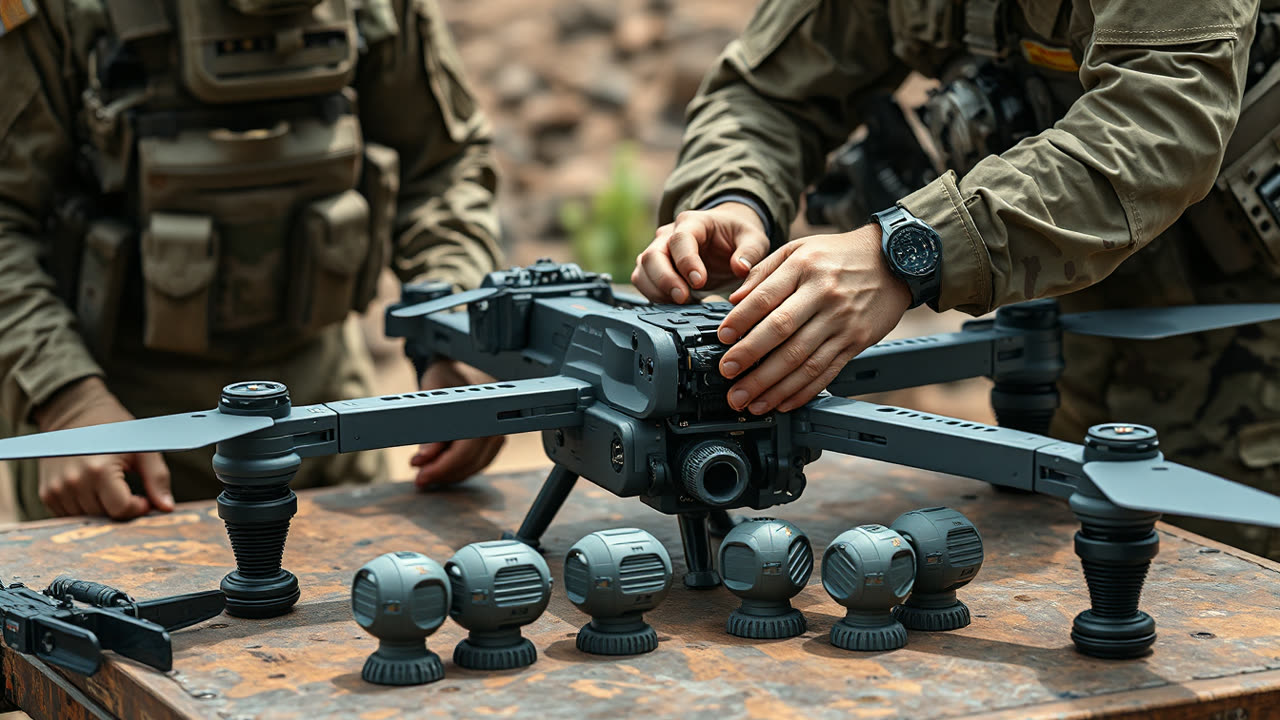
A U.S. Army unit has successfully deployed a drone assembled entirely in-house, utilizing 3D-printed "Dragoon Bombs" filled with ball bearing shrapnel, marking a significant shift towards decentralized, adaptable battlefield manufacturing. This innovative approach, spearheaded by soldiers who are now training to assemble drones and fabricate bomb casings on-site, enables rapid prototyping and deployment of mission-specific ordnance, moving beyond traditional, centralized procurement channels. The device, reportedly capable of a range up to 12 miles, can be configured for both anti-personnel and anti-light armor missions, offering a versatile tactical asset. This capability represents a crucial evolution in military logistics and combat readiness, allowing units to tailor their equipment to immediate threats and operational environments without relying on lengthy supply chains or pre-manufactured specialized munitions.
The strategic importance of this development lies in its profound impact on military agility and supply chain resilience. By enabling units to design and produce custom drones and munitions in the field, the Army significantly reduces its dependence on complex, often vulnerable, industrial supply lines. This "democratization of manufacturing" at the tactical edge means that forces can adapt to evolving threats with unprecedented speed, potentially turning a two-year procurement cycle into a matter of days or even hours. For users, primarily frontline soldiers, this translates into immediate access to specialized tools and weapons, directly addressing specific battlefield challenges, which can range from reconnaissance in complex urban terrain to precision strikes against soft targets. The ability to rapidly iterate and improve designs based on real-world feedback also fosters a culture of innovation within military units, empowering soldiers to become problem-solvers rather than merely equipment operators. Industrially, this trend poses a significant disruption to traditional defense contractors, who may face reduced demand for off-the-shelf solutions as in-house capabilities expand. However, it also opens new avenues for companies specializing in advanced manufacturing technologies, portable 3D printing solutions, and modular drone components, shifting the focus from finished products to foundational manufacturing tools and raw materials.
Historically, military procurement has been characterized by lengthy development cycles, high costs, and a "one-size-fits-all" approach to equipment. The current move towards in-house assembly and 3D printing stands in stark contrast to this legacy, drawing parallels to the rapid innovation seen in commercial tech sectors. While the U.S. military has been exploring 3D printing for decades, primarily for spare parts and prototyping, this deployment signifies a critical step towards using additive manufacturing for direct combat roles. Rivals, particularly China and Russia, have also invested heavily in drone technology and advanced manufacturing, though the extent of their decentralized, in-field production capabilities for combat-ready systems remains less transparent. China, for instance, has demonstrated significant advancements in drone swarm technology and manufacturing scale, but the focus has largely been on mass production rather than localized, rapid customization. The U.S. Army's approach, therefore, offers a distinct advantage in adaptability and responsiveness over adversaries who might prioritize sheer volume but lack the granular control over design and deployment. Compared to prior generations of military drones, which were often purpose-built and expensive platforms, these in-house assembled units leverage readily available commercial-off-the-shelf (COTS) components, making them more cost-effective and easier to repair or upgrade.
Looking ahead, this pioneering deployment signals a future where distributed manufacturing becomes an integral part of military doctrine. We can anticipate a substantial investment in ruggedized, field-deployable 3D printers capable of working with a wider array of materials, including metals and advanced polymers, to produce more complex and durable components. Training programs for soldiers will likely expand to include advanced manufacturing skills, turning infantry units into self-sufficient mini-factories. The ethical and regulatory frameworks surrounding the proliferation of easily manufactured, customizable munitions will also need urgent attention, particularly concerning accountability and arms control. Furthermore, the integration of artificial intelligence and machine learning into these localized manufacturing processes could enable even greater autonomy in design and production, allowing systems to propose optimized solutions for specific threats with minimal human intervention. This could lead to a paradigm shift in military operations, where the ability to rapidly innovate and produce tailored solutions on demand becomes as critical as traditional firepower, fundamentally reshaping the dynamics of future conflicts.