US Navy's Saildrone Surveyor Launches Missiles, Reshaping Naval Warfare
The U.S. Navy has successfully demonstrated a significant leap in unmanned naval warfare, conducting live-fire exercises in the Pacific where a Saildrone Surveyor, initially designed for oceanographic research, launched dual Joint Air-to-Ground Missiles (JAGM) against a target.
✨ This content was summarized and interpreted by AI; it may contain errors — please verify accuracy with the original sources. Learn more
Listen to this story
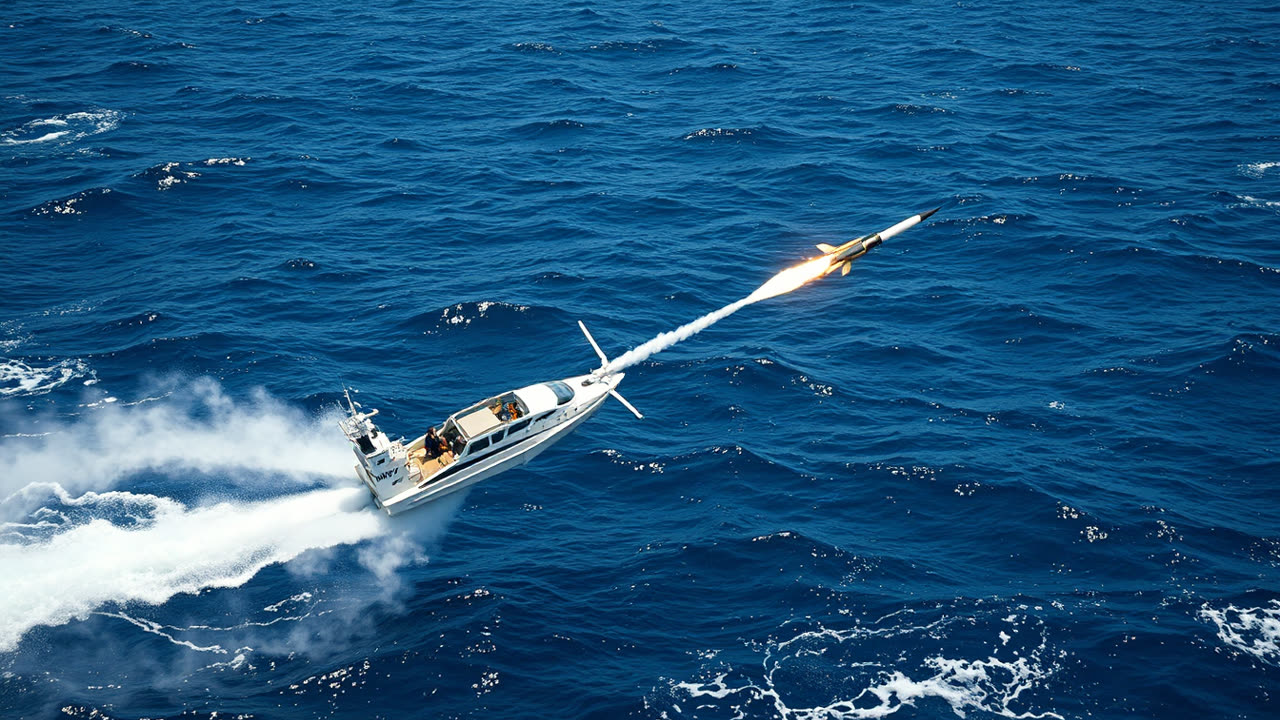
The U.S. Navy has successfully demonstrated a significant leap in unmanned naval warfare, conducting live-fire exercises in the Pacific where a Saildrone Surveyor, initially designed for oceanographic research, launched dual Joint Air-to-Ground Missiles (JAGM) against a target. This unprecedented test, which also involved a carrier strike group integrating armed unmanned surface vessels (USVs) and electronic warfare capabilities, marks a pivotal moment in the Navy's strategic shift towards distributed maritime operations and unmanned systems integration. The Saildrone Surveyor, a 72-foot-long autonomous vessel powered primarily by wind and solar energy, showcased its adaptability beyond its original intelligence, surveillance, and reconnaissance (ISR) and ocean mapping roles by effectively becoming a mobile missile launch platform. This successful weaponization of a long-endurance, low-signature USV fundamentally alters the calculus of naval power projection and fleet architecture.
The significance of this development is multifaceted, profoundly impacting both naval strategy and the broader defense industry. Economically, Saildrone Surveyors are considerably cheaper to procure and operate than traditional manned warships, with estimated costs for a Surveyor around $2 million, dwarfed by the billions required for destroyers or frigates. This cost efficiency allows the Navy to deploy a larger number of platforms, increasing fleet size and geographical reach without a commensurate increase in budget. Operationally, these armed USVs enhance the concept of "distributed lethality," spreading offensive capabilities across a wider array of platforms, making it more challenging for adversaries to target and neutralize the fleet. By deploying numerous smaller, less detectable, and expendable platforms capable of delivering precision strikes, the Navy can create a more resilient and adaptable force. Furthermore, the use of unmanned systems in contested environments significantly reduces the risk to human personnel, allowing for more aggressive tactics in high-threat areas. The integration with a carrier strike group during the exercises also highlights a future where manned and unmanned assets operate synergistically, with USVs potentially acting as forward scouts, sensor nodes, or even decoy platforms, extending the strike group's operational envelope and enhancing its survivability against sophisticated threats.
The Saildrone Surveyor itself represents a new generation of USVs, far removed from earlier, smaller, and less capable prototypes. Its wind and solar propulsion system grants it exceptional endurance, theoretically allowing it to operate at sea for up to 12 months without refueling, a capability unmatched by most conventional naval vessels. Originally designed for uncrewed ocean data collection and maritime domain awareness, its robust platform has proven capable of supporting significant payloads, including sophisticated sensor suites and, now, weapon systems like the JAGM. The JAGM, a multi-purpose missile designed to replace the Hellfire, Maverick, and TOW missiles, offers enhanced precision and lethality against a wide range of land and sea targets, further augmenting the Surveyor's offensive punch. Compared to rival nations, particularly China, which has been rapidly developing its own unmanned naval capabilities, the U.S. Navy's demonstration with the Saildrone Surveyor showcases a critical advantage in integrating long-endurance, commercially-derived platforms with advanced weaponry. While China has invested heavily in large, combat-focused USVs, the U.S. approach of adapting existing, proven platforms for armed roles offers a potentially faster and more cost-effective path to widespread deployment. This also contrasts with earlier U.S. Navy USV efforts, which often focused on purpose-built, highly specialized, and sometimes more expensive platforms, demonstrating a pragmatic shift towards leveraging commercial innovation.
Looking ahead, the successful arming of the Saildrone Surveyor is likely to accelerate the U.S. Navy's acquisition and deployment of similar armed USVs. The "Project Overmatch" initiative, aimed at connecting manned and unmanned systems across all domains, will undoubtedly see these platforms play an increasingly central role in data sharing, targeting, and strike coordination. The Navy's goal to field a "hybrid fleet" of over 150 unmanned surface and underwater vessels by 2045 suggests a future where these autonomous systems form a significant portion of its operational force, conducting missions from persistent ISR and anti-submarine warfare to mine countermeasures and, crucially, offensive strike. Future iterations could see these USVs equipped with more diverse weapon systems, including anti-ship missiles or even defensive capabilities. However, challenges remain, particularly in the areas of command and control, cybersecurity, and the ethical implications of autonomous weapon systems. Developing robust, resilient, and secure communication links to these distant platforms will be paramount, as will establishing clear rules of engagement and human oversight protocols to ensure responsible use. The legal frameworks surrounding autonomous lethal force also require careful consideration. Nevertheless, this recent demonstration heralds a new era of naval warfare, where agile, persistent, and increasingly lethal unmanned platforms will redefine maritime strategy and operational capabilities for decades to come.