USS Essex 3D-Prints Flight-Ready Drones and 1,000+ Parts at Sea, Revolutionizing Military Logistics
A containerized factory aboard the USS Essex successfully 3D-printed a dozen flight-ready, 80-mph First-Person View (FPV) drones and over 1,000 vital parts, including critical spares for Apache helicopters, during a two-week journey to Hawaii, demonstrating a significant leap in expeditionary manufacturing capabilities despite rough seas and 12-foot waves.
✨ This content was summarized and interpreted by AI; it may contain errors — please verify accuracy with the original sources. Learn more
Listen to this story
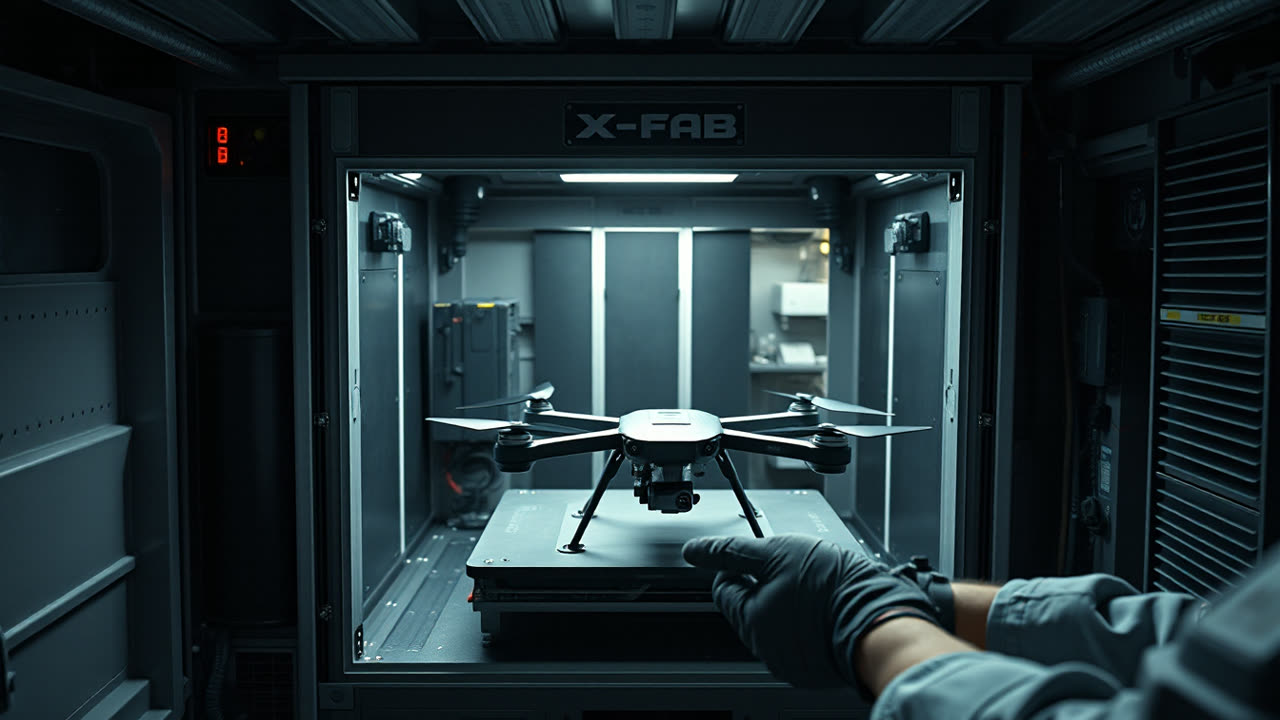
A containerized factory aboard the USS Essex successfully 3D-printed a dozen flight-ready, 80-mph First-Person View (FPV) drones and over 1,000 vital parts, including critical spares for Apache helicopters, during a two-week journey to Hawaii, demonstrating a significant leap in expeditionary manufacturing capabilities despite rough seas and 12-foot waves. This unprecedented exercise, part of the Marine Corps' Project Kraken, showcased the ability to produce operational assets and essential components in challenging maritime environments, directly addressing the logistical vulnerabilities inherent in traditional global supply chains. The deployment of the "X-FAB" container, a portable additive manufacturing facility, represents a pivotal shift towards localized production, potentially transforming how military forces sustain operations and respond to emergent needs far from established industrial bases.
The success aboard the USS Essex holds profound implications for military logistics, operational readiness, and the broader defense industry. By enabling the on-demand fabrication of combat-ready drones and critical spares, this capability drastically reduces reliance on lengthy and often vulnerable supply lines. Imagine a scenario where a critical component fails in a remote theater; instead of waiting weeks for shipment, a replacement can be printed within hours or days, minimizing downtime and maximizing asset availability. This not only enhances combat effectiveness but also reduces the logistical footprint and associated costs of maintaining vast spare parts inventories. Furthermore, the ability to rapidly iterate and produce specialized drones tailored for specific missions, from reconnaissance to decoy operations, offers an unprecedented tactical advantage. The FPV drones, capable of 80 mph, suggest applications ranging from advanced scouting to potentially swarming tactics, providing commanders with flexible, customizable aerial assets on demand.
Historically, naval forces have faced immense challenges in maintaining complex machinery thousands of miles from shore, with spare parts often subject to delays, damage, or obsolescence. Previous efforts in military additive manufacturing primarily focused on printing non-critical parts or prototypes in more stable, land-based environments. While the US Navy has explored 3D printing for years, with initiatives like the X-FAB pushing capabilities forward, the USS Essex exercise marks a critical validation of at-sea, combat-ready production. This contrasts sharply with prior generations where a broken part often meant a ship or aircraft was mission-incapable until a replacement arrived, sometimes from halfway across the globe. Rivals, while also investing in additive manufacturing, have not publicly demonstrated such a robust, at-sea, combat-ready fabrication capability under such adverse conditions. The ability of the X-FAB to function effectively amidst 12-foot waves underscores the engineering resilience and maturity of the integrated system.
Looking ahead, this successful demonstration signals a clear trajectory towards more widespread integration of additive manufacturing across military branches. The immediate next steps will likely involve refining the X-FAB’s capabilities, expanding the range of printable materials, and increasing the complexity and size of producible components. We can anticipate further investment in developing robust, deployable manufacturing units that can withstand diverse operational environments, from arctic conditions to desert heat. The implications extend beyond spare parts and drones; future iterations could include printing specialized tools, medical devices, or even components for larger systems. This distributed manufacturing paradigm could fundamentally alter defense procurement strategies, favoring flexible, localized production over centralized, mass manufacturing for certain items. However, challenges remain, including material certification for critical structural components, ensuring cybersecurity for digital designs, and training personnel to operate these advanced mobile factories. Despite these hurdles, the USS Essex exercise stands as a powerful testament to a future where military forces are not just consumers of technology, but its agile producers, capable of self-sufficiency and rapid innovation at the very edge of the battlespace.