Vermeer Unveils Full-Scale Lunar Excavator Prototype, Escalating Space Resource Race
International equipment manufacturer Vermeer has unveiled its full-scale Interlune excavator prototype, a machine engineered to process 100 metric tons of lunar regolith per hour while simultaneously extracting valuable helium, fundamentally shifting the landscape for both the heavy equipment industry and the burgeoning space economy by transforming abstract lunar resource utilization into a tangible engineering challenge with profound implications for Earth's energy future and humanity's expansion into space.
✨ This content was summarized and interpreted by AI; it may contain errors — please verify accuracy with the original sources. Learn more
Listen to this story
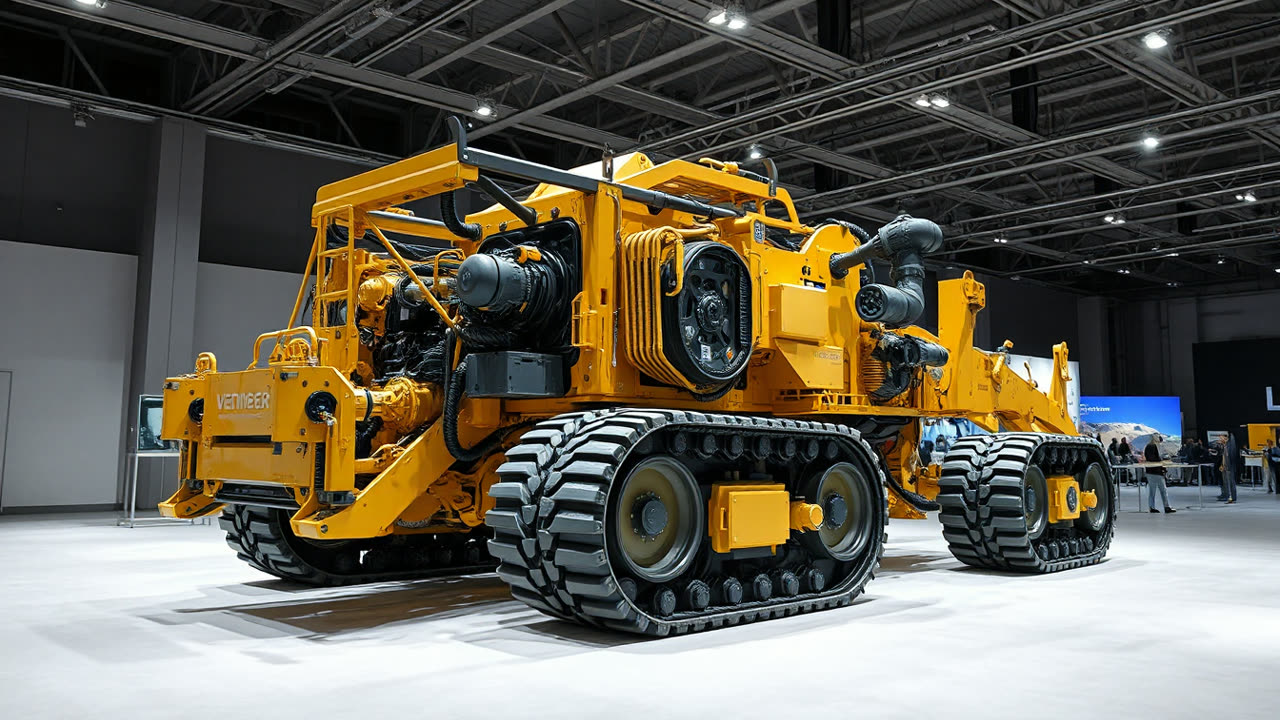
International equipment manufacturer Vermeer has significantly escalated the lunar resource race with the unveiling of its full-scale Interlune excavator prototype, a machine engineered to process 100 metric tons of lunar regolith per hour while simultaneously extracting valuable helium. This formidable capability positions Vermeer as a critical player in the nascent but rapidly accelerating field of extraterrestrial mining, transforming the abstract concept of lunar resource utilization into a tangible engineering challenge with potentially profound implications for Earth's energy future and humanity's expansion into space.
The Interlune excavator, developed in partnership with the space resources company Interlune, represents a monumental leap in heavy equipment design, adapting terrestrial excavation principles to the harsh vacuum, extreme temperatures, and low gravity of the lunar environment. Its stated capacity to ingest 100 metric tons of rocks and dirt hourly is not merely an impressive statistic; it is a fundamental benchmark for the viability of large-scale lunar operations. This rate of material processing is crucial for economically extracting helium-3, a rare isotope abundant in lunar regolith but scarce on Earth, which holds immense promise as a clean, powerful fuel for future fusion reactors. The machine’s integrated extraction capability means it’s not just moving dirt, but actively refining it on-site, a critical step to minimize payload mass for return journeys or in-situ resource utilization. The partnership with Interlune, a company focused specifically on lunar helium-3 extraction, underscores a targeted approach to commercializing lunar resources, moving beyond government-led exploratory missions to a more industrial framework.
The unveiling of the Interlune excavator fundamentally shifts the landscape for both the heavy equipment industry and the burgeoning space economy. For traditional manufacturers like Vermeer, known for their robust terrestrial machinery, this venture signifies a diversification into an entirely new, high-stakes market. It demonstrates that the technological prowess developed over decades for construction and mining on Earth can be adapted to solve the unique engineering challenges of off-world operations. This move could catalyze further investment and innovation from other established heavy equipment giants, potentially sparking an "off-world" arms race among manufacturers to develop excavators, drills, and transport systems tailored for lunar or even Martian conditions. For users – future space agencies, private space mining companies, and even eventual lunar colonists – the Interlune offers a concrete tool to unlock the moon's potential. Its high processing rate directly translates to faster resource accumulation, making projects like establishing permanent lunar bases or fueling deep-space missions more economically feasible. Without efficient excavation and processing, the vast reserves of lunar helium-3, water ice, and rare earth elements remain largely inaccessible.
Compared to its nascent rivals and the rudimentary excavation methods of prior lunar missions, the Interlune excavator stands out. Previous lunar sample returns relied on small scoops and drills attached to robotic landers, designed for scientific analysis rather than industrial-scale processing. Even current proposals for lunar mining often involve smaller, less integrated systems. While companies like Caterpillar have also expressed interest in lunar construction and resource extraction, and startups like Lunar Outpost and Astrobotic are developing smaller robotic platforms for surface operations, Vermeer's full-scale prototype with its 100-ton-per-hour processing and integrated helium extraction capability appears to be a front-runner in demonstrating industrial-scale readiness. The challenge for rivals will be to match this demonstrated throughput and integrated functionality, or to specialize in niche applications like precise water-ice extraction from shadowed craters, which may require different design considerations. The Interlune's design likely incorporates advanced materials to withstand the abrasive lunar regolith and extreme thermal cycling, along with autonomous or semi-autonomous operational capabilities to minimize human intervention given the communication delays and hazardous environment.
Looking ahead, the successful deployment and operation of the Interlune excavator will mark a pivotal moment, potentially accelerating the timeline for commercial lunar resource extraction. The next steps will undoubtedly involve rigorous testing in simulated lunar environments, followed by a planned uncrewed mission to the Moon to validate its performance in situ. Data from such a mission will be invaluable for refining the design and proving the economic viability of lunar mining operations. Should the Interlune prove effective, it could pave the way for a permanent human presence on the Moon, supported by locally sourced materials and energy. We can anticipate a surge in demand for supporting infrastructure, including lunar power generation, communication networks, and transportation systems, all of which will need to be developed concurrently. Furthermore, the focus on helium-3 suggests a long-term vision for a fusion energy economy on Earth, making the moon a strategic asset for future energy security. The "heavy equipment space race" is not just about digging; it's about laying the groundwork for an entirely new industrial frontier, with Vermeer's Interlune prototype serving as a powerful harbinger of humanity's off-world future.