Vogue World's Robot Runway Flop Highlights AI Fatigue
Vogue World: Milano's integration of Unitree humanoid robots on the runway for its 'Age of Intelligence' segment drew widespread disappointment, becoming a viral symbol of superficial AI application and public 'AI fatigue'.
✨ This content was summarized and interpreted by AI; it may contain errors — please verify accuracy with the original sources. Learn more
Listen to this story
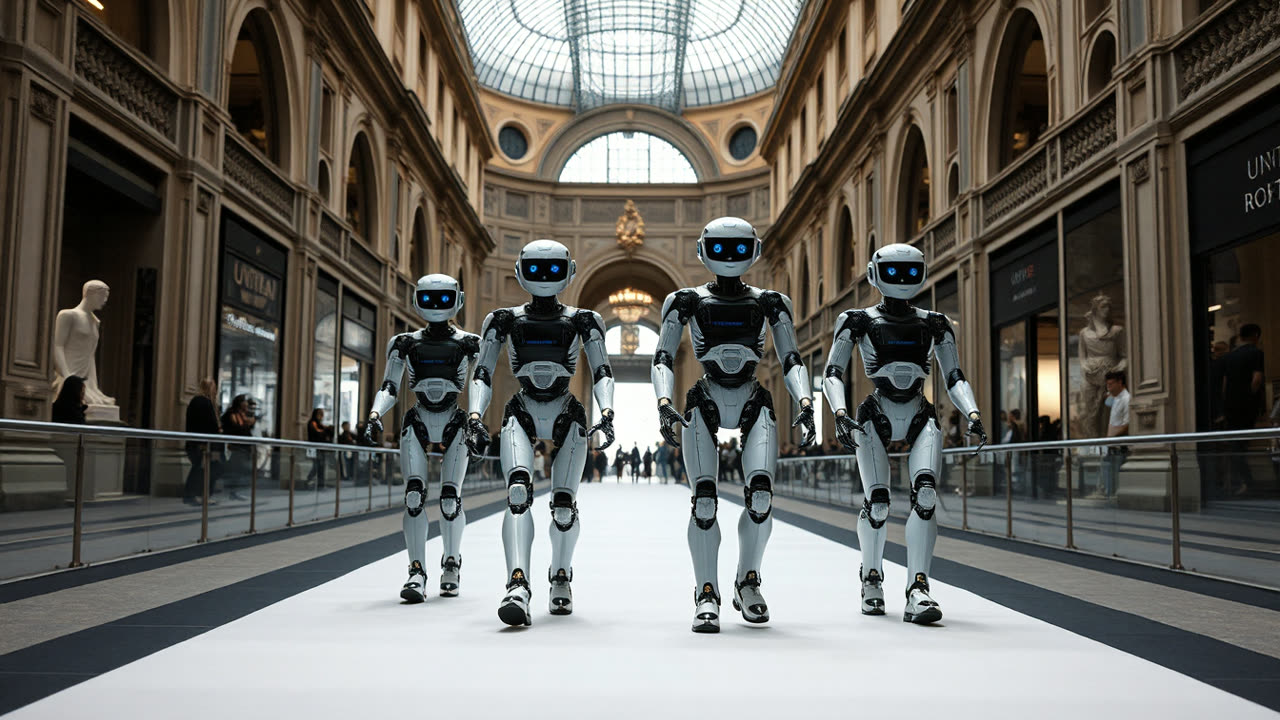
Vogue World: Milano 2026, held on September 22nd at the historic Galleria Vittorio Emanuele II, intended to celebrate Italian craftsmanship and the nexus of tradition and technology, yet its integration of humanoid robots on the runway elicited widespread disappointment and confusion. During the "Age of Intelligence" segment, four humanoid robots from Chinese robotics company Unitree Robotics traversed the runway, performing basic gestures and a "lasso" dance to Gigi D'Agostino's "L'Amour Toujours." The robots, notably unclothed and lacking any discernible interaction with the showcased fashion, became the most talked-about, and largely ridiculed, moment of an otherwise star-studded event featuring legacy houses like Prada, Armani, and Gucci. Social media quickly seized upon the visibly "stunned" expressions of designers Miuccia Prada and Alessandro Michele in the front row, transforming their reactions into viral memes that encapsulated the general public's "AI fatigue" and the question, "Where are the clothes?"
This superficial display of technology, positioned by Vogue World creative director Juan Costa Paz as an "inflection point in human history," starkly underscores the precarious balance luxury brands face when attempting to merge heritage with innovation. The event's theme, "Where The Future Is Made By The Hand," directly contradicted the uninspired robot performance, which offered little beyond novelty and failed to meaningfully engage with the concept of craftsmanship or fashion itself. For an industry built on exclusivity, artistry, and the human touch, a bland robotic interlude, seemingly driven by tech sponsors like Meta Glasses and OpenAI, risked diluting the very prestige Vogue World aimed to celebrate. The public's unenthusiastic response highlights a growing skepticism towards technology, particularly AI, when it's presented as a mere spectacle rather than a tool for genuine creative enhancement or problem-solving.
The fashion world is no stranger to technological experimentation on the runway, but previous iterations demonstrated a more integrated and artistic approach. Alexander McQueen's iconic 1999 "No. 13" show, for instance, featured industrial robot arms spray-painting a white dress worn by model Shalom Harlow, transforming it into a dynamic work of art. Hussein Chalayan similarly pushed boundaries with garments embedded with mechanical systems that evolved through different fashion eras in 2000. More recently, Coperni's Fall/Winter 2023-24 show saw Boston Dynamics' Spot robot dogs interacting directly with models and garments, creating a choreographed relationship between machine, body, and clothing. These examples succeeded because the technology served a creative purpose, enhancing the narrative or challenging perceptions of fashion. In contrast, Vogue World's robots simply existed, offering no comparable function or artistic depth, leading to the perception that they were included merely because "AI and robotics are currently fashionable subjects." Even the same Unitree Robotics humanoids had previously taken center stage at Shanghai Fashion Week AW25-26, suggesting that the issue wasn't the robots themselves, but their unimaginative application in Milan.
Looking ahead, the incident at Vogue World: Milano serves as a critical lesson for the luxury and fashion sectors. While technology is undeniably reshaping the industry—from AI-assisted design and predictive trend forecasting to digital sampling, virtual try-ons, and smart textiles—its integration into the consumer-facing aspects, particularly live shows, demands far greater sophistication. Brands must move beyond superficial gimmicks and embrace "gentle AI" that augments human creativity and experience, rather than overshadowing or replacing it. The future of fashion lies in leveraging technology to address genuine challenges like sustainability, supply chain transparency, and hyper-personalization, all while preserving the artisanal essence and emotional connection that define luxury. Vogue's announcement that the next Vogue World will take place in San Francisco in 2027 suggests a continued drive to engage with Silicon Valley. However, for this ambition to resonate, future events must demonstrate a profound understanding of how technology can truly elevate fashion, rather than merely serving as a distracting, uninspired spectacle. The industry's evolution hinges on a thoughtful, integrated approach that respects both tradition and genuine innovation, ensuring that the "human touch" remains at the core of its creative expression.