Wawa Expands EV Charging Footprint with Self-Branded Electrify America Fast Chargers
East Coast convenience giant Wawa is significantly expanding its electric vehicle charging infrastructure, introducing self-branded Electrify America fast chargers at eight Pennsylvania locations, signaling a strategic shift to direct ownership and revenue control.
✨ This content was summarized and interpreted by AI; it may contain errors — please verify accuracy with the original sources. Learn more
Listen to this story
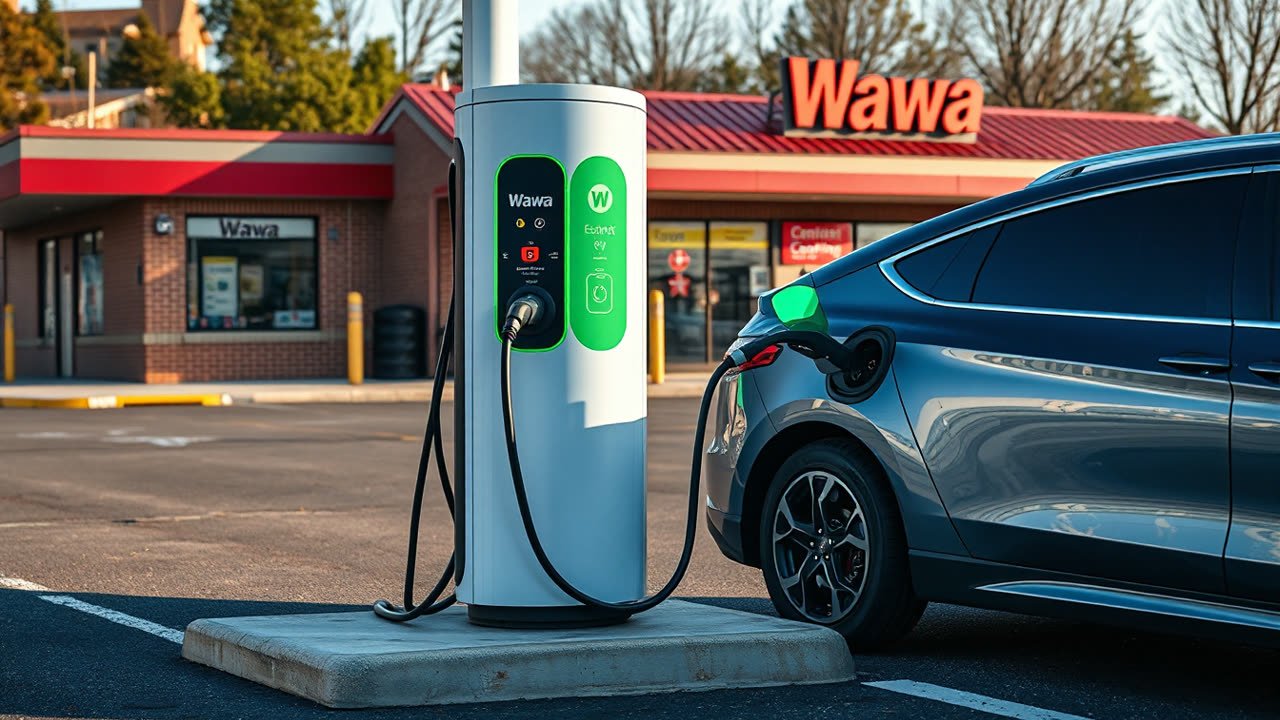
Wawa, the prominent East Coast convenience retailer, is significantly expanding its footprint in the electric vehicle (EV) charging sector, introducing self-branded Electrify America fast chargers at eight Pennsylvania locations this year, a strategic move that follows its earlier launch of Wawa-branded Tesla Superchargers. This latest deployment will feature advanced DC fast charging stations, with five sites offering speeds up to 400 kilowatts (kW) through both NACS and CCS connectors, and the remaining three providing up to 350 kW via CCS connectors. The initiative, described by Wawa's Senior Vice President Rich Makin as a "test" for Wawa-owned charging, signals a clear intent to assume direct control over the charging experience and revenue streams, moving beyond its previous role as merely a host for third-party networks.
This shift by Wawa holds substantial implications for both EV users and the broader industry. For consumers, it promises enhanced convenience and reliability, as Wawa gains direct control over pricing, site expansion, and operational uptime, addressing a critical pain point in public charging infrastructure. The presence of ultra-fast chargers (up to 400 kW) with both NACS and CCS connectors is particularly beneficial, future-proofing these locations against evolving vehicle standards and ensuring accessibility for a wider array of EV models. Drivers can expect a more consistent and integrated experience, where a charging stop seamlessly blends with Wawa's established in-store amenities, encouraging longer visits and increased ancillary sales of coffee and food.
Industrially, Wawa's aggressive foray into owning and branding charging infrastructure underscores a pivotal transformation within the convenience retail sector. Once primarily landlords for charging networks, major chains like Wawa are now recognizing the strategic value of EV charging as a core business asset, aiming to capture the entire revenue stream from electricity sales. This trend is mirrored by competitors such as Circle K, which is partnering with IONNA to install hundreds of 400 kW fast chargers, and Walmart, which continues to roll out its own branded stations. These retailers are leveraging their extensive real estate and existing customer traffic to become indispensable hubs for the growing EV population, intensifying competition not only among charging networks but also within the retail landscape itself. This multi-network, multi-connector approach adopted by Wawa also highlights the industry's move towards interoperability and standardization, vital for mass EV adoption.
Wawa's evolution in the EV charging space is particularly notable given its history. For over a decade, Wawa has been a key partner to Tesla, hosting Superchargers at 223 sites with more than 2,100 stalls, making it the largest host of Tesla Superchargers. Earlier this year, in January 2026, Wawa launched its first self-branded Tesla Supercharger site in Alachua, Florida, featuring 16 stalls with a 325 kW power output, setting its own price at $0.37/kWh for both Tesla and non-Tesla users. This transition from a hosting model to an owner-operator model, now extended to Electrify America, signifies a calculated move to exert greater control over the customer experience and profitability.
Compared to its rivals, Wawa is positioning itself as a comprehensive charging destination. The Tesla Supercharger network remains dominant in the U.S., boasting 37,428 ports across 3,088 stations as of mid-May 2026, representing 52% of all DC fast charging ports and known for its high reliability and an uptime exceeding 99.9%. Tesla is also transitioning to V4 Supercharger cabinets, capable of up to 500 kW for compatible vehicles. Electrify America, a subsidiary of Volkswagen Group of America, has also expanded significantly, surpassing 5,600 chargers across North America by February 2026 and holding approximately 7.7% of the U.S. DC fast-charging market with 5,743 ports as of July 2026. While Electrify America has faced criticism regarding reliability, it is actively upgrading its network and adopting NACS connectors, with its white-label platform proving instrumental for partnerships like Wawa's. Furthermore, Wawa also hosts IONNA fast chargers, a network backed by eight major automakers, which aims to deploy 30,000 charging bays by 2030, offering 400 kW charging with both CCS and NACS connectors. This multi-network strategy allows Wawa to cater to the diverse needs of EV drivers, irrespective of their vehicle's charging standard.
Looking ahead, Wawa's "test" in Pennsylvania is likely a precursor to a much broader rollout across its more than 1,100 locations in 14 states, solidifying its position as a leading convenience-based charging provider. The EV charging market is maturing, shifting from a focus on sheer scale to emphasizing operational performance, reliability, and an exceptional customer experience. Federal initiatives, such as the National Electric Vehicle Infrastructure (NEVI) program, are also playing a crucial role by providing significant funding (up to 80% of project costs) for DC fast charging stations along alternative fuel corridors, mandating features like four 150 kW ports, 24/7 availability, and 97% uptime, which aligns with Wawa's emphasis on reliability. The future will undoubtedly see more white-label partnerships and strategic alliances between charging network operators and large retailers, as they collectively work to build a robust, user-friendly, and profitable EV charging ecosystem. The emphasis will remain on seamless integration of charging with daily routines, making the act of "refueling" an EV as convenient and commonplace as filling a gas tank.