Waymo Launches Driverless Robotaxi Service in Denver, San Diego, and Tampa
Waymo has launched its public driverless ride-hailing service in Denver, San Diego, and Tampa, bringing its total operational footprint to 14 U.S. cities and cementing its leadership in autonomous mobility.
✨ This content was summarized and interpreted by AI; it may contain errors — please verify accuracy with the original sources. Learn more
Listen to this story
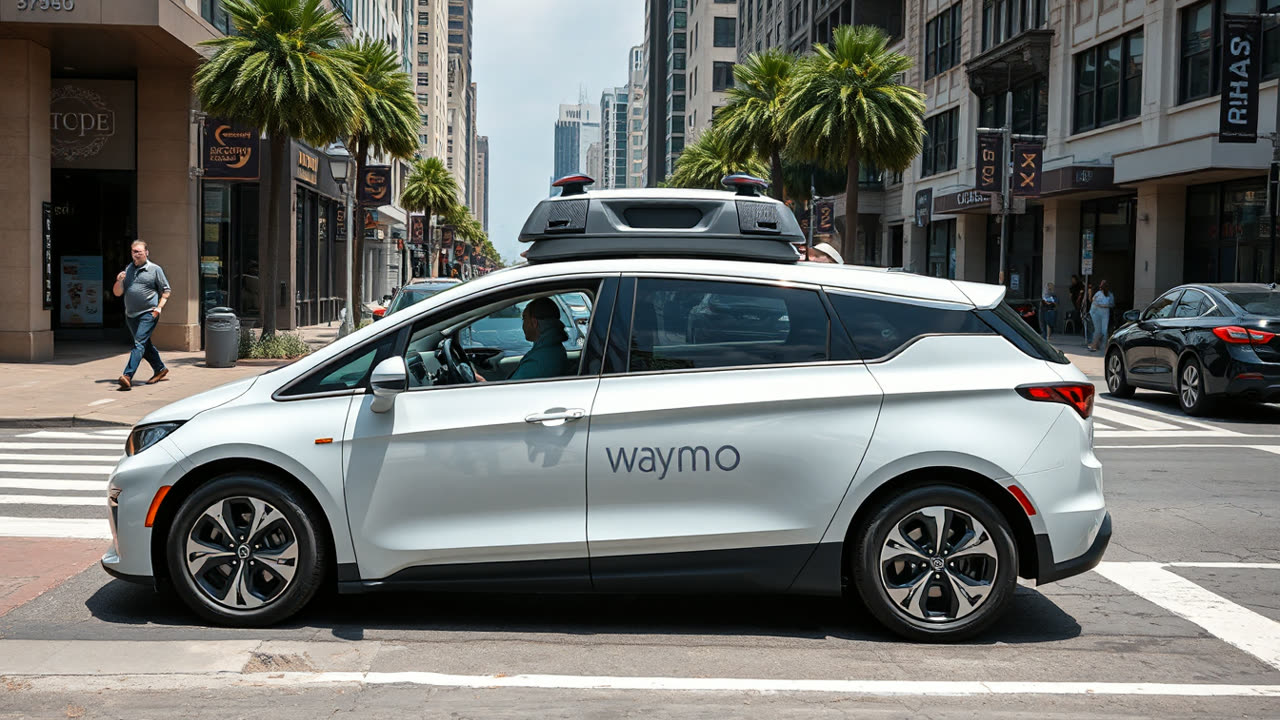
Waymo initiated public driverless ride-hailing services in Denver, San Diego, and Tampa on Monday, September 1, 2026, expanding its operational footprint to 14 U.S. cities and further solidifying its lead in the burgeoning autonomous vehicle sector. This strategic move follows extensive testing phases in each market, where tens of thousands of residents had already signed up for early access, indicating a significant public appetite for fully driverless transportation. The addition of these three diverse metropolitan areas – a high-altitude city, a sprawling coastal metropolis, and a rapidly growing sunbelt hub – demonstrates Waymo's increasing confidence in its fifth-generation Driver technology to handle varied urban complexities, from dense downtown traffic to distinct weather patterns and diverse road infrastructure.
This expansion marks a critical inflection point for both Waymo and the broader autonomous vehicle industry, moving beyond a handful of initial test cities to a more widespread commercial deployment that impacts a larger user base. For consumers, the immediate impact is the promise of enhanced convenience, safety, and potentially, eventually, cost-effectiveness compared to traditional ride-hailing. Waymo's vehicles, operating without a human safety driver, offer a consistent, predictable service unburdened by human factors like fatigue or distraction, which could fundamentally reshape urban mobility patterns by reducing private car ownership and alleviating parking congestion in dense areas. The sheer volume of pre-registrations underscores a growing public acceptance and enthusiasm for driverless technology, a crucial hurdle for the industry to overcome after years of cautious skepticism. For the industry, Waymo's accelerated rollout puts immense pressure on rivals like General Motors' Cruise and Amazon's Zoox, who have faced their own set of operational challenges and regulatory scrutiny in recent years. While Cruise has made strides in cities like San Francisco, its operations have been subject to more public incidents and regulatory suspensions, particularly after a widely reported collision in late 2023 led to a temporary halt in its California operations. Zoox, while testing in cities like Las Vegas and Seattle, has yet to achieve the same scale of public deployment as Waymo, focusing more on purpose-built vehicles and a more measured rollout. Waymo's consistent, if deliberate, expansion strategy, underpinned by billions of miles of real-world and simulated driving, positions it as the benchmark for reliability and safety in the driverless space.
Waymo's journey began over a decade ago as the Google self-driving car project, evolving through various technological iterations. Its current fifth-generation Driver system integrates an advanced suite of lidar, radar, and camera sensors, processed by sophisticated AI algorithms that create a 360-degree view of the vehicle's surroundings and predict the behavior of other road users with remarkable accuracy. This comprehensive sensing and perception stack represents a significant leap from earlier prototypes, which were often limited by less robust sensor arrays and less mature machine learning capabilities. Unlike some competitors that prioritize a "vision-only" approach, Waymo's multi-modal sensor fusion provides redundancy and resilience, particularly in adverse weather conditions or complex lighting scenarios. This approach contributes to its robust safety record, a critical differentiator in an industry where public trust is paramount. Waymo's existing operational cities, including Phoenix, San Francisco, Los Angeles, Austin, and Atlanta, have served as crucial proving grounds, allowing the company to refine its technology and operational playbooks across diverse environments before this latest expansion. The company's strategy emphasizes a phased approach, starting with geo-fenced operational design domains (ODDs) and gradually expanding service areas within each city as its mapping and driving intelligence matures.
Looking ahead, Waymo's expansion to 14 cities signals an aggressive push for market dominance and hints at a future where autonomous ride-hailing is a commonplace urban utility rather than a novel experiment. The next phase will likely involve further geographical expansion, with Waymo targeting more mid-sized and large U.S. cities that present viable economic models and amenable regulatory environments. Concurrently, the company will focus on enhancing the capabilities of its Driver technology to handle increasingly complex scenarios, such as unmapped construction zones, diverse weather phenomena beyond light rain, and potentially even off-road conditions for specialized applications. The introduction of purpose-built autonomous vehicles, designed from the ground up without driver controls, similar to what Zoox is developing, could also be on Waymo's horizon, potentially in collaboration with automotive partners like Geely's Zeekr. Regulatory harmonization across states and municipalities will remain a critical challenge and opportunity, as a patchwork of varying rules can impede rapid scaling. Furthermore, the economic sustainability of robotaxi services will be tested as Waymo scales, requiring careful optimization of fleet utilization, maintenance, and energy costs. Waymo's current trajectory suggests a future where its fully autonomous vehicles will not only transport passengers but also potentially integrate into logistics and last-mile delivery services, further diversifying its revenue streams and cementing its role as a foundational layer in the smart city infrastructure of tomorrow.