Waymo Robotaxi Gridlock Paralyzes San Francisco, Mayor Demands Tougher State Oversight
A massive, hours-long gridlock caused by Waymo robotaxis brought parts of San Francisco to a standstill, prompting Mayor Daniel Lurie to demand immediate, tougher state-level oversight for autonomous vehicle operators.
✨ This content was summarized and interpreted by AI; it may contain errors — please verify accuracy with the original sources. Learn more
Listen to this story
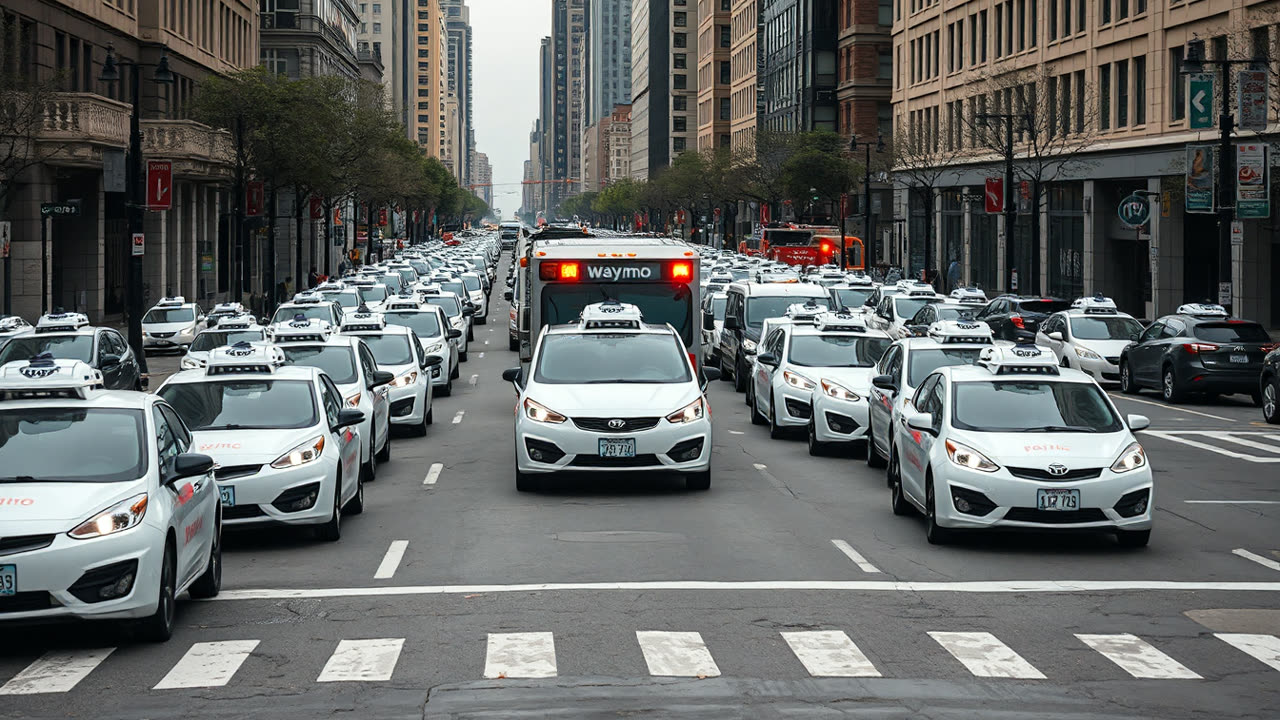
A massive, hours-long gridlock event caused by Waymo robotaxis brought parts of San Francisco to a standstill on July 15, prompting Mayor Daniel Lurie to demand immediate, tougher state-level oversight for autonomous vehicle (AV) operators. The incident, which reportedly paralyzed key downtown arteries and emergency vehicle access for over four hours, saw dozens of Waymo vehicles simultaneously halt, creating an unprecedented choke point that city officials described as a critical public safety failure. This latest disruption pushes the already strained relationship between San Francisco’s municipal government and the burgeoning robotaxi industry to a breaking point, signaling a potential regulatory pivot that could reshape the deployment of AV technology nationwide.
The immediate fallout from the gridlock is profound, extending beyond mere inconvenience to encompass serious questions about urban resilience and emergency response capabilities. Eyewitness accounts and city reports indicate that ambulances and fire trucks struggled to navigate the immobilized robotaxi fleet, raising alarms about response times in life-threatening situations. For users, the incident underscores the fragility of current AV systems in complex urban environments, eroding public trust that companies like Waymo have painstakingly tried to build. While Waymo quickly attributed the stoppage to a rare confluence of a software anomaly and an unusual surge in network traffic, their subsequent, somewhat opaque explanation has done little to assuage local anger. This event matters immensely because it shifts the narrative from isolated "stuck robotaxi" anecdotes to a systemic failure capable of paralyzing a major metropolitan area, directly challenging the industry's promise of safer, more efficient transportation.
Mayor Lurie's direct appeal to state regulators, likely the California Public Utilities Commission (CPUC) and the Department of Motor Vehicles (DMV), marks a significant escalation from previous calls for localized control. Historically, the CPUC has held primary authority over robotaxi deployment and expansion in California, often overriding local objections in the interest of fostering innovation. This incident, however, provides concrete evidence that the current regulatory framework, which largely permits AV expansion unless a pattern of significant safety issues is demonstrably proven, is insufficient to prevent large-scale urban disruption. Lurie is reportedly advocating for a "kill switch" mandate, requiring operators to implement a remote override system that city authorities could activate in emergencies, along with stricter reporting requirements for all operational anomalies, not just those involving collisions or injuries.
The context for this crisis is rooted in a series of prior, albeit less severe, incidents involving both Waymo and its now-beleaguered rival, Cruise. While Waymo has generally maintained a stronger safety record than Cruise, which saw its California operating permit suspended indefinitely in late 2023 after a pedestrian-dragging incident and subsequent regulatory scrutiny, even Waymo has experienced occasional "freezing" events and minor traffic obstructions. The key difference here is the scale and duration: previous incidents were typically localized and resolved relatively quickly. This recent gridlock represents a qualitative shift, demonstrating a single point of failure within an AV fleet's operational logic that can cascade into widespread civic paralysis. Compared to the prior generation of AV testing, which involved human safety drivers, the current fully driverless operations inherently carry a higher risk of unmitigated system failures, a risk that San Francisco is now acutely experiencing.
Looking ahead, the fallout from this incident is likely to have far-reaching implications. State regulators, now under intense public and political pressure, will find it increasingly difficult to resist calls for more stringent oversight. Expect to see serious consideration of Mayor Lurie's proposed "kill switch" and enhanced data-sharing protocols, potentially leading to a more collaborative regulatory model that grants cities greater input into AV deployment and emergency response protocols. For Waymo, the immediate challenge is not just to resolve the underlying software issue but to rebuild public trust through transparent communication and demonstrable improvements to its fail-safe mechanisms. This may involve implementing more robust, geographically partitioned operational safeguards to prevent system-wide failures, or even temporarily scaling back operations in densely populated areas until new protocols are in place. The incident also serves as a stark warning to other cities considering or currently hosting robotaxi services, suggesting that the current laissez-faire regulatory approach may be unsustainable. Ultimately, the San Francisco gridlock could mark a turning point, ushering in a new era of more cautious, city-centric AV deployment that prioritizes public safety and urban resilience over unchecked technological acceleration.