Weird and Wonderful Headphones at CanJam SoCal 2026 Redefine High-Fidelity Audio
CanJam SoCal 2026 unveiled a wave of groundbreaking personal audio innovations, from revolutionary MEMS drivers to advanced wireless lossless solutions, promising to redefine high-fidelity listening.
✨ This content was summarized and interpreted by AI; it may contain errors — please verify accuracy with the original sources. Learn more
Listen to this story
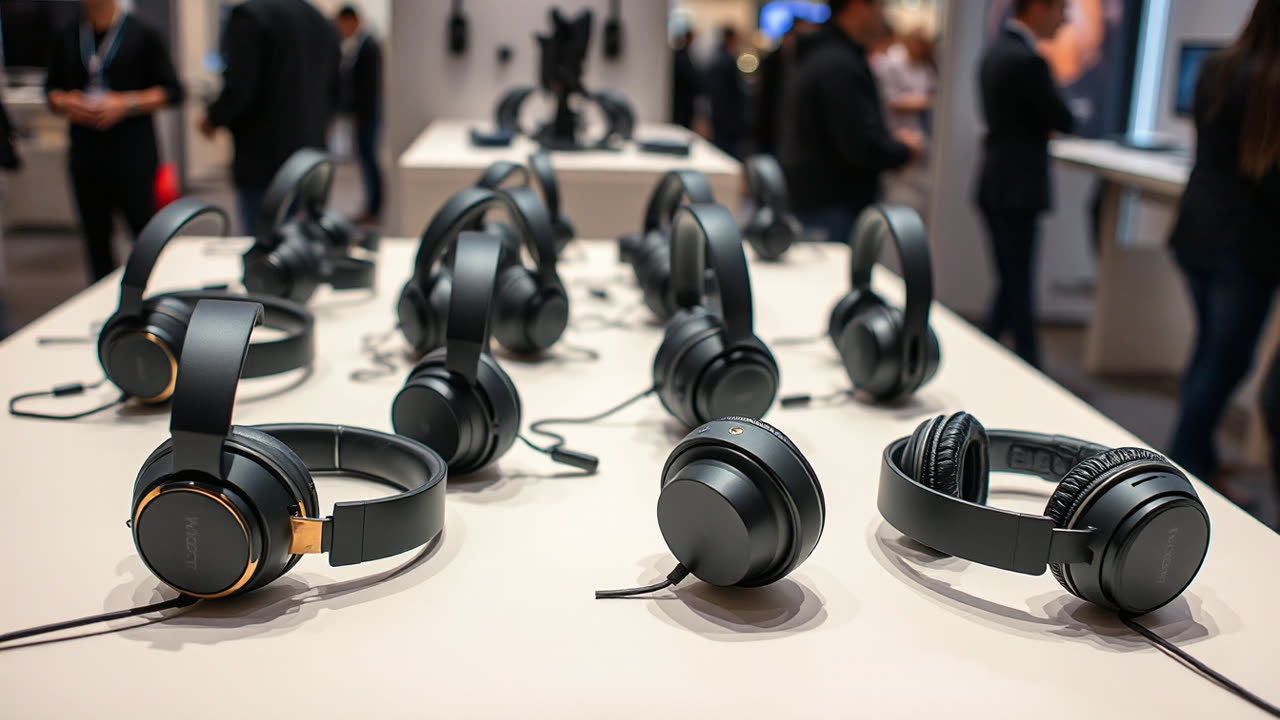
CanJam SoCal 2026, held from August 29-30, 2026, at the Irvine Marriott, showcased an exhilarating departure from the staid incrementalism of mainstream personal audio, revealing a landscape brimming with genuinely "weird and wonderful" innovations poised to redefine high-fidelity listening. This year's event, alongside CanJam NYC and London, highlighted a vibrant ecosystem where exotic materials, revolutionary driver technologies, and sophisticated digital processing are pushing the boundaries of what headphones can achieve.
At the forefront of this revolution is the emergence of **MEMS (Micro-Electro-Mechanical Systems) drivers**, signaling a profound shift in transducer technology. xMEMS Labs, a significant player in this space, is targeting volume production for its Sycamore MEMS loudspeaker in the second half of 2026. This groundbreaking solid-state alternative to conventional dynamic drivers is astonishingly compact, reportedly 98% smaller by volume (just 85mm³ compared to approximately 4,000mm³ for 50mm dynamic drivers) and weighing a mere 150 milligrams. Its dramatically lower moving mass promises tighter manufacturing tolerances, leading to unparalleled left-right channel matching and consistency, a perennial challenge for traditional designs. The impact extends beyond pure fidelity; xMEMS is also implementing its µCooling technology, an "air pump-on-a-chip," to actively manage humidity and heat buildup within earcups, addressing a long-standing comfort issue during extended listening sessions. This technology was already hinted at in products like the Creative Aurvana Ace earbuds, and its application to full-size headphones, as seen in the new Kinera Freya-Vanir which utilizes a dedicated MEMS driver for ultra-high frequencies, promises enhanced openness and airiness in the soundstage.
Another significant development observed was the continued refinement of **planar magnetic and electrostatic drivers**, particularly in overcoming their traditional limitations. Audeze's new LCD-5s, priced at $4,500, integrates their Symmetric Linear Acoustic Modulator (SLAM) technology to deliver a more powerful and controlled bass response, directly addressing the often-criticized lack of low-end impact in many electrostatic designs. SLAM achieves this by precisely managing air pressure around the driver through tuned acoustic channels, rather than forcing greater diaphragm excursion. This incremental yet crucial refinement on a flagship model like the LCD-5s demonstrates a commitment to pushing existing technologies to their theoretical limits. Similarly, Melodic Artification made waves at CanJam NYC 2026 with the industry's first implementation of pure beryllium diaphragms within planar magnetic drivers for their flagship Infinitum headphones and Eternitum in-ears. Beryllium's exceptional stiffness-to-weight ratio, previously lauded in high-end dynamic drivers like the Focal Utopia, now promises lightning-fast transient response and unprecedented detail in planar magnetic architectures.
The proliferation of **advanced wireless solutions and sophisticated digital signal processing (DSP)** further underscored the innovative spirit of CanJam 2026. HiFiMAN, for example, is championing truly lossless wireless audio via Wi-Fi, moving beyond the bandwidth limitations of Bluetooth. Their Arya WiFi and HE1000 WiFi models can handle full-resolution audio streams, including PCM up to 768 kHz and native DSD, by incorporating proprietary Hymalaya R2R DACs and integrated amplifiers directly into each earcup. This self-contained playback system, though currently offering 6-7 hours of battery life in Wi-Fi mode, represents a significant leap towards uncompromised wireless fidelity. Beyond raw data transfer, companies like EarFun and Edifier are integrating sophisticated digital crossover architectures and multi-driver setups in their latest wireless offerings. The EarFun Wave Pro X, launching September 3, 2026, features a Dual-Coaxial Acoustic Architecture (DCAA) with a 40mm woofer and a 10mm tweeter per earcup, managed by a DSP-enhanced analog crossover. Similarly, Edifier's WH950NB Pro headphones, unveiled at IFA 2026, employ a dual-driver design (40mm woofer, 10mm tweeter) with a DSP-enhanced analog crossover to ensure smoother transitions between drivers. These designs aim to deliver reference-grade sound quality in a wireless, noise-canceling form factor, further blurring the lines between traditional audiophile gear and consumer convenience.
These advancements collectively signify a critical juncture for the headphone industry. For users, particularly audiophiles, it means access to unparalleled clarity, dynamic range, and spatial reproduction that surpasses previous generations. The focus on comfort through innovations like xMEMS' µCooling addresses long-standing ergonomic issues, making high-end listening more enjoyable for extended periods. For the industry, these "weird and wonderful" headphones are not mere niche curiosities but vital innovation drivers. They challenge established norms, compel traditional manufacturers to accelerate their R&D, and create new market segments for specialized components and bespoke designs. The increasing integration of AI for real-time sound personalization and adaptive noise cancellation, as well as spatial audio with dynamic head tracking seen in models like the Edifier WH950NB Pro, hints at a future where headphones are not just playback devices but intelligent, adaptive audio companions.
Looking ahead, the momentum generated at CanJam 2026 suggests a future where high-end headphones will continue to diversify, moving beyond the conventional dynamic and planar magnetic designs that have dominated for decades. We can expect MEMS drivers to become increasingly prevalent, not just in premium offerings but potentially trickling down to more accessible price points as production scales. The quest for truly immersive sound will likely see further development in acoustic metamaterials and advanced spatial audio algorithms, creating listening experiences that are indistinguishable from live performances. The ongoing battle for lossless wireless audio will intensify, with Wi-Fi and even more sophisticated radio technologies potentially supplanting Bluetooth for critical listening. As the lines between professional and consumer audio blur, the next few years promise a headphone market defined by bold experimentation, pushing the very limits of sound reproduction and user experience.
FACTS: The weird and wonderful headphones of CanJam 2026 — I've been reviewing headphones for a long time, and I've listened to everything from the barely serviceable to multi-thousand-dollar open-back headphones. But recently I've been uninspired by the state of mainstream options. Most are perfec (kaynak: The Verge AI, https://www.theverge.com/tech/990706/a-day-at-canjam-socal-2026)