Whisker-Equipped Drone Achieves Sub-Millimeter Tactile Navigation
A novel sub-100 gram drone, equipped with physical whiskers akin to those found on mice, marks a significant leap in autonomous navigation, enabling sub-millimeter precision in environments where traditional camera and GPS systems falter, fundamentally redefining the robustness and autonomy of small-scale aerial robotics and opening new frontiers for exploration, inspection, and emergency response.
✨ This content was summarized and interpreted by AI; it may contain errors — please verify accuracy with the original sources. Learn more
Listen to this story
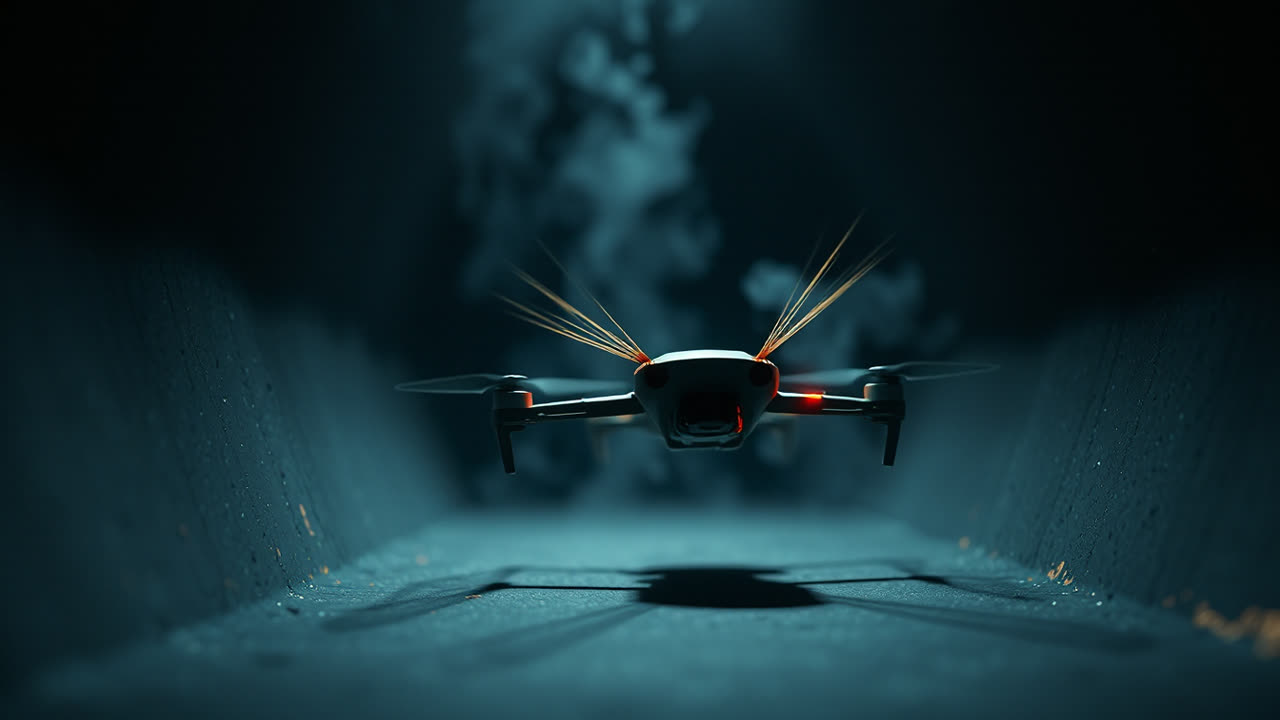
A novel sub-100 gram drone, equipped with physical whiskers akin to those found on mice, marks a significant leap in autonomous navigation, enabling sub-millimeter precision in environments where traditional camera and GPS systems falter. This innovative approach, driven by a mere 34KB of software, leverages three pressure sensors at the base of each whisker to interpret tactile feedback, allowing the drone to map its surroundings purely through touch. This development directly addresses critical operational gaps for drones in dark, dusty, or smoky conditions, opening new frontiers for exploration, inspection, and emergency response where visual and satellite-based guidance is unreliable or completely absent.
The significance of this tactile navigation system extends far beyond overcoming environmental obscurants; it fundamentally redefines the robustness and autonomy of small-scale aerial robotics. Current drone navigation heavily relies on visual-inertial odometry (VIO) or simultaneous localization and mapping (SLAM) algorithms, which process camera feeds to understand the environment and track movement. While effective in well-lit, clear spaces, these systems become effectively blind in low-visibility scenarios, rendering drones useless for crucial tasks like searching collapsed buildings, navigating inside active industrial facilities with airborne particles, or performing inspections in subterranean infrastructure. GPS, another cornerstone of drone navigation, is entirely non-functional indoors or underground, and can be easily jammed or spoofed, highlighting a persistent vulnerability in critical applications. The whisker-based system, by contrast, offers an intrinsically robust alternative, impervious to light conditions, atmospheric interference, or signal degradation, providing a fail-safe navigation method that enhances operational reliability in hostile environments.
This biomimetic design draws inspiration directly from nature, specifically the vibrissae of mammals, which are highly sensitive tactile organs crucial for navigating complex, dark environments. Unlike prior attempts at biomimetic sensing, which often involved complex sensor arrays or heavy computational loads, this new system distinguishes itself with its extreme lightweight profile and minimal software footprint. Conventional drones designed for similar precision often employ expensive lidar or radar units, which add considerable weight, power consumption, and cost, pushing them beyond the sub-100 gram category and limiting their agility and flight time. For instance, high-precision industrial inspection drones using lidar can weigh several kilograms and cost tens of thousands of dollars, making them unsuitable for agile, confined-space operations. The whisker drone's simplicity and efficiency are game-changers, promising to democratize access to advanced autonomous capabilities for smaller, more specialized applications. Its sub-millimeter precision is particularly notable, surpassing the typical centimeter-level accuracy achieved by many vision-based systems in ideal conditions, and offering unprecedented detail for close-quarter inspection and interaction.
The immediate impact on users will be most profound in sectors requiring persistent operation in challenging environments. First responders could deploy these drones into smoke-filled buildings to locate victims or assess structural integrity without risking human lives. Utility companies could inspect the interior of pipes, ventilation shafts, or power plant components where dust and darkness are prevalent, identifying faults with unparalleled accuracy. Mining operations could use them to map unstable tunnels, and search and rescue teams could navigate dense foliage or underground passages. The low computational overhead and minimal power requirements also suggest longer flight times compared to visually-guided drones that are constantly processing high-resolution imagery, further extending their utility in prolonged missions. Furthermore, the inherent privacy advantage of a non-visual navigation system might make these drones more acceptable for sensitive indoor applications where cameras raise concerns.
Looking ahead, the development of whisker-based navigation systems is likely to spark a new wave of innovation in biomimetic robotics, pushing the boundaries of what small, autonomous platforms can achieve. Future iterations might integrate more sophisticated tactile sensing, perhaps combining whiskers with haptic feedback to allow for manipulation or object identification. The principles could also be extended to ground-based robots operating in similar challenging conditions. As the technology matures, we could see hybrid navigation systems emerge, where whisker-based guidance complements visual and GPS data, providing an unprecedented layer of redundancy and resilience. Miniaturization and increased sensor integration will likely lead to even smaller, more agile drones capable of navigating incredibly tight spaces. The ultimate vision is a future where autonomous agents can seamlessly transition between diverse environments, from open skies to confined, pitch-black interiors, guided by an array of senses that mimic and even surpass biological capabilities, ushering in an era of truly ubiquitous and reliable robotic assistance.