WiCi One: Wireless External GPU Reshapes Portable Computing
The WiCi One, an external GPU enclosure leveraging Wi-Fi 7 to wirelessly deliver desktop-class graphics performance, is now available for preorders starting at $1,999, fundamentally reshaping expectations for portable computing and local AI acceleration.
✨ This content was summarized and interpreted by AI; it may contain errors — please verify accuracy with the original sources. Learn more
Listen to this story
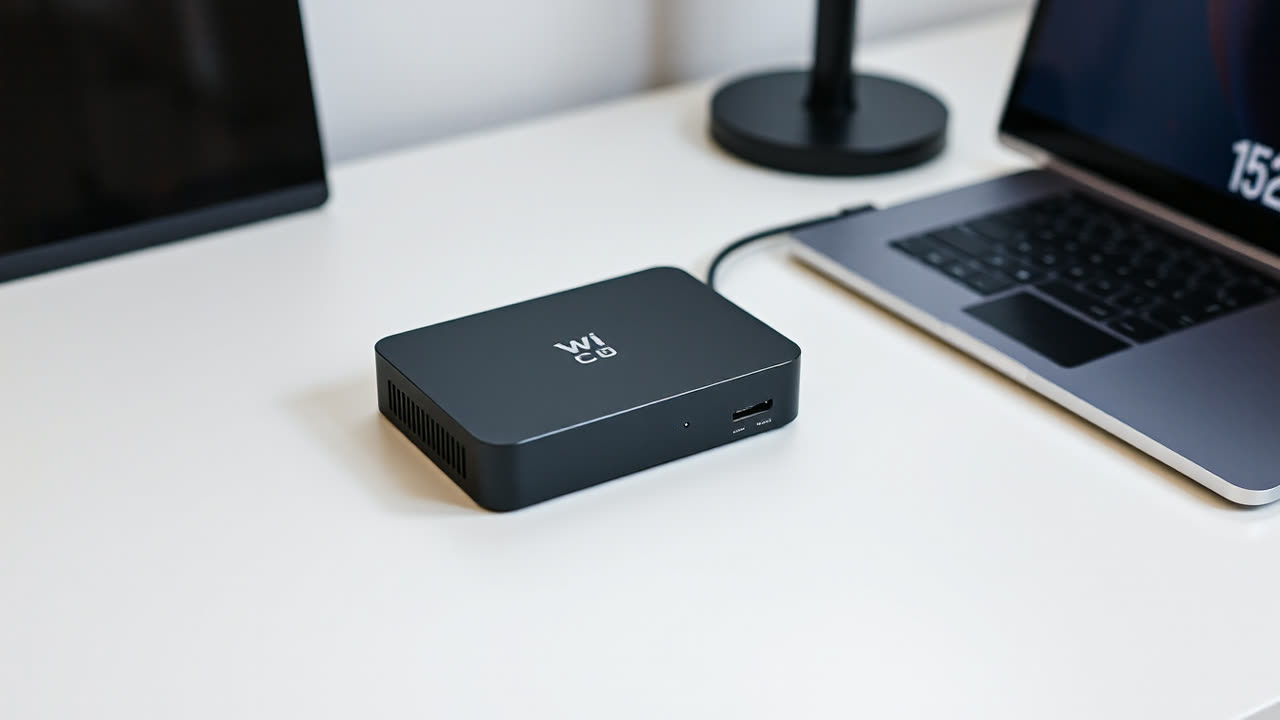
The WiCi One, an external GPU enclosure leveraging Wi-Fi 7 to wirelessly deliver desktop-class graphics performance, is now available for preorders starting at $1,999, fundamentally reshaping expectations for portable computing and local AI acceleration. This innovative device, developed by the startup WiCi and backed by Shokz, aims to transform any compatible laptop, tablet, or even smartphone into a powerful gaming or professional workstation without the constraints of physical cables.
At its core, the WiCi One is more than just a GPU enclosure; it functions as a compact mini-PC. The base configuration features an Nvidia RTX 5060 Ti with 16GB of VRAM, an Intel Core 3 100U CPU, and 1TB of PCIe 4.0 NVMe storage. A more potent variant is planned, housing an Nvidia RTX 5090 with 32GB of VRAM, an Intel Core Ultra 7 255H processor, and a substantial 4TB of PCIe 5.0 NVMe storage. Crucially, the WiCi One employs Wi-Fi 7 with a proprietary "AirLink transport" and a custom latency-reduction driver to present itself as a virtual local GPU to macOS, Windows, and Linux operating systems. This allows applications like Adobe Premiere Pro, DaVinci Resolve, and Blender to utilize its power seamlessly. Beyond traditional graphics tasks, WiCi has integrated an SDK with Python, JavaScript, and Swift libraries, alongside an OpenAI-compatible API, specifically targeting developers and AI workloads. The 4TB NVMe 5 storage is particularly significant for AI, utilizing a "TurboStream" weight-paging system to run models far larger than the GPU's VRAM directly on the device. Shipping for early access models is anticipated in Q4 2026, with a standard price of $2,599 for the RTX 5060 Ti version.
The WiCi One's significance lies in its bold attempt to sever the tether that has historically bound high-performance computing. For users, it promises unparalleled flexibility, allowing thin-and-light devices to access desktop-grade GPU power on demand, untethered from a desk. This is particularly impactful for creative professionals and researchers who require intense compute power for tasks like 3D rendering, video editing, and especially local AI model inference, without the reliance on cloud services or bulky workstations. The ability for a single WiCi One unit to serve multiple devices on a network further enhances its appeal as a shared computing resource in homes or small studios. From an industry perspective, WiCi is directly challenging the established external GPU market, which has long relied on high-bandwidth wired connections like Thunderbolt and OCuLink. If successful, it could carve out an entirely new category of "shared computing appliances," pushing the boundaries of wireless data transmission for demanding workloads.
Traditional wired eGPUs, such as the Gigabyte AORUS RTX 5060 Ti AI Box at $699.99 or MOREFINE's G2 at $1,099, rely on interfaces like Thunderbolt 4 (32 Gbps), Thunderbolt 5 (up to 120 Gbps asymmetric), or OCuLink (up to 64 Gbps). Even these high-speed connections typically incur a 10-20% performance penalty for gaming compared to an internally mounted GPU, due to bandwidth limitations, though this is less pronounced for content creation and AI tasks. The WiCi One, in contrast, operates over Wi-Fi 7, which, despite a theoretical maximum bandwidth of up to 46 Gbps, delivers a practical physical layer rate of around 11.5 Gbps for WiCi's 4x4 MIMO 320MHz configuration. This raw bandwidth is considerably lower than wired alternatives, raising significant questions about real-world performance, especially for latency-sensitive applications like gaming. WiCi's solution hinges on its custom driver, which employs sophisticated caching, deduplication, and compression techniques to minimize data transfer over the air, aiming to mitigate the inherent wireless limitations.
WiCi's own benchmarks claim impressive gaming performance, with the RTX 5060 Ti model reportedly achieving 80 FPS in Cyberpunk 2077 at 4K Ultra with DLSS 4, and 60 FPS in Black Myth: Wukong at 4K Cinematic. The RTX 5090 version is touted to exceed 110 FPS and 90 FPS in these titles, respectively. For AI, the RTX 5060 Ti model reportedly processes Google's Gemma 4 26B at 140 tokens per second, with the RTX 5090 surpassing 500 tokens per second. However, these are company-provided figures, and independent verification under varied real-world network conditions (distance, interference, multiple connected devices) remains critical. While wireless peripherals like mice and keyboards have largely overcome latency concerns using dedicated 2.4GHz links, the sheer volume and real-time nature of GPU data present a far greater challenge for Wi-Fi.
The informed outlook suggests that while WiCi One's gaming aspirations are ambitious, its initial and potentially strongest use case may lie in AI and professional content creation workloads. These tasks are often less sensitive to microsecond latency fluctuations than competitive gaming and can greatly benefit from the local processing power, large onboard storage for models, and multi-device sharing capabilities offered by the WiCi One. The ability to run large language models locally without relying on cloud infrastructure is a compelling proposition for developers and researchers. The high early-access price point of $1,999 positions it as a premium, specialized tool, likely targeting professionals and early adopters rather than mainstream gamers. The future success of wireless eGPUs will undoubtedly be tied to further advancements in wireless standards, with upcoming technologies like Wi-Fi 8 promising ultra-high reliability and reduced latency, potentially making such solutions more viable for all use cases. Until then, rigorous independent testing across a spectrum of real-world scenarios will be paramount to determine if WiCi One can truly deliver on its promise of desktop performance, cable-free.