Xbox's Project Helix Pivots to 'Family of Devices' Amidst Market Challenges
Xbox CEO Asha Sharma clarifies that Project Helix, initially perceived as a singular next-gen console, is evolving into a 'family of devices' to address declining revenue, Game Pass underperformance, and rising component costs.
✨ This content was summarized and interpreted by AI; it may contain errors — please verify accuracy with the original sources. Learn more
Listen to this story
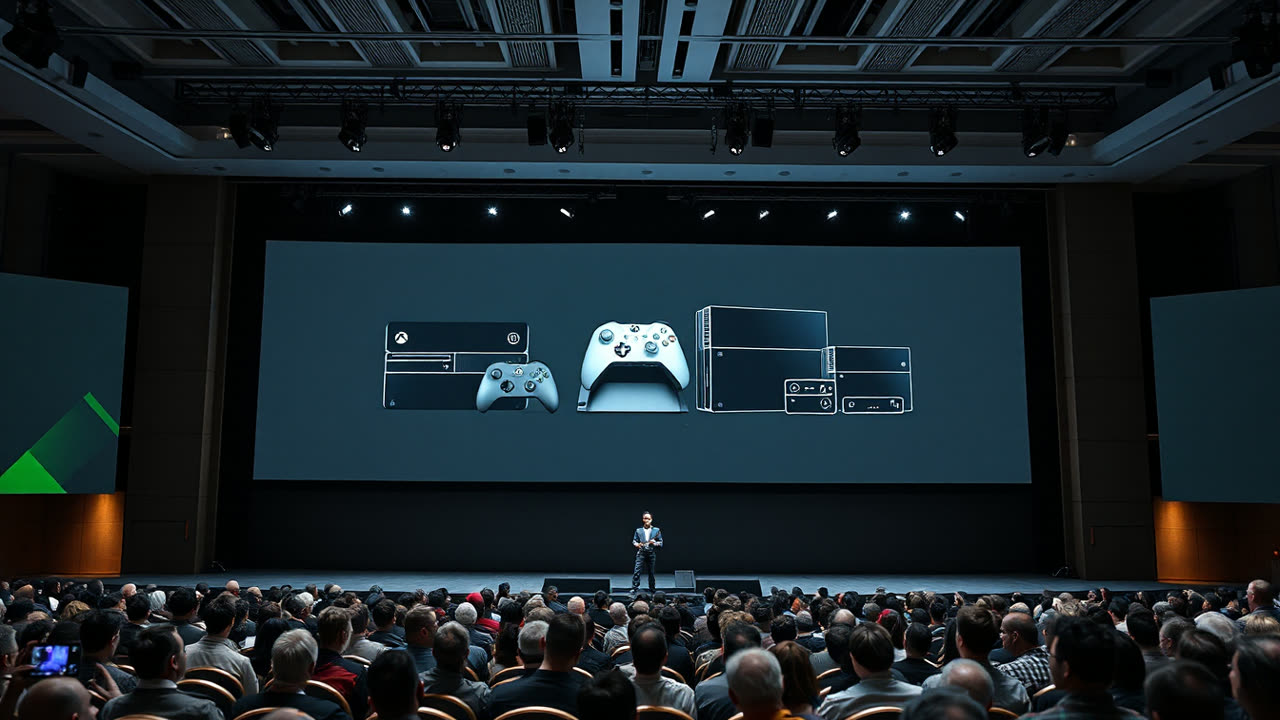
Xbox CEO Asha Sharma's recent clarification that Project Helix, initially understood as Microsoft's singular next-generation console, is in fact a "family of devices," signals a profound strategic pivot for the Xbox ecosystem. Announced in March 2026, Project Helix was initially described as the codename for a "next generation console" that would play both Xbox and PC games, with a focus on high-end performance and a "curated experience." However, Sharma's latest statements, made at Gamescom in August 2026, underscore a shift towards "efficiency and affordability alongside performance" amidst a challenging "Rampocalypse" — a period of soaring RAM and storage prices driven by AI infrastructure investments. This redefines Xbox's hardware future, moving beyond a traditional console cycle to embrace a more expansive and flexible gaming platform.
This evolution from a singular, powerful console to a "family of devices" is a crucial response to several market pressures and internal strategic realignments. Xbox's hardware business has faced thin profit margins and declining revenue, with hardware revenue plummeting by 33% year-on-year in Q3 2026, and content and services down another 5%. The company's flagship subscription service, Game Pass, has also fallen significantly short of its ambitious targets, reportedly reaching around 30 million subscribers by July 2026, well below the 77 million projected for the year. This underperformance, exacerbated by a 50% price hike for Game Pass Ultimate in October 2025, which saw the monthly cost rise from $19.99 to $29.99, led to a loss of "millions" of subscribers. Consequently, Microsoft is compelled to rethink its approach, prioritizing accessibility and broader market penetration over solely high-end, potentially expensive, console hardware.
The "family of devices" concept likely encompasses a range of hardware, from traditional consoles to handhelds and potentially even OEM PCs, all unified under the Xbox ecosystem and powered by a custom AMD Magnus SoC. This hybrid approach aims to offer a seamless gaming experience across different form factors, allowing players to access their Xbox and PC game libraries, including titles from platforms like Steam and Epic Games, within a unified "Xbox mode" interface running on Windows 11. This strategy leverages Microsoft's strength in the PC market and its cloud gaming initiatives, which include a free, ad-supported tier launched in July 2026 for streaming owned games. The ability to stream owned games without a Game Pass subscription, even with a one-hour session limit and pre-roll ads, offers a low-barrier entry point into the Xbox ecosystem, especially for casual or budget-conscious players.
In comparison to rivals, this multi-device strategy positions Xbox differently. Sony's PlayStation 5 has seen strong sales, reaching 95.3 million units by June 30, 2026, although recent quarterly sales have declined by 36% compared to the same period in 2025, partly due to increased console prices. Rumors suggest Sony's next console, the PlayStation 6, is targeting a 2027 release, potentially alongside a handheld device, but its launch date remains undecided due to the ongoing component shortage and rising memory prices. Nintendo, with its Switch 2 having launched in June 2025, continues to dominate physical game sales, accounting for 63% of the U.S. market in 2026, compared to PlayStation's 32% and Xbox's mere 4%. Nintendo is also planning a new Switch 2 model with a replaceable battery for Fall 2026 and an OLED version potentially in 2027-2028, with older Switch models being phased out by early 2027 in Europe. While Xbox Series X|S sales saw an 86% jump in June 2026 in the U.S., this was noted as offsetting previous decreases and potentially driven by upcoming price increases.
Looking ahead, Xbox's commitment to a "family of devices" and a hybrid PC/console experience, potentially launching as early as 2027, suggests a future where hardware is less about a single monolithic box and more about flexible access to the Xbox platform. The recent announcement of a disc-to-digital program, allowing players to convert thousands of physical Xbox games into digital entitlements, further supports this vision, offering a consumer-friendly bridge to an increasingly digital future, especially as competitors like Sony are reportedly phasing out physical disc production for new PlayStation titles by January 2028. This move aims to preserve player choice and backward compatibility, even if future Xbox hardware lacks a disc drive, a possibility Sharma has not ruled out. The success of this strategy hinges on Microsoft's ability to deliver compelling software, with a renewed focus on exclusive titles like *Gears of War: E-Day* and the potential exclusivity of *The Elder Scrolls VI* to drive interest in the platform. By diversifying hardware options and emphasizing ecosystem flexibility, Xbox is attempting to navigate the volatile hardware market and declining Game Pass growth, aiming to solidify its position as a pervasive gaming service across multiple devices.