XPENG's Iron Humanoid Robot Achieves Immediate Operational Readiness Post-Assembly
XPENG's Iron humanoid robot walked out to receive its staff badge immediately after assembly, demonstrating unprecedented out-of-the-box operational capability that could revolutionize robotic deployment.
✨ This content was summarized and interpreted by AI; it may contain errors — please verify accuracy with the original sources. Learn more
Listen to this story
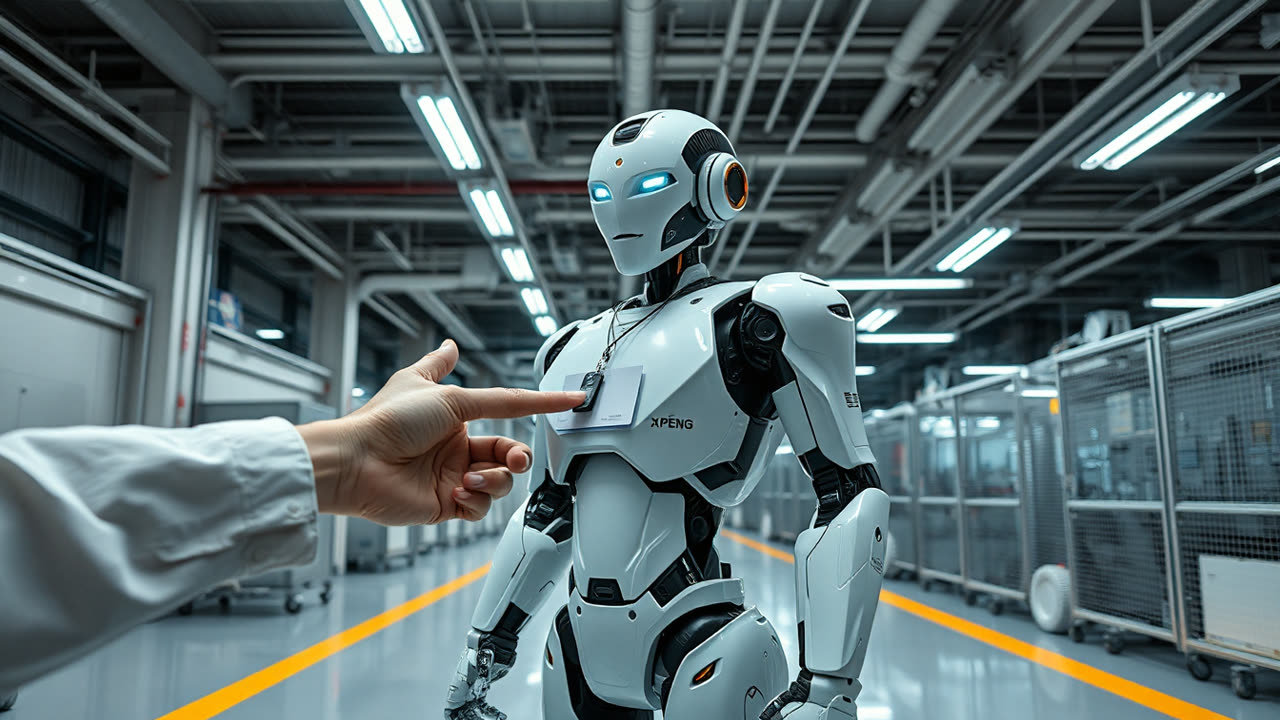
XPENG's Iron humanoid robot, a testament to rapid integration and operational readiness, immediately walked out to receive its staff badge after assembly, signaling a potential paradigm shift in the deployment of complex autonomous systems. This unprecedented demonstration, where a sophisticated bipedal robot required no extensive calibration or setup post-manufacturing, highlights XPENG's aggressive push into the robotics sector and challenges conventional expectations for robotic deployment. The Iron robot, first unveiled in October 2022, has evidently matured beyond its initial prototype phase, showcasing a level of out-of-the-box functionality that could drastically reduce the time and expertise traditionally required to bring advanced robotics online.
This immediate operational capability holds profound implications for both the robotics industry and potential end-users. For manufacturers, it suggests a future where humanoid robots can be integrated into production lines or service environments with minimal downtime, akin to plugging in a new appliance rather than commissioning a complex machine. This dramatically lowers the barrier to entry for businesses considering automation, potentially accelerating adoption across logistics, elder care, and even domestic applications. The traditional bottleneck of expert technicians spending hours, if not days, fine-tuning and programming new robots could be significantly alleviated, leading to faster ROI and greater scalability. For the industry, XPENG's achievement sets a new benchmark for "assembly-line readiness," pushing rivals like Tesla's Optimus, Figure AI, and Boston Dynamics' Atlas and Stretch to prioritize ease of deployment alongside raw performance metrics.
XPENG's foray into humanoid robotics is a strategic extension of its electric vehicle (EV) and intelligent mobility ecosystem, leveraging its expertise in AI, autonomous driving, and sophisticated hardware integration. The company's vision, articulated by CEO He Xiaopeng, positions robotics as a critical component of future smart living and smart manufacturing. While initially focused on R&D for mobility and smart manufacturing applications, the broader ambition is to develop humanoid robots capable of entering households by 2025. This contrasts with Boston Dynamics' long-standing focus on extreme mobility and research, or Agility Robotics' concentration on warehouse logistics with its Digit robot. Tesla's Optimus, while sharing a similar long-term vision for mass production and household integration, has yet to demonstrate the same level of immediate post-assembly operational readiness publicly, often showcasing robots in controlled environments or with visible support systems during initial demonstrations. Figure AI, backed by major investors like OpenAI and Microsoft, is also making rapid progress, recently demonstrating its Figure 01 robot performing complex tasks, but the emphasis has been on dexterity and AI integration rather than immediate factory-to-functionality.
The Iron robot’s design, featuring human-like proportions and bipedal locomotion, is intended for versatile interaction with human-centric environments, a clear departure from industrial robotic arms or wheeled AGVs. Its ability to navigate and interact immediately post-assembly suggests advanced self-calibration routines and robust internal models of its own kinematics and environmental perception. This implies a highly integrated software-hardware stack that can bootstrap itself efficiently, minimizing the need for external intervention. The underlying technology likely draws heavily from XPENG's XNGP (XPENG Navigation Guided Pilot) ADAS system, which provides sophisticated perception, planning, and control algorithms adaptable to robotic platforms.
Looking ahead, the immediate challenge for XPENG and the broader humanoid robotics sector will be scaling this operational readiness from a singular demonstration to mass production. Maintaining such precision and integration across thousands or millions of units, while simultaneously reducing costs, will be paramount. Further developments will undoubtedly focus on enhancing dexterity, improving battery life, refining human-robot interaction, and expanding the robot's cognitive capabilities through more advanced AI models. The next generation of Iron robots will likely feature increasingly sophisticated manipulation capabilities to perform a wider array of tasks, moving beyond simple locomotion and badge reception to complex assembly, service delivery, and even companionship. As manufacturing techniques for these complex machines become more streamlined and automated, the vision of humanoid robots seamlessly integrating into various aspects of daily life and industry, ready to work the moment they roll off the assembly line, moves closer to reality, with XPENG positioning itself at the forefront of this transformative shift.