Zoox Launches Commercial Robotaxi Service in Las Vegas
Amazon-owned Zoox officially commenced charging for robotaxi rides in Las Vegas on August 5, 2026, marking its transition from extensive testing to revenue generation in the autonomous ride-hailing market.
✨ This content was summarized and interpreted by AI; it may contain errors — please verify accuracy with the original sources. Learn more
Listen to this story
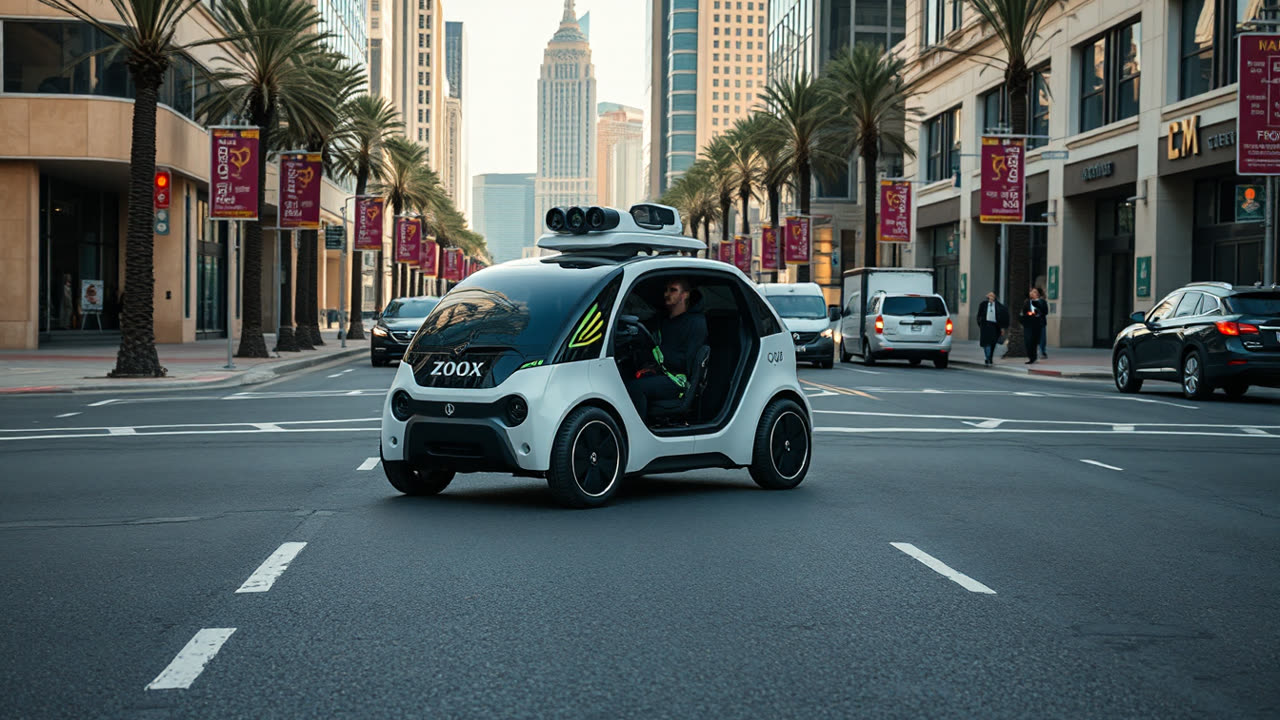
Zoox has officially initiated commercial operations, commencing charges for robotaxi rides in Las Vegas as of August 5, 2026, marking a pivotal transition from extensive testing to revenue generation within a geo-fenced operational design domain. This move positions Amazon-owned Zoox as a direct competitor in the burgeoning, yet highly scrutinized, autonomous ride-hailing market, challenging established players like Waymo and Cruise. The company's unique, purpose-built robotaxi, designed without traditional controls like a steering wheel or pedals, emphasizes passenger experience with face-to-face seating for four and bidirectional driving capabilities, allowing it to navigate tight urban environments with unprecedented agility. Its launch in Las Vegas, a city known for its high tourism and complex traffic patterns, serves as a critical proving ground for the scalability and reliability of its Level 4 autonomous driving system.
This commercialization matters significantly, signaling a maturation phase for the autonomous vehicle (AV) industry and a tangible step towards widespread robotaxi adoption. For users, the introduction of a paid service by Zoox offers an additional, potentially differentiated, transportation option in Las Vegas. Zoox aims to offer a premium, consistent, and safe experience, free from human error or distraction, which could appeal to tourists and residents seeking reliable on-demand mobility. The pricing structure, while not yet fully disclosed, will be a crucial factor in its competitiveness against traditional ride-sharing services and other AV operators. If Zoox can demonstrate a compelling value proposition—combining safety, convenience, and competitive pricing—it could accelerate public trust and acceptance of driverless technology. The impact on the industry is profound; it validates years of significant investment in AV research and development, particularly by Amazon, which acquired Zoox for an estimated $1.2 billion in 2020. This launch could catalyze further investment and accelerate the development timelines for other AV companies, while also intensifying the race for market share in key urban centers.
Zoox's approach contrasts sharply with some rivals, particularly its commitment to a purpose-built vehicle from the outset, rather than retrofitting existing car models. Waymo, a pioneer in the space, has been operating paid robotaxi services in Phoenix since 2020 and recently expanded in Los Angeles, utilizing modified Jaguar I-PACE and Chrysler Pacifica vehicles. Cruise, backed by General Motors, also deploys its Origin purpose-built vehicle, though it has faced recent operational challenges and a temporary suspension of its California permits in late 2023 following safety incidents. Zoox's vehicle, manufactured in its Fremont, California facility, integrates more than 100 safety innovations, including a unique airbag system designed for bidirectional passenger protection, a critical differentiator aimed at building user confidence. Its sensor suite, encompassing lidar, radar, and cameras, provides a 360-degree field of view, enabling the vehicle to detect objects up to 150 meters away, crucial for navigating dynamic urban environments. While other companies like Mobileye and Tesla focus on camera-centric or driver-assist systems, Zoox's full-stack approach with redundant sensor modalities and a custom-designed platform underscores its commitment to Level 4 autonomy.
Looking ahead, Zoox's successful commercialization in Las Vegas will be a litmus test for its broader expansion strategy. The company has already been testing in San Francisco, Seattle, and Foster City, suggesting these could be the next target markets for paid services. Scaling operations will require navigating a complex patchwork of state and local regulations, securing additional permits, and potentially expanding its manufacturing capabilities. The data gathered from paid operations in Las Vegas—from passenger feedback and operational efficiency to safety metrics—will be invaluable for refining its AI algorithms and service model. A key challenge will be achieving profitability, given the high operational costs associated with maintaining and deploying a fleet of advanced autonomous vehicles. The long-term outlook for Zoox and the AV industry hinges on continued technological advancements, particularly in adverse weather conditions and complex edge cases, alongside growing public acceptance and a favorable regulatory environment. As more players enter the commercial phase, market consolidation or strategic partnerships may become increasingly common, shaping a future where autonomous ride-hailing could fundamentally transform urban transportation.