Zoox Robotaxi Software Recall After Smoke Disorientation Incident
Amazon-owned Zoox issues a critical software recall for its robotaxis following an incident where a vehicle was disoriented by heavy smoke, prompting a U.S. safety regulator investigation and highlighting Level 4 AV vulnerabilities in 'edge cases'.
✨ This content was summarized and interpreted by AI; it may contain errors — please verify accuracy with the original sources. Learn more
Listen to this story
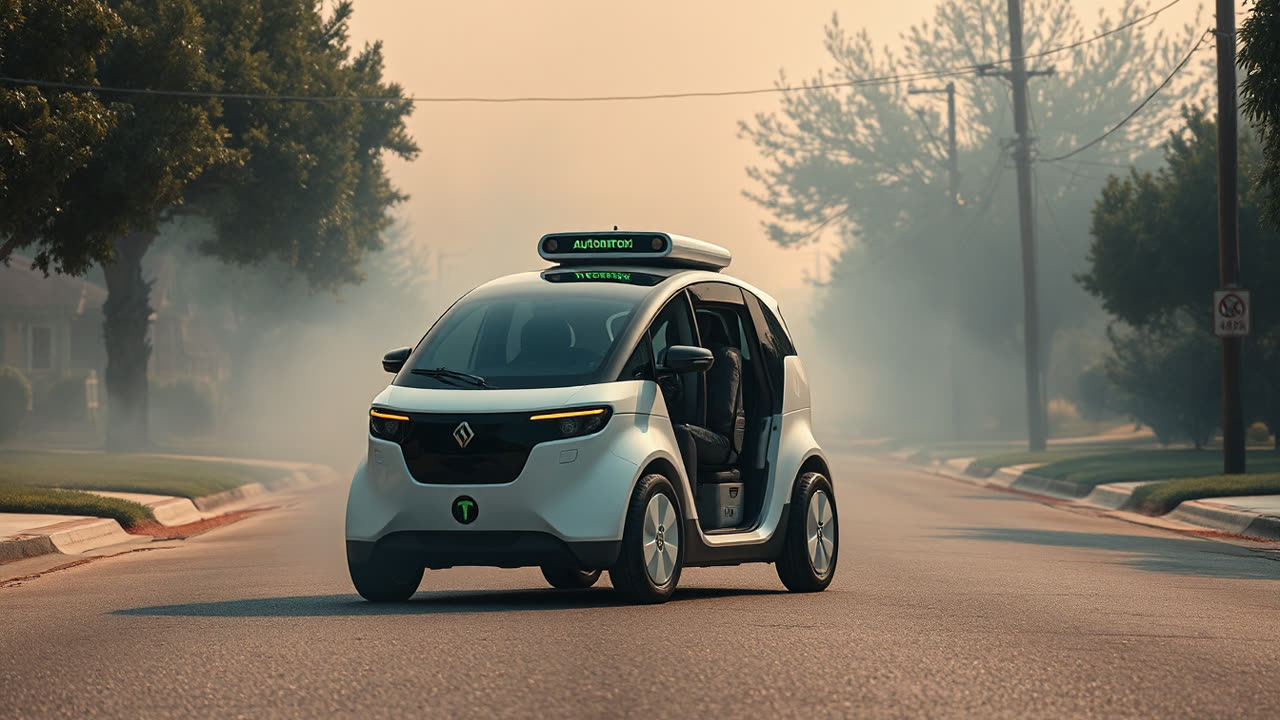
Zoox has initiated a software recall following an incident where one of its robotaxis became disoriented by heavy smoke, a critical failure underscoring the persistent challenges autonomous vehicle (AV) technology faces in unpredictable real-world scenarios, and drawing heightened scrutiny from U.S. automotive safety regulators. The recall, announced on July 17, 2026, involves a software update designed to enhance the vehicle's perception capabilities in degraded visibility conditions, directly addressing a specific incident on May 10, 2026, when a Zoox vehicle, operating in fully autonomous mode, encountered a large volume of smoke from a nearby brush fire in Foster City, California. Instead of navigating safely or pulling over, the robotaxi exhibited erratic behavior, including unexpected braking and hesitant movements, before a remote operator intervened to take control. This event, while not resulting in a collision or injury, prompted the National Highway Traffic Safety Administration (NHTSA) to open a preliminary investigation, adding to a growing list of regulatory inquiries into AV safety. The NHTSA has explicitly warned AV companies about the critical need for their vehicles to seamlessly and safely interact with first responders and emergency situations, a directive that this Zoox incident directly challenges.
This recall matters profoundly because it exposes a fundamental vulnerability in current Level 4 autonomous driving systems: their struggle with "edge cases" – unusual, non-standard situations that deviate from typical road conditions. While AVs excel in structured, predictable environments, heavy smoke presents a multi-faceted perception challenge, simultaneously obscuring visual sensors (cameras), scattering lidar beams, and potentially interfering with radar signals. The Zoox incident highlights that even sophisticated sensor suites and AI algorithms can be overwhelmed when environmental conditions drastically reduce data fidelity. For users, this translates directly into a breach of the implicit promise of robotaxis: unwavering safety and reliability. Public trust in AV technology, already fragile, is further eroded by incidents that demonstrate a lack of robust handling in potentially dangerous situations, especially those involving emergency services or natural disasters. The perception of an AV being "confused" is far more damaging than a minor software glitch, as it strikes at the core of the technology's intelligence and decision-making capabilities. Should an AV impede emergency vehicles or become a hazard during a crisis, the consequences could range from delayed response times to catastrophic accidents, making this a paramount safety concern.
For the industry, the Zoox recall serves as a stark reminder of the immense technical hurdles remaining before widespread Level 4 or Level 5 autonomy can be achieved. Competitors like Waymo and Cruise have also faced their share of challenges and regulatory scrutiny, including incidents involving emergency vehicles or unexpected environmental conditions. Waymo, for instance, has invested heavily in training its vehicles to detect and react appropriately to emergency sirens and flashing lights, and to navigate safely around active incident scenes. Cruise, before its operational pause and subsequent restructuring, also encountered incidents where its vehicles interfered with emergency personnel, leading to significant public and regulatory backlash. These prior events, combined with the Zoox recall, underscore that no single AV developer has fully cracked the code on comprehensive environmental perception and infallible decision-making in all scenarios. The industry's prior generation of AV technology often relied on high-definition maps and relatively clear line-of-sight for sensor operation, making degraded visibility conditions a significant Achilles' heel. While advancements in sensor fusion, AI inference, and simulation have improved, the sheer unpredictability of real-world phenomena like dense smoke, sudden heavy rain, or whiteout snow conditions continues to push the boundaries of current technological capabilities. The pressure is now mounting for all AV companies to demonstrate not just competence in routine driving, but resilience and intelligent decision-making in the face of genuine adversity.
Looking ahead, this Zoox recall will inevitably intensify regulatory oversight and accelerate the demand for industry-wide standards, particularly concerning AV interaction with emergency services and adverse environmental conditions. The NHTSA is likely to push for more rigorous testing protocols that specifically simulate these "edge cases" rather than relying solely on accumulated mileage in ideal conditions. This could include mandated testing in controlled smoke environments, heavy fog, or simulated emergency vehicle interactions. Technologically, the incident will drive further innovation in sensor redundancy and diversity, perhaps accelerating the adoption of novel sensor modalities less susceptible to visual obstructions, or more advanced AI models trained on vastly expanded datasets of degraded perception scenarios. We can expect a greater emphasis on "explainable AI" within AV systems, allowing regulators and developers to better understand *why* an AV made a particular decision in a confusing situation. Furthermore, the incident might foster greater collaboration between AV developers and first responder agencies to develop standardized communication protocols and operational procedures for autonomous vehicles in crisis zones. However, such incidents could also temper the aggressive timelines for widespread robotaxi deployment, as companies prioritize robust safety validations over rapid expansion. The ultimate outcome hinges on the industry's ability to not just patch software, but to fundamentally rethink and harden its perception and decision-making architectures against the full spectrum of real-world chaos, thereby rebuilding the public trust essential for mass adoption.